A 22.5-pound rock that held open a farm door near Edmore, Michigan, for decades is an iron meteorite. Scientists at Central Michigan University, the Smithsonian Institution and UCLA confirmed it, and it now ranks as the sixth-largest meteorite recorded in Michigan.
The team described the find at the 50th Lunar and Planetary Science Conference in 2019. Its crystal pattern, Smithsonian curator Catherine Corrigan later explained to a campus audience, formed over millions of years of slow cooling deep inside an asteroid.
Shed door on an Edmore farm
David Mazurek of Grand Rapids bought a farm in Edmore in 1988, about 30 miles southwest of Mount Pleasant. On a tour of the property, he asked about the odd rock propping open a shed door, Central Michigan University said in its October 2018 account.
The farmer called it a meteorite. He said that in the 1930s he and his father saw it come down at night on their land, “and it made a heck of a noise when it hit.” By morning they had dug it out of a small crater, still warm.
The farmer let Mazurek keep the rock with the farm. Mazurek held on to it for 30 years, even after he moved away, using it as a doorstop and sending it to school with his children for show and tell.
Hamburg’s fireball revived the question
In January 2018, a meteor lit up the sky over southeast Michigan and dropped stones near Hamburg. Mazurek read about people selling small pieces of it and started to wonder what his own rock was worth.
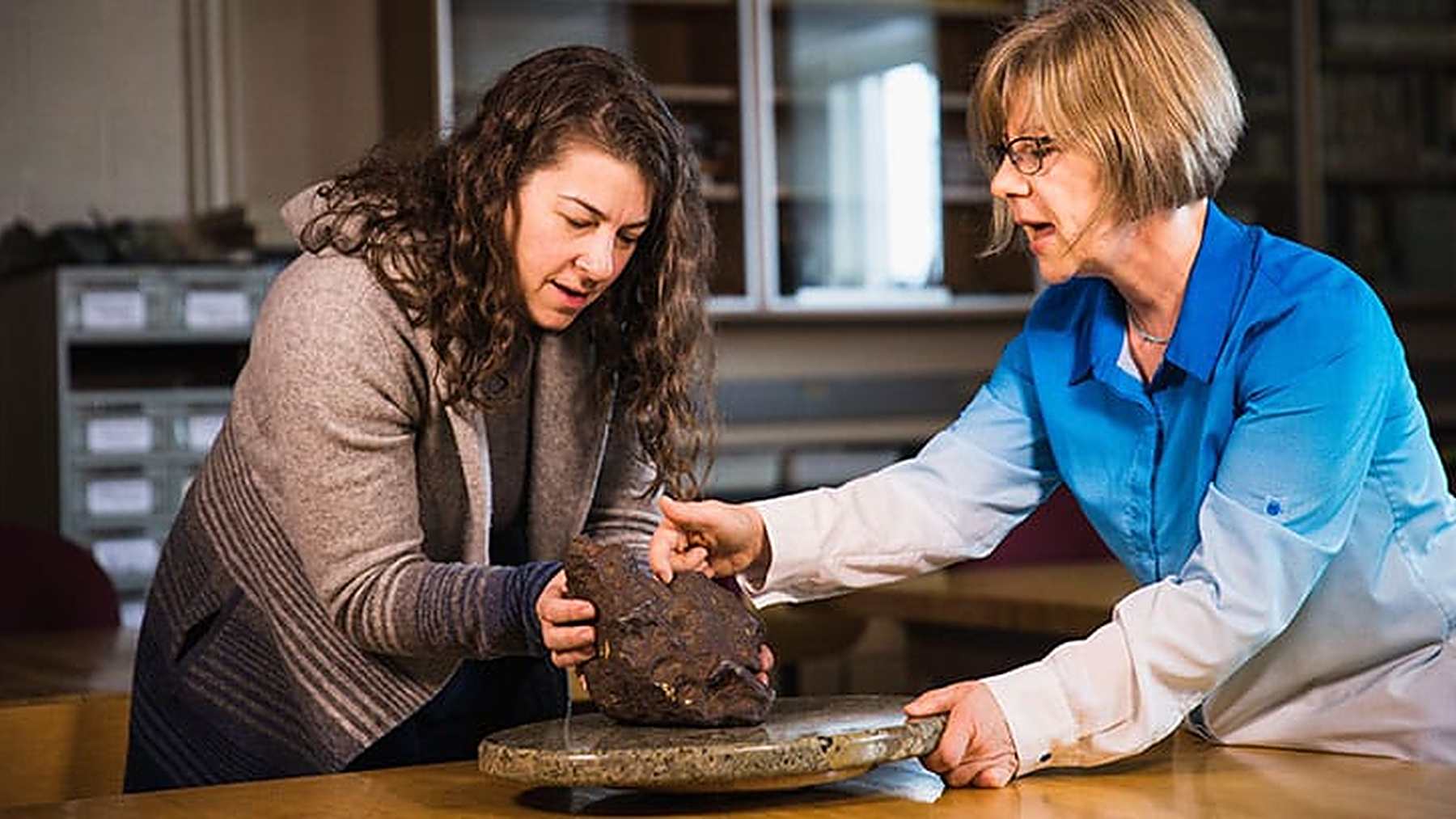
A friend who had studied geology at Central Michigan sent him to Mona Sirbescu, a geology faculty member in earth and atmospheric sciences. For 18 years, every rock brought to her had turned out to be what she jokingly calls “meteor wrongs,” but this rock was different. “I could tell right away that this was something special,” she said.
An X-ray fluorescence scan in Brooks Hall showed metal with about 88 percent iron and 12 percent nickel. To be sure, Sirbescu cut off a slice, polished it and sent it to a colleague at the Smithsonian in Washington, D.C.
Acid on a polished slice
That colleague was Catherine Corrigan, a geologist and curator of Antarctic meteorites at the Smithsonian’s National Museum of Natural History. Her team checked the nickel with a scanning electron microscope and X-ray spectroscopy. Then they etched the surface with nital, a weak mix of nitric acid and alcohol.
The acid revealed a Widmanstätten pattern, a crosshatch of interlocking metal plates. The slice held kamacite and taenite, two iron-nickel alloys, plus a phosphide mineral called schreibersite. Kamacite bands were about 0.031 inch (0.8 millimeter) wide.
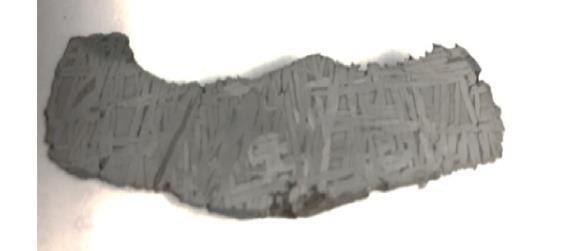
Band width is what makes Edmore a medium octahedrite. Outside, the rock is roughly triangular, about 6.7 by 7.9 by 9.1 inches (17 by 20 by 23 centimeters). Patches of light brown fusion crust, the skin that melts during the plunge through the atmosphere, still cling to it.
Iridium set Edmore apart
The Smithsonian also sent a sample to John Wasson, a professor emeritus at UCLA, for neutron activation analysis. This test measures trace elements by making them briefly radioactive. Edmore’s cobalt level, 5.41 milligrams per gram, placed it in the IIIAB group of iron meteorites.
Its chemistry looks like that of other low-iridium IIIAB irons, such as Grant and Hardesty. Hardesty turned up in Oklahoma in 1986 and is the only one of the group’s close matches from the United States. Even it differs from Edmore by 15 to 25 percent in iridium, the abstract shows.
Based on the iridium data in particular, the authors called the rock “a new IIIAB iron meteorite.” In plain terms, Edmore joined a family of irons that scientists already knew, under its own name.
Cooling inside a lost asteroid
Corrigan saw the whole rock for the first time in 2019, at a talk at Central Michigan. She told the crowd that Edmore is a 4.5 billion-year-old relic from the once-molten core of an unknown asteroid between Mars and Jupiter.
As that core cooled by about a degree and a half every million years, its metal grew into the plates seen in the slice. London’s Natural History Museum says most iron meteorites are thought to be the cores of asteroids that melted early on. Each one gives scientists a sample from inside a parent body they could never drill into.
Corrigan said the metal is similar in some ways to Earth’s own core. That makes it useful, she explained, “because we’re never going to be able to get a piece of that.”
Only the farm family saw it
Everything about the landing comes from the farmer’s memory. The abstract gives 1939 as the year it reportedly fell, while the university’s 2018 account says only the 1930s, and the tale reached scientists only secondhand, passed from one owner to the next.
In April 2019, Mazurek sold the rock for $75,000 to Michigan State University’s Abrams Planetarium through a donor. In July, Sirbescu got his check for $7,500, which her department set aside for undergraduate research projects.
If you have a heavy, rusty stone in your garage, a photo won’t settle it. The U.S. Geological Survey says a possible meteorite has to be examined in person to be identified.
The classification was presented in a 2019 conference abstract led by Corrigan, with co-authors from the Smithsonian, UCLA and Central Michigan University.
“They might be holding open your barn door,” Corrigan told her audience in Mount Pleasant. Edmore did that job for roughly 80 years before a geologist cut it open.
Photo: Central Michigan University