For years, scientists were convinced that they knew what killed the dinosaurs. The explanation was: About 66 million years ago, an enormous asteroid hit Mexico and killed three-quarters of all species, including all dinosaurs except birds.
What was still not clear was where the asteroid had come from. A study carried out in 2024 offered a possible explanation. Its chemical composition indicated it could have been a carbon-rich asteroid formed beyond the planet Jupiter. This gave researchers very strong evidence about its origin, and got closer to answering a question that had remained unanswered although the impact theory was widely accepted.
A rare metal revealing its cosmic address
The most important clue was ruthenium, a rare metal that was found in the debris that was spread around after the rock impacted the Earth. There is not a lot of ruthenium in Earth’s crust, so most of what researchers found in that layer likely came from the asteroid. This is why this metal was so useful for tracing the origin of the object.

Mario Fischer-Gödde of the University of Cologne and his team studied the ruthenium isotopes collected from samples found in Denmark, Italy, and Spain. They all had the same chemical signature, the same one that was found in carbonaceous meteorites from asteroids that originated beyond Jupiter.
The team also studied Chicxulub: a material from five other impact sites. These samples were more closely related to siliceous asteroids, which are formed closer to the Sun. But Chicxulub was different, so it seems like the asteroid that killed the dinosaurs has actually traveled here from far away.
What struck Earth 66 million years ago
Scientists believe that the Chicxulub asteroid was about 6 to 9 miles (10 to 15 kilometers) wide. It hit Earth at approximately 12 miles per second (20 kilometers per second) and produced the Chicxulub crater, located in the Yucatán Peninsula, which stretches about 112 miles (180 kilometers) across the area.
The area surrounding the impact was destroyed almost instantly. The rock turned to vapor, debris flew high into the sky, and the extreme heat caused fires to start across the region.
The damage quickly spread across the world. Dust, smoke, and sulfur blocked sunlight, cooled the planet, and damaged the photosynthesis, leaving plants struggling to survive. Food chains were destroyed, and about three-quarters of all species on Earth died. Birds were the only dinosaurs to survive.
How scientists linked the asteroid to the extinction
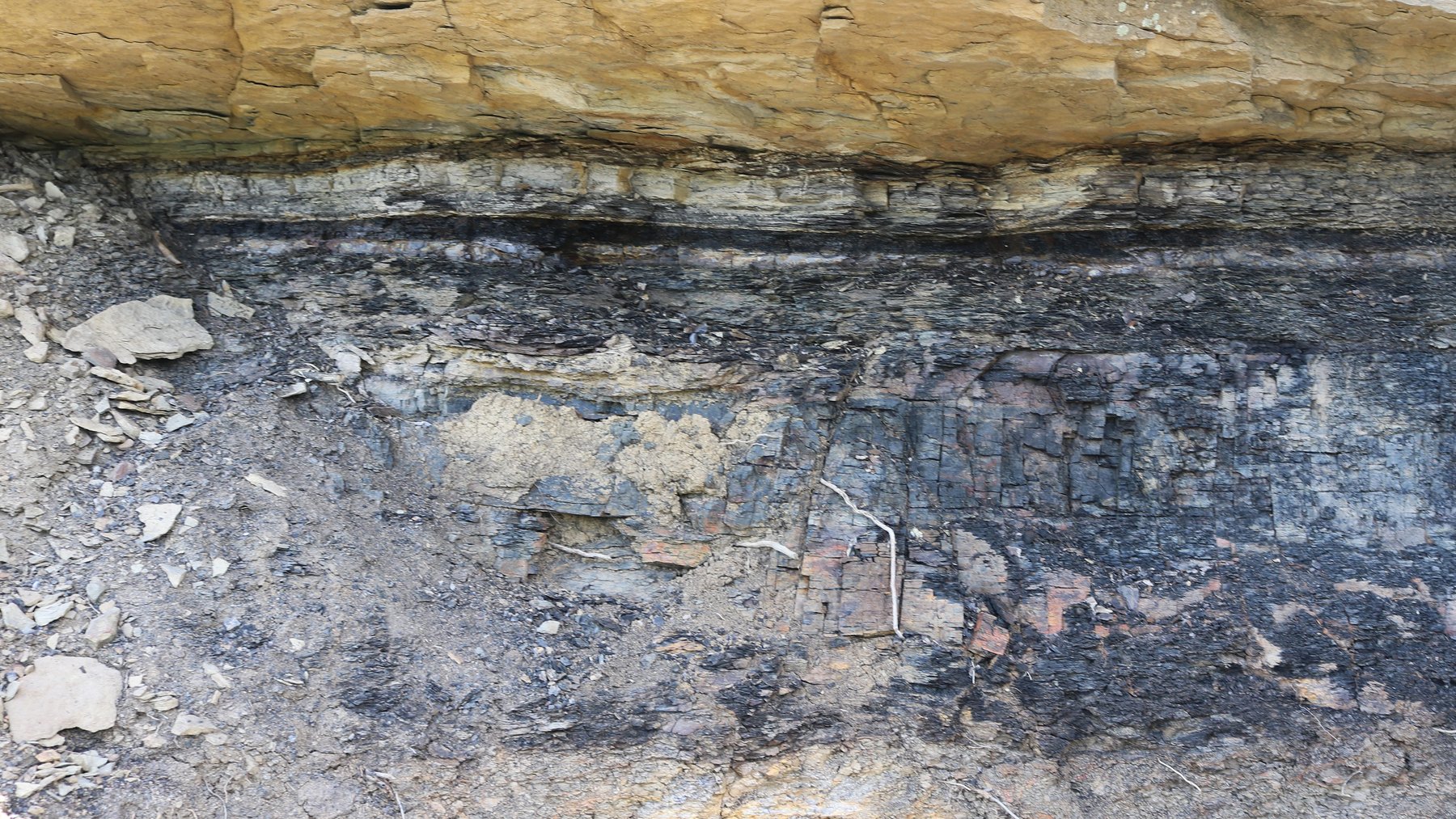
When physicist Luis Alvarez and geologist Walter Alvarez presented this theory in 1980, many scientists disagreed, they were not convinced. Their main clue was a layer of clay from the end of the Cretaceous which contained unusually high levels of iridium. This element is commonly found in asteroids, but very rare in Earth’s crust.
Many people doubted the idea at first, but as new evidence was found, they gradually changed their minds. Researchers found shocked quartz and tiny glass droplets, which are both created under strong pressure. Then, around 1990, they found the Chicxulub crater, so these clues found around the world were now pointing in the same direction.
This story is important because the new ruthenium study has a very similar scientific path. It does not have a clear picture of the asteroid or a large piece to examine. Instead, it has tiny samples that indicate one same origin.
The full journey of the asteroid is not revealed beyond Jupiter
Knowing the asteroid was formed beyond Jupiter does not mean its whole trajectory before reaching Earth is identified. The isotope signature reveals the type of material it is made out of and the general area where it came from, but it does not show the exact route it took for billions of miles.
The result evidenced a carbon-based asteroid, rather than a comet or one of the most frequent asteroids consisting mainly of silica, common within the inner solar system, according to scientists. Nonetheless, this is a powerful geochemical proof, although it is not the final answer about its history.
This difference is what gives perspective to the discovery. While the asteroid’s exact movement heading towards Earth’s orbit must still be investigated further, the analysis narrows down its place of origin.
Could Earth be hit by another asteroid the size of Chicxulub?
Happening over geological time lapses rather than human ones, impacts like the Chicxulub one are extremely infrequent. The Sentry system perpetually analyzes up-to-date observations looking for eventual impacts, and based off of this, there is no evidence of a significant asteroid threat for at least the next century according to NASA.
Being more numerous and hard to find, spotting smaller near-Earth objects proves to be a more strenuous task. Although it would not replicate Chicxulub’s planet wide destruction, some of them could nonetheless result in significant regional harm. That is what maintains world-wide defense programs and sky surveys vigilant.
Although not fully revealed, the mystery is narrower
The extinction itself is still under analysis by researchers. While the picture itself is clear, scientists still investigate just how much of the damage was done by sulfur, dust, soot, fire, cooling, and the fail of photosynthesis.
But, nowadays one conclusion is way firmer than it was back in 2024: the Cretaceous was ended by a rock formed beyond Jupiter, which arrived on Earth on the poorest date possible.