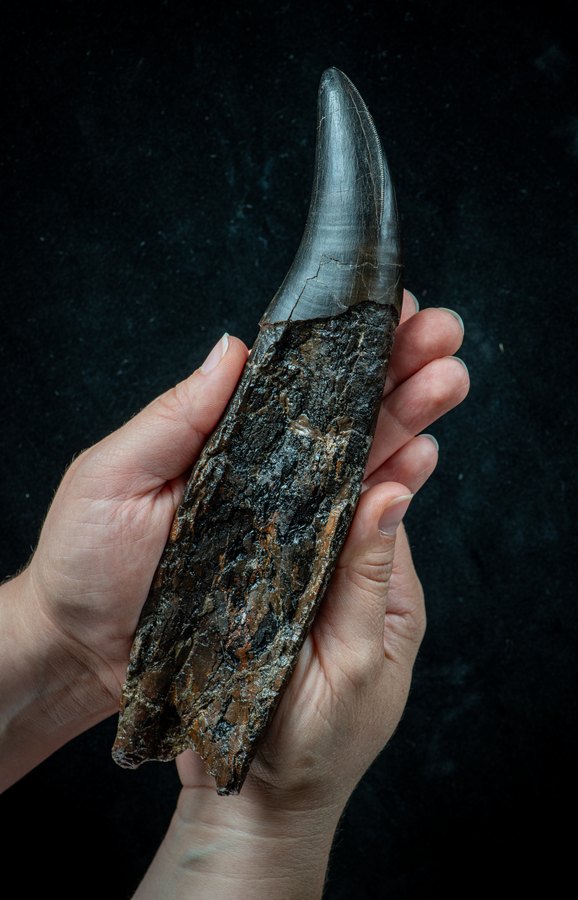
A UCLA-led team measured T. rex body temperature for the first time in a study published September 16 in Science Advances, using enamel from three fossil teeth. The answer is 97.3°F (36.3°C), close to the reading a doctor expects from a healthy person.
According to the paper, the uncertainty is 4.5°F (2.5°C) either way, expressed as one standard error. Even so, the dinosaur comes out well above crocodiles from the same rocks. It was also warmer than the air around it.
Two teeth from Thomas
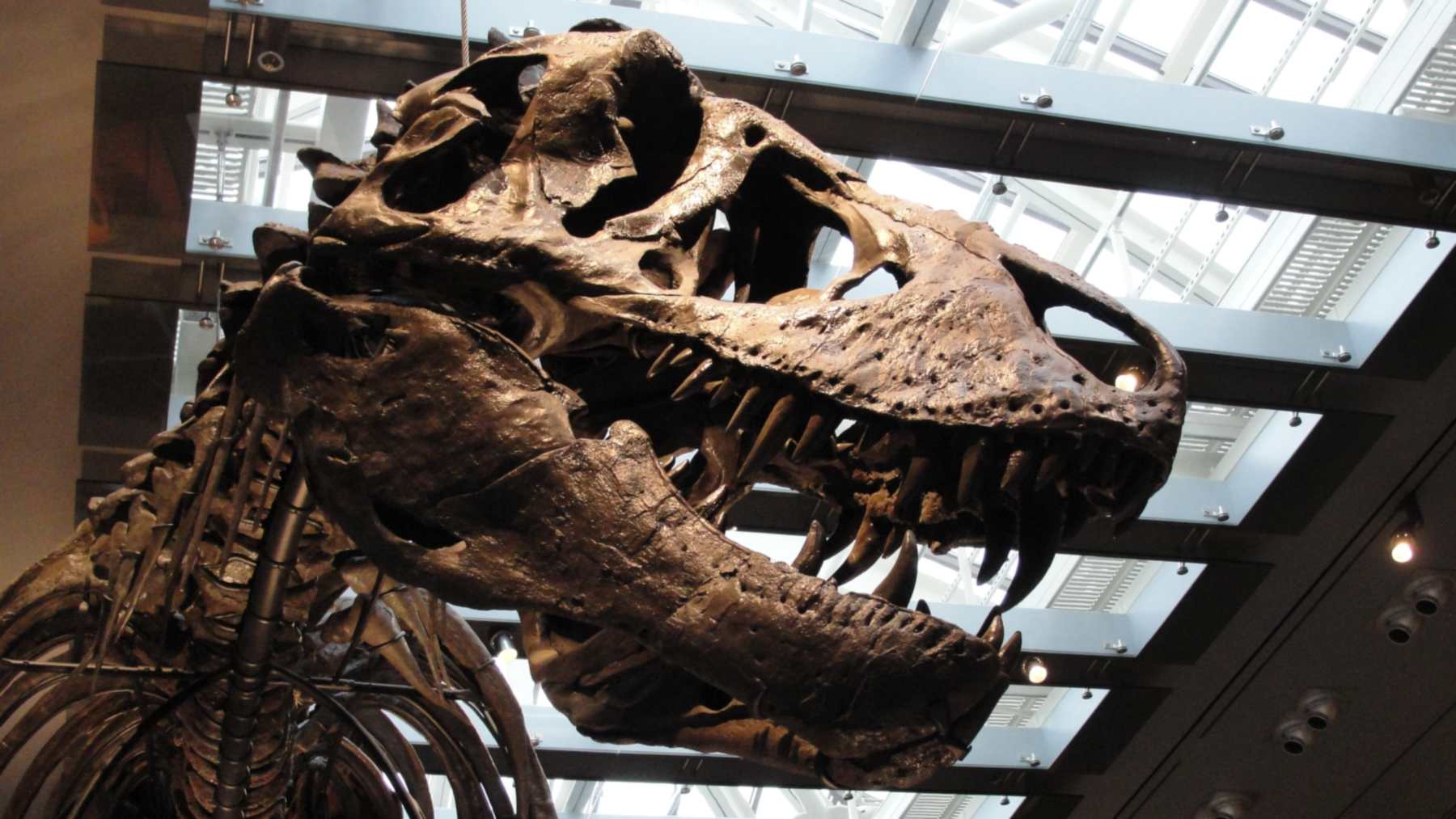
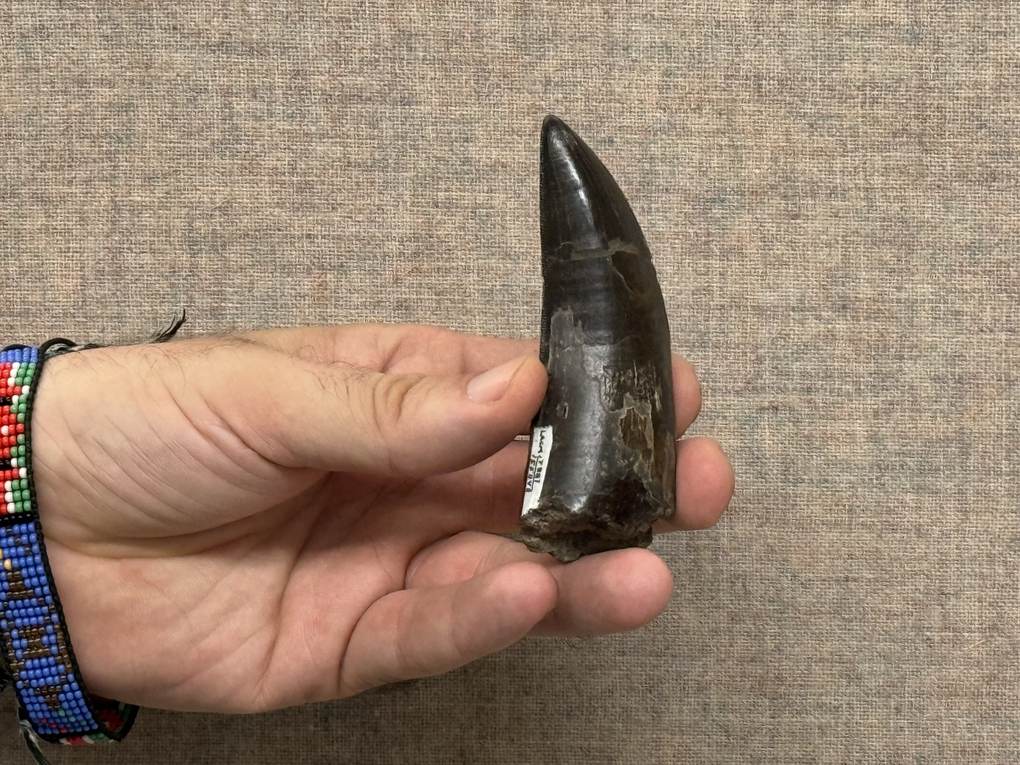
Two of the teeth came from Thomas, a T. rex dug up in Montana in 2005. Its skeleton now stands in the Dinosaur Hall of the Natural History Museum of Los Angeles County.
The third tooth belonged to a second T. rex in the museum’s collection. Both animals come from the Hell Creek Formation, the same rock layers that yielded a toothless “hell chicken” dinosaur.
Museums rarely hand over fossils for tests that grind part of them into powder. Over roughly a decade, the UCLA group cut the material needed by about 90 percent, according to the university’s announcement.
“Nobody hands you a T. rex tooth unless you can show them you only need a few milligrams,” said senior author Aradhna Tripati. She is a UCLA isotope geochemist and climate scientist.
Luis Chiappe heads research and collections at the museum and is curator of its Dinosaur Institute. “Sacrificing small portions of two teeth to learn about T. rex’s body temperature is definitely worth the trade-off,” he said.
Rare isotopes as a thermometer
The technique, known as clumped isotope thermometry, reads a temperature record locked into the enamel. Rare heavy forms of carbon and oxygen, called isotopes, sometimes bond to each other there. Those bonds form more often in the cold and less often in the warmth.
Lead author Randon Flores and co-author Robert Eagle, a UCLA geobiologist, removed enamel with a dental drill. They dissolved the powder in phosphoric acid, which released carbon dioxide. A mass spectrometer then counted the isotope bonds in that gas.
Eagle said any part of the skeleton could work in theory, but living bones are constantly dissolved and replaced. “Tooth enamel has large crystalline structures that are extremely durable,” he said, which makes it the part of the skeleton that best resists change over the eons.
“No one’s been able to make a temperature measurement like this before,” Eagle said in the UCLA release. In his view, the number sits above a reptile or a sloth and below a bird.
Hell Creek crocodiles ran cooler
Chemical changes after burial can overwrite a fossil’s original signal, so the team brought in five crocodilian teeth from the same Hell Creek beds. Those came out at 87.6°F (30.9°C) on average, nearly 10 degrees Fahrenheit below the tyrannosaur.
Had burial reset both sets of teeth, the crocs and the T. rex would have given similar readings, Eagle said. The paper reports the difference as statistically significant, with a P value of 0.0108. Living crocodilians also like to sit between 86°F and 95°F (30°C and 35°C), and the fossil average lands right in that window.
Freshwater mussels from Hell Creek, which record warm-season water, average about 78.6°F (25.9°C). Climate simulations for the area give a mean annual air temperature of 64°F to 69°F (17.8°C to 20.7°C), so the tyrannosaur ran warmer than its surroundings.
Close to an elephant
On the mammal side, the 97.3°F estimate matches the biggest land animals alive today. The authors cite 96.8°F (36.0°C) for Indian elephants and 97.2°F (36.2°C) for African elephants.
Birds, the living descendants of dinosaurs, tend to run hotter. Ostriches sit at 100.6°F to 103.5°F (38.1°C to 39.7°C), still within the study’s margin of error. Smaller flying birds average about 106.9°F (41.6°C).
Modern reptiles usually run at 82°F to 86°F (28°C to 30°C), the UCLA release notes. For Eagle, a warm T. rex fits an active hunter or scavenger that needed steady meals. Those energy needs, in turn, shape how researchers rebuild ancient food webs.
From Mexico to Alaska
Body heat also helps decide where an animal can live. Alessandro Chiarenza, a paleontologist at University College London, helped feed the new temperature into climate models of North America 66 million years ago.
The resulting map of suitable habitat stretches from Mexico to Alaska and includes cooler, northern areas. Most known T. rex fossil sites fall inside the zones the model rates highly. Those sites cover only a fraction of the predicted range, though.
Alaska’s North Slope offers a real-world check on that map. Remains of young tyrannosaurids have turned up there, at a past latitude of about 85 degrees north. Winters at that spot dropped below freezing.
According to Chiarenza, winter there would have been too cold for a cold-blooded dinosaur. No fossils of lizards, turtles or crocodiles are known from Cretaceous Alaska. The paper cites earlier work suggesting that tyrannosaurs lived there year-round.
Metabolic rate stays an open question
A body temperature does not reveal how fast an animal burned energy. Very large animals can hold steady warmth with a slow metabolism, simply because of their bulk. For that reason, the authors write that “caution must be taken in basing inferences of metabolic rate on body temperature alone.”
Only three teeth from two animals were measured, a sample the authors call limited. The drilled patches came from a limited part of each crown, so a seasonal bias cannot be fully ruled out. Two samples from different teeth of Thomas did give statistically indistinguishable results.
Three teeth cannot show whether every T. rex ran this warm, including animals of other ages, since the species kept growing until almost 40. The full study was published in Science Advances.
Photo: Dinosaur Institute, Natural History Museum of Los Angeles County