Animals that hibernate cut their energy use so far that their bodies barely run through the winter. In Yellowstone National Park, a grizzly’s heart beats 40 to 50 times per minute in summer. During hibernation it slows to 8 to 19 beats, according to the National Park Service.
The same bear takes about one breath every 45 seconds and lowers its metabolic rate by 50 to 60 percent. Bats, ground squirrels and frogs go further, each with its own way of surviving months without food.
Eight heartbeats a minute in Yellowstone
Bears in hibernation generally do not eat, drink, defecate or urinate, the park service writes on its Yellowstone bear page. A grizzly burns about 4,000 calories a day in the den, compared with about 20,000 during the late-summer feeding binge known as hyperphagia.
Yellowstone lists a body temperature of 94 to 95°F (34.4 to 35°C) for a hibernating grizzly. An active bear runs at 98 to 101°F (36.5 to 38.5°C).
The park service calls grizzlies “shallow hibernators” because they do not cool down as far as many smaller species. It still classifies them as true hibernators.
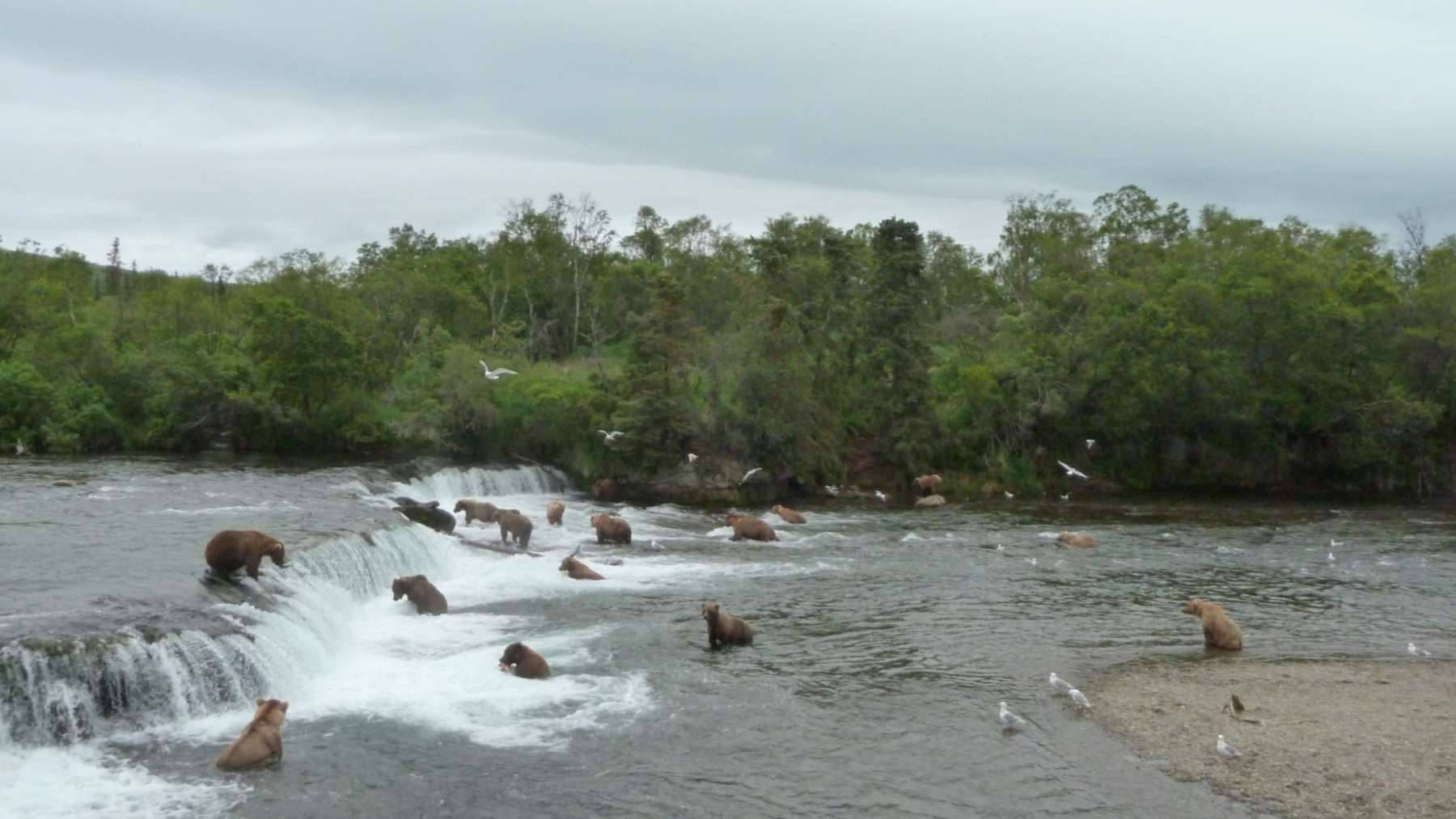
At Katmai National Park in Alaska, the park blog gives a heart rate of 8 to 10 beats per minute. Body temperature there stays above 88°F (31°C), and bears can lose up to a third of their body weight by spring.
171 days in the den
In Yellowstone, den time depends on sex and family status. Females with cubs average 171 days, other females 151 and males 131, the park reports.
Grizzlies there enter their dens in the first or second week of November. Males come out in the last week of March, and females follow in April.
A Yellowstone grizzly loses 15 to 30 percent of its body weight over the winter. To prepare, large bears put on a few hundred pounds of fat before denning, Katmai says. Visitors follow that feast every year in Katmai’s online contest, and Fat Bear Week 2026 went to Backpack.
Pregnant females give birth inside the den in late January or early February. Their gestation lasts 235 days and includes delayed implantation, according to Yellowstone’s grizzly facts. One bear raised in a tiny cage even began hibernating again once it had space and cold.
A bat heart at 10 beats
In torpor, a bat’s heart drops from 200 to 300 beats per minute to about 10. Its body temperature can fall to near freezing, the National Park Service explains on its bat hibernation page.
That state saves about 98 percent of the bat’s energy, and a hibernating bat can go minutes without breathing. Torpor bouts last from a few hours to about a month. Little brown bats can stay in hibernation for more than six months.
Frozen wood frogs in Denali
Wood frogs in Alaska survive the winter partly frozen. Denali National Park reports that they can endure temperatures as low as 10.4°F (-12°C).
During that time, the park writes, “they don’t breathe and their hearts don’t beat.” The heart and liver freeze last and thaw first in spring.
Ice forms around the frog’s cells and stays out of them, according to Kobuk Valley National Park. In that park, the frogs face winter air that commonly reaches -40 degrees.
Arctic ground squirrels near 32°F
Arctic ground squirrels push mammal hibernation close to the limit. They stay just below 32°F (0°C) for two to three weeks at a time, the University of Alaska Fairbanks reports.
Between those stretches, the animals warm themselves back up to about 100°F (37.8°C) within 10 to 20 hours. Then they drop back into torpor. Repeating the cycle, they can sit out up to three-quarters of the year.
White-nose syndrome hit 90 percent
White-nose syndrome, a fungal disease that strikes bats while they hibernate, was first documented in New York in 2006. It has killed millions of North American bats, according to the US Geological Survey.
In a 2021 USGS study, northern long-eared, little brown and tricolored bats lost over 90 percent in under 10 years. “The impacts of white-nose syndrome on bat populations have been swift and severe, but we are not without hope,” said Jeremy Coleman, national white-nose syndrome coordinator at the US Fish and Wildlife Service.
The disease reached Oregon in March 2026, when the state Department of Fish and Wildlife confirmed its first cases. They were six Yuma myotis and one little brown bat. Bats already face other pressures, such as the wind turbines near a Texas bat colony.
Farmers have a direct stake in those losses as well. According to the 2021 USGS release, bats save US farmers at least $3.7 billion a year in pest control.
Bear temperatures differ by park
Park service pages do not give one figure for a hibernating bear. Katmai cites a temperature above 88°F, while Yellowstone lists 94 to 95°F. The two parks also give different heart rates and weight losses.
Those gaps reflect different bear populations, sources and ways of measuring. The ranges in this article come from each park’s own page, and no single number applies to every bear.
The white-nose syndrome figures carry a similar limit of their own. Agencies count affected states differently, depending on whether they track the disease or only the fungus. This article therefore gives no state total.
The data come from National Park Service pages for Yellowstone, Katmai, Denali and Kobuk Valley, consulted on October 30, 2026. Other sources are the University of Alaska Fairbanks, the Oregon Department of Fish and Wildlife and the USGS white-nose syndrome release of April 21, 2021.
Photo: Katmai National Park and Preserve / Wikimedia Commons (public domain)