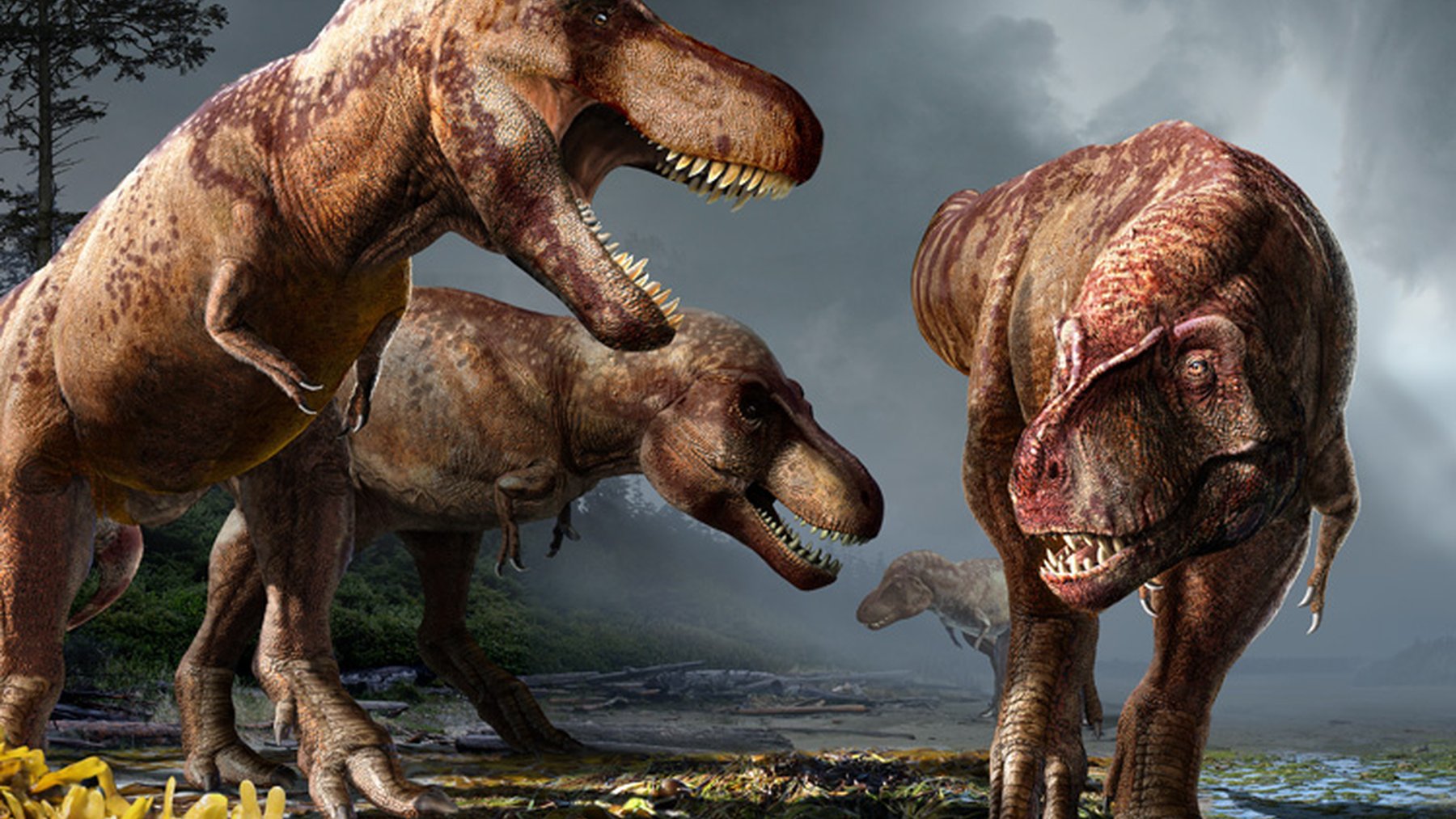
A scientific study estimated that around 2.5 billion T. rex lived in North America over 2,4 millions of years and in comparison, there are only 32 of them that are preserved in museums around the world. This means that finding a fossil of this dinosaur is quite a miracle in terms of statistics. There is only one for over 80 millions that existed!
The number did not come from counting bones
Instead of counting how many T. rex’s bones were found, Charles Marshall and his colleagues at the University of California, Berkeley, estimated how many animals could have lived at that time. To do this, they combined their body mass, the extent of their territory, the duration of the species, and their population density. It was then with the Monte Carlo simulations that helped them deal with uncertainty in those inputs.
With all these calculations, they concluded that 20.000 adults were alive at any given time, with an average density of one dinosaur per 100 square kilometers. Following that number and their logic, this gave a total of 2.5 billion across around 127,000 generations.
Every fossil had to win a long lottery
The first step for a T. rex to become a fossil is to basically to die. But then, its remains needed to be buried quickly enough to escape scavengers, weather, and decay. And yes…bones and teeth had a better chance of “surviving” soft tissue.
Then came tens of millions of years underground, surviving erosion, rocks movements, and exposure without having the remains destroyed or hidden. And finally, the fossil had to emerge at the surface at just the right moment and place so that a human knew where to look.
A century of research rests on a tiny sample
The famous Barnum Brown discovered the first partial T. rex skeleton in Montana in 1902. A little bit later, it was Henry Fairfield Osborn that formally named the species in 1905, opening a scientific story that has continued for more than a century. But it was still in 2021 that less than 100 individuals were identified, and most of them were represented by only one fossilized bone.
This really explains why the major specimens receive names and why one skeleton can motivate a lot of years and years of investigation. Of course, this does not make science weak… Actually what it shows is how much researchers can learn when they analyze and compare them with other fossils and living animals.
What museums show and what scientists infer
What is really important in science, and specifically about these kinds of studies, is that the big achievement is not perfect certainty, and yes being able to find reliable clues from an almost empty archive. And I think that,as Marshall said, it is really surprising how much we actually know about these dinosaurs.

A skeleton displayed at a museum can give you a sense of certainty about how it actually was. But that is not the whole picture, since some reconstructions come from growth marks, biological models, related species, and modern animal biology –-and not all details come directly from bones.
A newer model moved the total, not the message
There have been different studies that calculate the numbers of T.rex, but to be honest the new ones do not “destroy” previous works. This is because the population estimations for an extinct species depend on assumptions that cannot be directly measured. Science becomes more precise when it tests its own methods, but under any of those models, the fossil record keeps on being extraordinarily thin.
The missing record reaches far beyond T. rex
T. rex is a large, famous dinosaur with robust bones, and more than a century of intense searching behind it. If one of paleontology’s best-known predators is represented by only some skeletons, this means that many species that were smaller or that lived for a short time were erased without a single trace. This means that a big part of the prehistoric life could be completely missing forever.
So the next time you go to a museum and see any kind of skeleton, it is good to remember the millions of animals behind it so that this single survivor could be here with us.