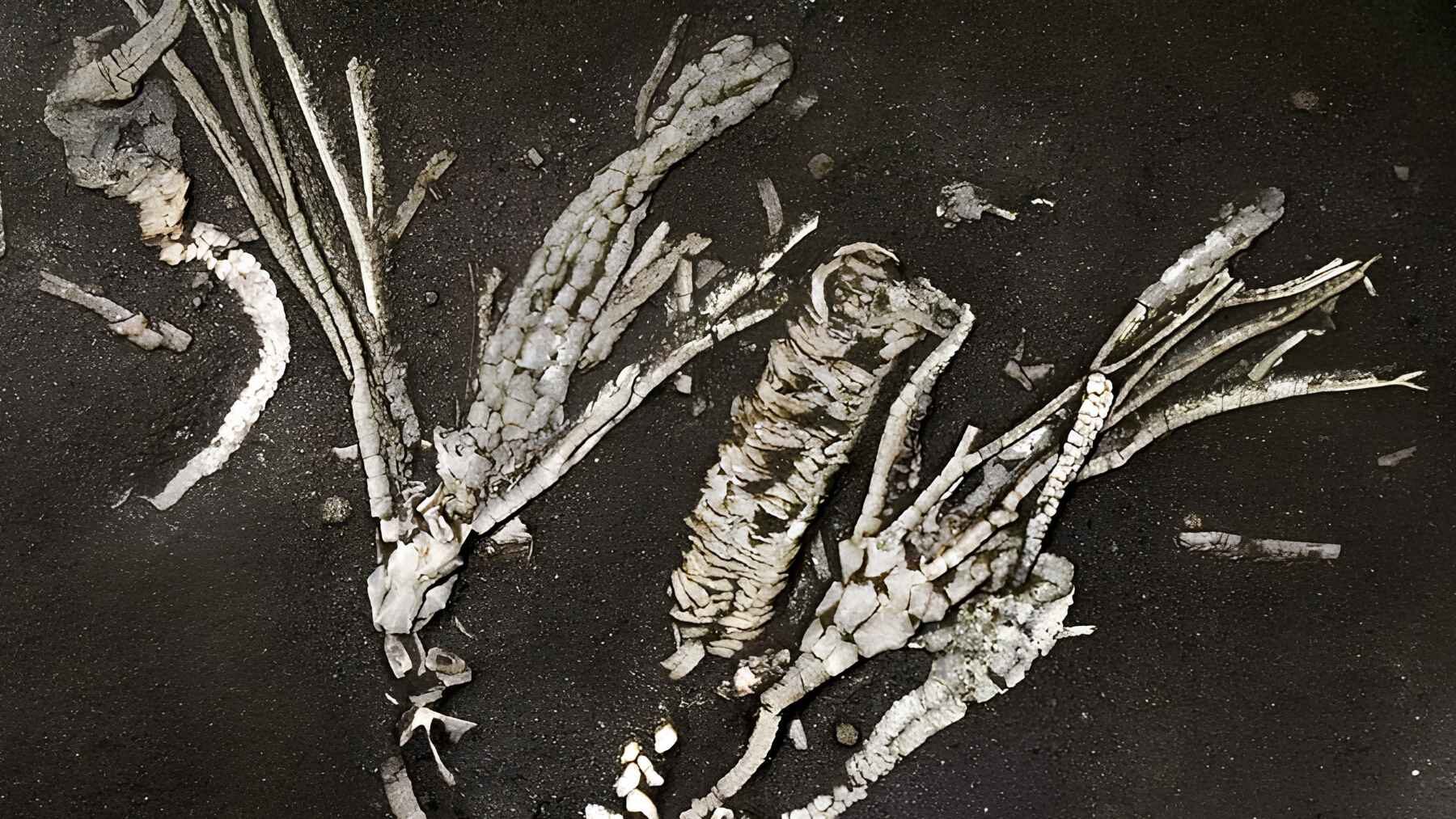
A fossil kept for years in a small museum collection in Montreal has revealed something almost never seen in animals this old. Paleontologists identified preserved feeding tissue in a crinoid that lived about 452 million years ago, long before dinosaurs and before complex life became common on land. The find is the oldest known crinoid soft tissue and only the second confirmed case in the group’s vast fossil record.
The tissue consists of tiny tube feet, soft structures used to catch food from moving water. Their shape suggests this ancient animal may have fed in a way unlike today’s stalked crinoids, giving scientists a rare look at how early ocean communities worked. The specimen also carries a second lesson, since major discoveries can spend years sitting quietly in museum drawers.
A sea animal that looked like a flower
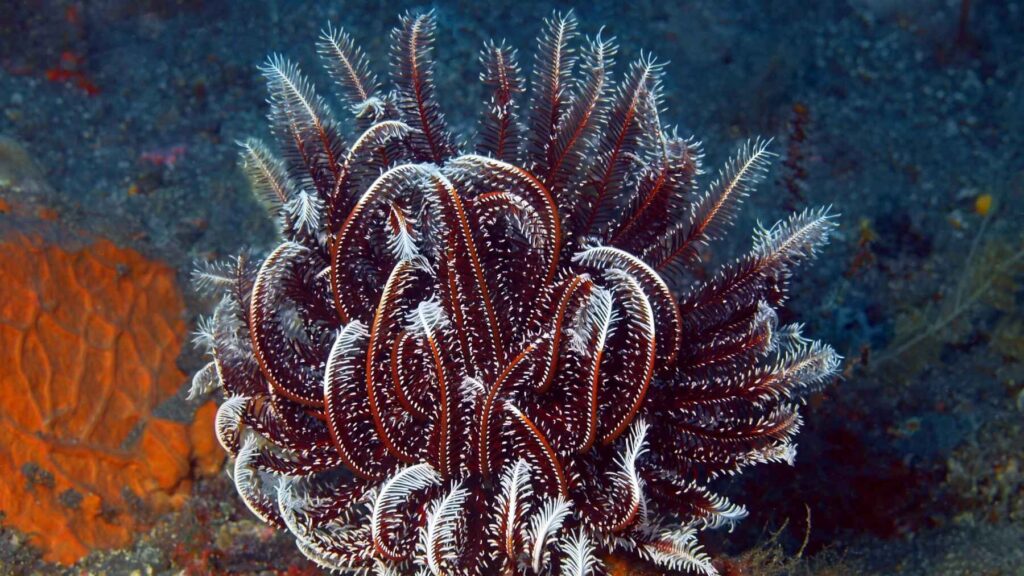
Crinoids are echinoderms, the same broad animal group as sea stars and sea urchins. Many have a stalk and a crown of branching arms, so they can resemble flowers rooted to the seafloor, although they are animals.
They use their feathery arms and tube feet to trap plankton and other particles carried by currents. Think of a living filter held in the flow, except its most revealing feeding tools are soft and usually disappear soon after death.
Why soft tissue almost never survives
University of Oklahoma paleontologists Selina Cole, who called the preservation “truly one in a million,” and David Wright led the analysis. Both also curate invertebrate fossils at the Sam Noble Oklahoma Museum of Natural History, and they worked with William Ausich of Ohio State University and Mario Cournoyer of Montreal’s Musée de paléontologie et de l’évolution.
After death, skin, organs, and similar tissues are usually consumed or broken down before burial can lock them into rock. Here, the tube feet became thin films of pyrite, the iron-rich mineral often called fool’s gold, while the harder plates remained as calcite, a common mineral in limestone. Those two mineral signatures helped the team separate soft anatomy from skeletal pieces.
The fossil nearly hid its secret
The two specimens were already cataloged in the collection and did not look dramatic at first glance. When the rock was dry and viewed under direct light, the tiny structures blended into the surrounding surface and were easy to miss.
The researchers changed the viewing conditions. Angled light made the slightly raised features reflect, while temporary immersion in alcohol increased the contrast enough to trace tube feet along several arms. Sometimes the breakthrough is not a new fossil but a new way of looking at an old one.
What the tube feet reveal
The team measured 26 clearly preserved tube feet across the two specimens. Each averaged about 0.018 in. long and 0.006 in. wide, with the equivalent of roughly 100 positioned along each inch of the feeding grooves. Small indeed, but packed with information.
Their spacing matched expectations for the crinoid branch to which the species belonged. Yet the combination of length and spacing differed from the range documented in living crinoids, suggesting that Dendrocrinus simcoensis may have held its arms in a cone or in several directions while feeding.
Why does that matter? Feeding posture affects which currents and food particles an animal can exploit, much as tooth shape offers clues about a mammal’s diet. The fossil therefore records behavior and habitat, not just body shape.
An ancient ocean comes into focus
The fossils came from the Late Ordovician Neuville deposit in Quebec, a marine setting about 452 million years old. Crinoids shared those seas with trilobites, brachiopods, bryozoans, and other invertebrates while complex seafloor communities were expanding.
Hard plates tell scientists which animals were present, but soft feeding structures show more of how they lived. Tube feet can reveal how an animal captured suspended food, responded to currents, and divided ecological space with neighboring species. That makes this tiny tissue a useful clue to the workings of an entire seafloor community.
A 2013 study documented the only other known fossil crinoid with preserved tube feet, from a Devonian species that lived tens of millions of years later. The new find moves direct evidence for this feeding system back into the Ordovician and supports the idea that ancient crinoids used a broader range of feeding designs than living examples show.
Museum drawers are part of the field
The species was formally described in a 2020 study of exceptionally preserved Ordovician crinoids, but the importance of these soft structures became clear only after specialists revisited the material. That sequence is common in paleontology. A fossil can be collected in one decade and answer a different question much later.
Museum collections are more than storage rooms. Careful imaging, fresh questions, and the right expertise can turn an overlooked slab into evidence that changes part of an animal’s evolutionary story. The researchers’ home collection alone contains more than one million invertebrate fossils, far more than one person could study during a career.
Community support also mattered here because the institution holding the specimens is sustained entirely by donations. Keeping collections safe, cataloged, and open to visiting researchers may sound routine, but this case shows the scientific payoff. There are likely more important details waiting in plain sight.
What this discovery changes
The finding does not overturn crinoid evolution, but it fills a major gap left by millions of fossils made mostly of hard parts. Scientists now have direct evidence of an ancient feeding system rather than having to infer every detail from skeletal plates.
In practical terms, the fossil connects anatomy, behavior, and environment in a single specimen. A row of tube feet nearly invisible on a museum slab now offers a clearer picture of life in seas more than 450 million years ago. Tiny tissue, big window.
The main study has been published in Royal Society Open Science.