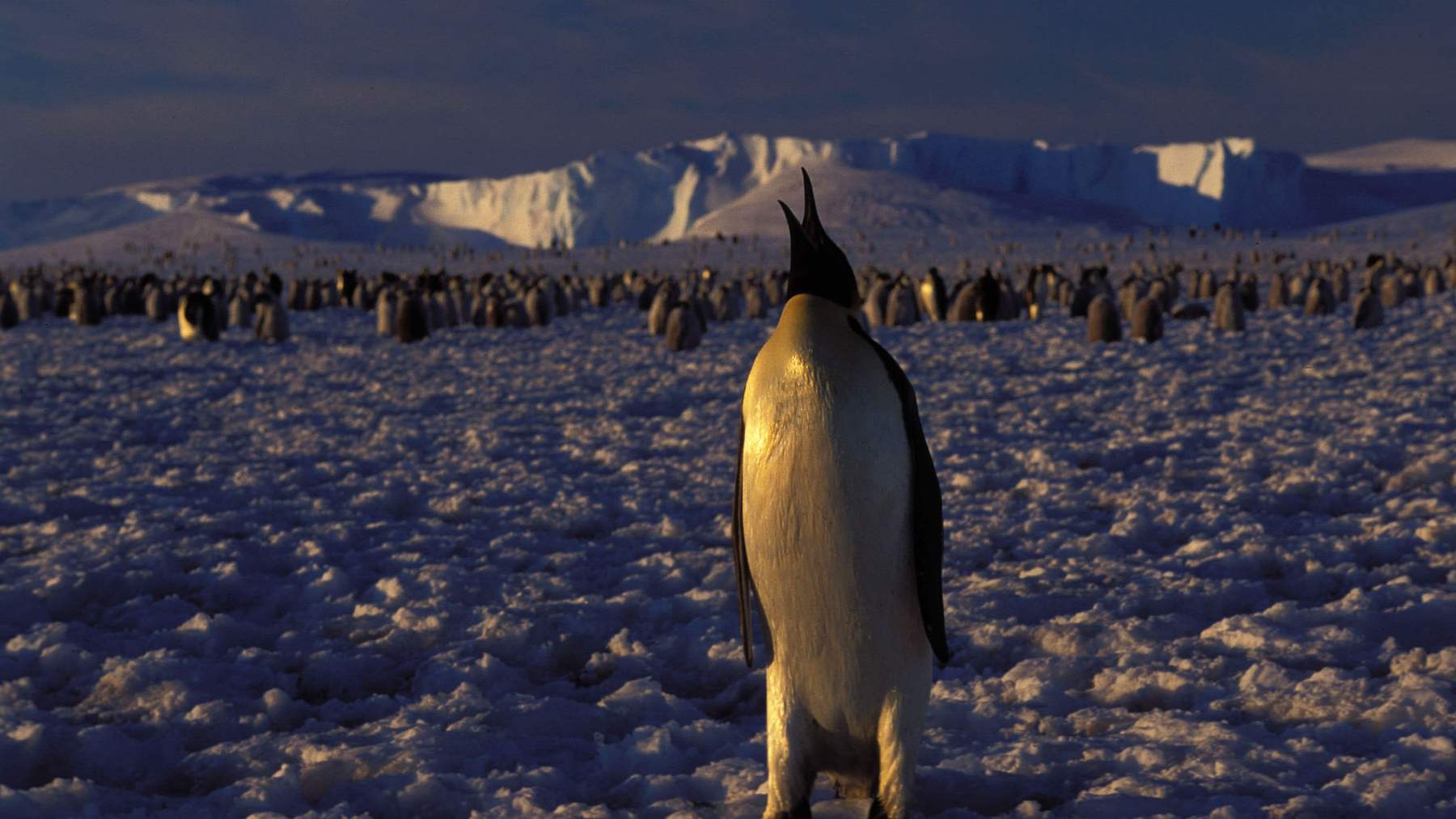
Emperor penguins spend the darkest months of the year on Antarctic sea ice, hidden from optical satellites. A study published September 2, 2026, shows that a free European radar satellite can follow them through that darkness. With it, researchers tracked three colonies year-round from 2017 to 2024.
The work was led by Grant Macdonald, of the Department of Geography at Durham University. His record shows colonies drifting across the ice in winter and later walking away from open water. At Atka Bay, the birds even climbed onto glacier ice in years when the sea ice held firm.
Radar that sees through the night
Cameras on optical satellites need daylight, which is scarce during the Antarctic winter from mid-April to late August. Until now, winter data on these birds came from a few field studies, tagged birds and one remote-controlled observatory.
The team turned to Sentinel-1, a European Space Agency mission that carries synthetic aperture radar, or SAR. The instrument fires microwave pulses at the ground and measures the echo. Clouds and the polar night do not block it, and it images the Antarctic coast routinely.
Smooth winter sea ice returns a weak, even signal, and the colonies stood out against it as bright patches. When the team followed those patches from one scene to the next, they saw them shift position over the weeks.
A bright patch that kept moving
An iceberg can glow on radar too, but once frozen into winter fast ice it stays put for months. Fast ice is sea ice anchored to the coast. Emperor penguins lay their eggs and raise their chicks on it.
To check, the researchers compared radar scenes with Landsat 8 and Sentinel-2 photos from late August and September, when daylight returns. The bright radar spots matched darker areas inside the brown stains seen in satellite images of penguin droppings.
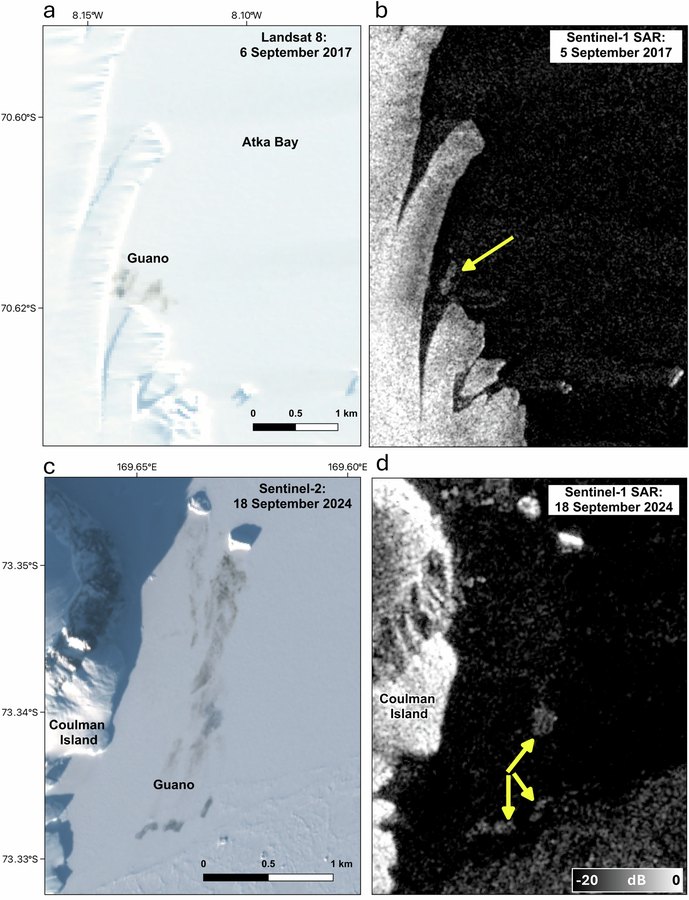
Guano stays behind after the birds leave, yet the radar signal jumped from place to place. That pattern, the authors write, “indicates that the enhanced backscatter was generated primarily by the penguins themselves.” Their best guess is that birds over 3 feet (1 meter) tall roughen the flat ice, but the physics remains untested.
Eight winters at three colonies
The study followed Atka Bay in the Weddell Sea, plus Coulman Island and Cape Washington on the Ross Sea coast. Their latest spring counts list 9,657, 19,822 and 12,178 adults.
Macdonald checked 444 radar images at Atka Bay, 328 at Coulman Island and 391 at Cape Washington. He often logged new positions more than once a week. In winter the colonies moved less than later in the season, but they never stood still.
Cape Washington’s birds almost always stayed within about 0.3 miles (0.5 kilometers) of their first winter spot. Atka Bay broke the pattern in 2022. By July 7, that colony sat more than 0.9 miles (1.5 kilometers) from its April 17 position, for reasons the authors call “not yet obvious.”
From September on, both parents must leave to feed the chicks, and the colonies broke apart. Satellite photos showed up to 8 groups at Atka Bay, 14 at Cape Washington and 19 at Coulman Island.
At each site, at least one group ended up more than 3.1 miles (5 kilometers) from its starting point. The record was 3.56 miles (5.73 kilometers) at Coulman Island. That is straight-line distance, not the total ground the birds walked.
Climbing onto the Atka glacier
Some of the strangest moves took the birds away from the sea. In seven of the eight years, the Atka Bay colony left the fast ice for the neighboring ice shelf, a floating tongue of glacier ice. The earliest switch came on September 3 and the latest on October 28.
Fast ice at Atka Bay never broke up early during the study, yet the penguins moved months before breakout. The paper does not explain why, and the authors treat the cause as an open question.
At the two Ross Sea colonies, groups kilometers apart often turned at the same moment, with no visible change in the ice. The authors link this to earlier field evidence that shifts in wind speed and direction, “rather than ice conditions, may be the main driver of such movements.”
A nursery built on sea ice
Emperor penguins return to their colonies around April, and each female lays a single egg in mid-May. According to the Australian Antarctic Program, the male then carries the egg on his feet for 65 to 75 days. He keeps it near 100°F (38°C) while the air can fall below minus 31°F (minus 35°C).
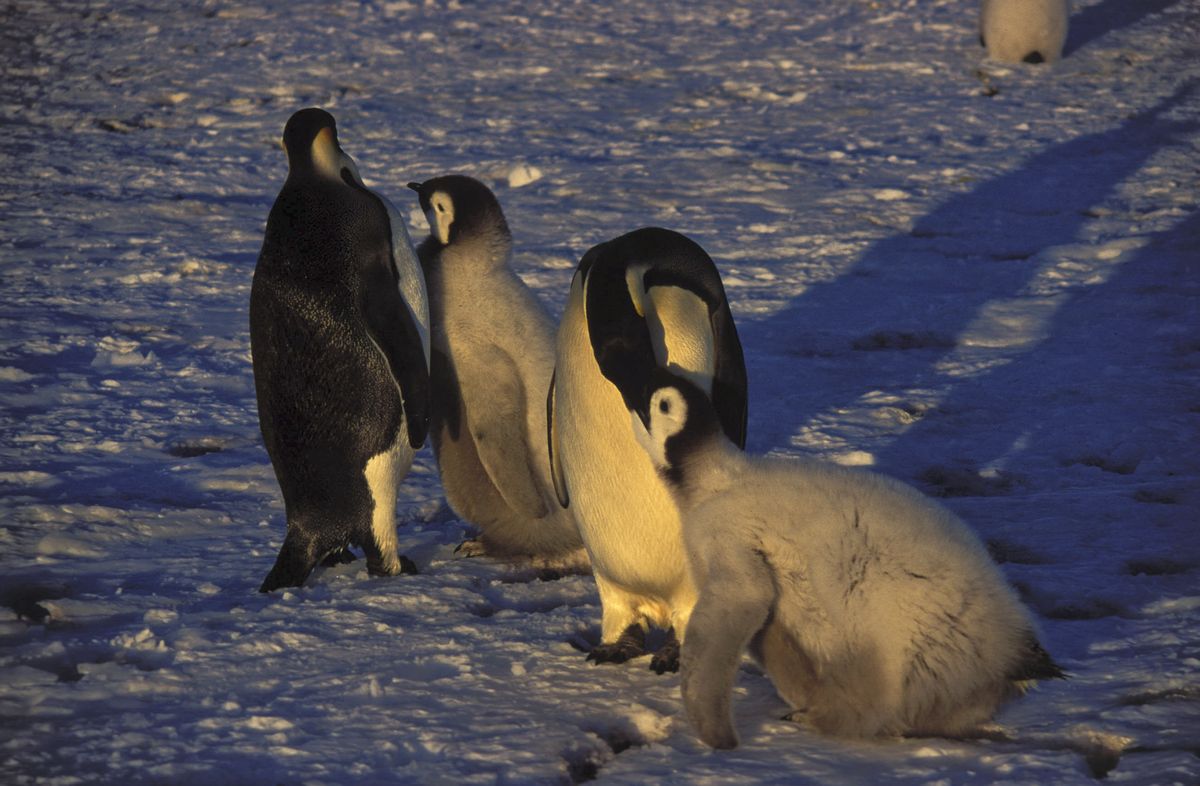
Chicks need solid ice until their waterproof feathers grow in around December and January. The study notes that early fast ice breakout has already caused presumed breeding failure in several regions. Since 2016, sea ice around the continent has shrunk sharply, and the authors say it may have entered a new state.
The paper describes emperor penguins as threatened by climate change, mainly through losses of Antarctic sea ice. Under a high-warming scenario, models cited in the paper suggest 98 percent of colonies could be quasi-extinct by 2100.
No wind records at the colonies
Radar shows where a colony sits, not how many birds it holds or what any single penguin does. Rough or older ice can shine as brightly as a colony. That made the Snow Hill colony impossible to find in early tests.
The team also tested a semi-automated detector, but it threw up too many false positives. Macdonald tracked every colony by hand instead. Climate reanalysis data are too coarse to test the wind idea, so the authors want wind gauges at the colonies themselves.
A winter map could also help draw exclusion zones if emperor penguins become a specially protected species, the authors write. The full study was published in Communications Earth & Environment.
The paper also points to NISAR, a joint mission of NASA and India’s space agency. It began collecting radar images over the Antarctic coast in late 2025, and sharper radar could reveal smaller groups inside each colony.
Photo: Hannes Grobe / Alfred Wegener Institute, CC BY 3.0