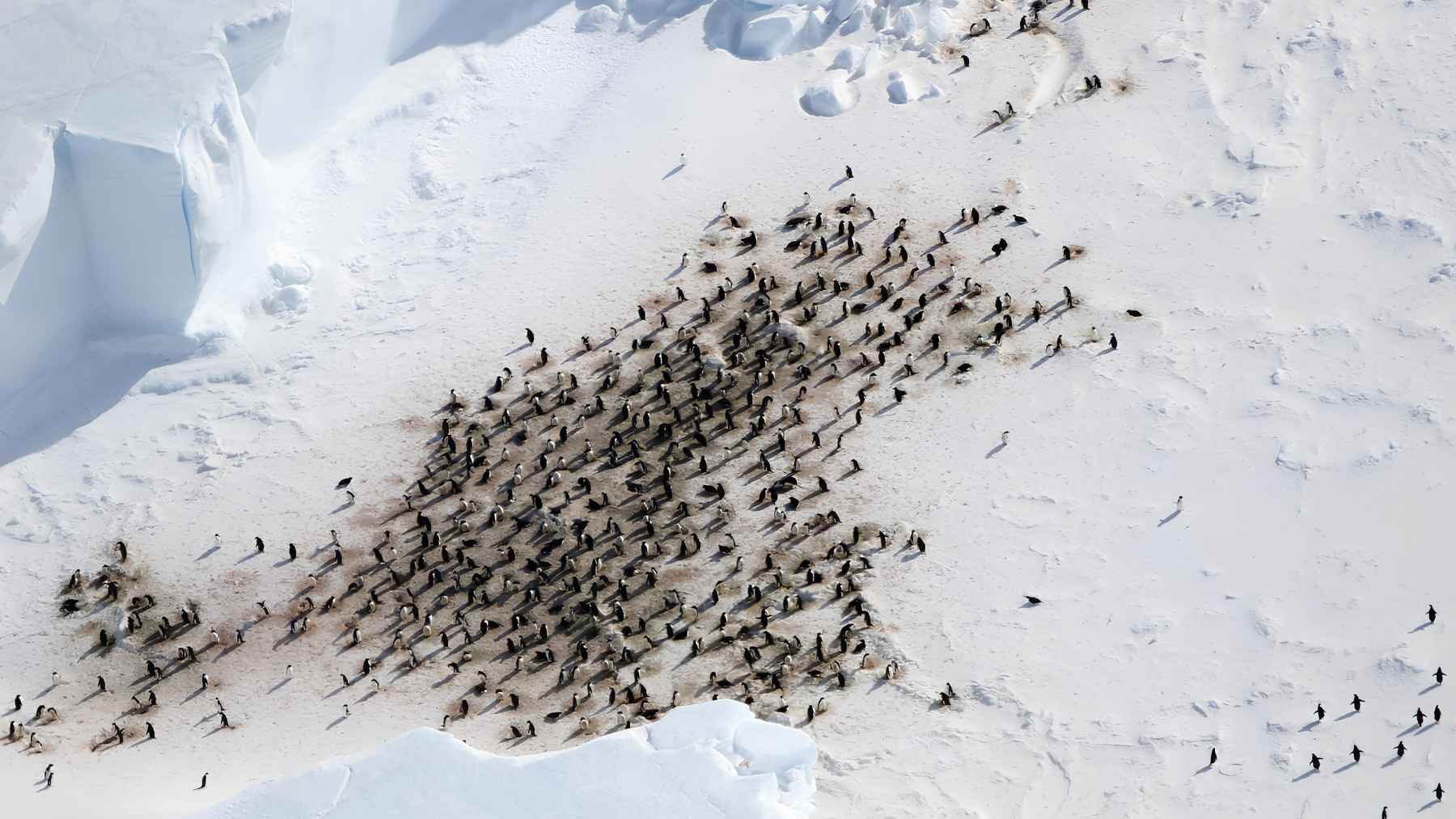
From the ground, an Adélie penguin colony can look like a noisy blur of birds, rocks, snow, and reddish stains. From orbit, those stains have become a 30-year record of what the birds were eating across Antarctica. The unlikely climate archive was sitting in plain sight all along.
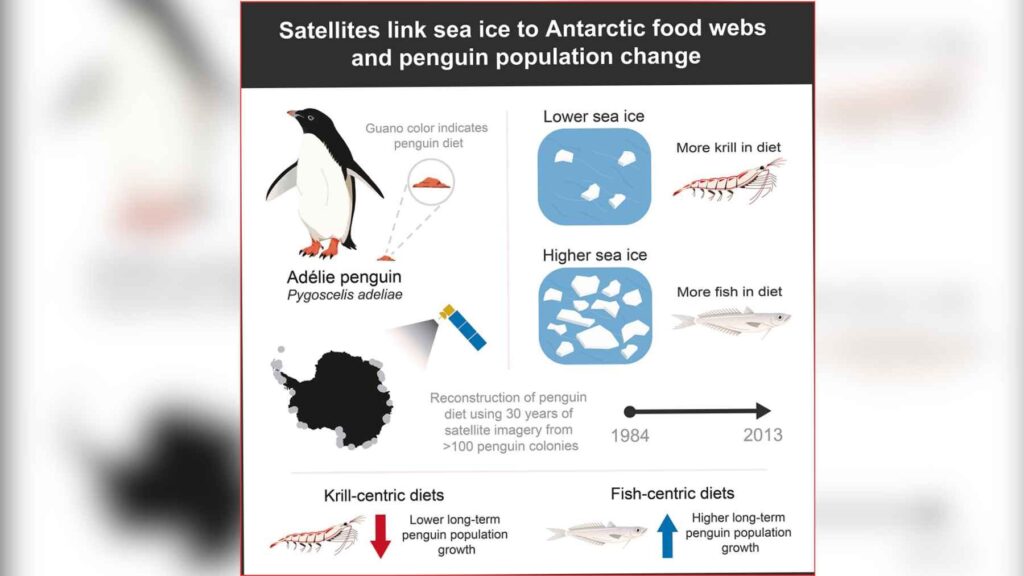
A new study reconstructed penguin diets at 119 colonies from 1984 to 2013. It found that year-to-year changes in sea ice were closely tied to shifts between fish and krill, while colonies with more krill-heavy diets were more likely to be declining. Now, penguin poop is showing how warming can ripple through an entire food web.
Penguin poop becomes a food receipt
Casey Youngflesh of Clemson University led the work with colleagues from Stony Brook University, the University of California, Santa Cruz, NASA’s Goddard Space Flight Center, and other institutions. The team examined 1,334 colony-year records, each representing one colony in one breeding season, and nearly 180,000 guano-stained satellite pixels. That scale would be nearly impossible to achieve by ship and on foot.
Adélie penguins feed mainly on Antarctic silverfish and krill during the breeding season. Fish-rich meals tend to leave whiter guano, while krill turns it pink or red, a difference described in earlier Landsat research. The stain therefore works like a giant food receipt spread across the ground.
The scientists did not assume color alone was enough. They collected guano at colonies, measured its reflected light, and used stable isotope analysis, a method that reads tiny natural chemical differences in a sample. This helped place each diet on a scale from krill-heavy to fish-heavy and gave the satellite colors biological meaning.
How satellites read the stains
A satellite sees more than the colors visible to human eyes. It records a “spectral signature,” which is a light fingerprint created by the way a material reflects visible and infrared wavelengths. Snow, rock, vegetation, and guano each leave a slightly different signal.
The researchers applied their laboratory model to images from three generations of Landsat satellites. Each pixel covered roughly a 100×100-ft. square, so the method was not reading one dropping or one bird. It was reading the accumulated stain from a whole breeding colony.
Co-author Michael Polito put it plainly: “We spied on penguins from space.”
Sea ice changes the menu
Sea ice is ocean water that freezes at the surface, and it is more than a white platform. It supports algae and small animals that feed the Antarctic food chain, while also shaping where silverfish and krill can develop and gather. Change the ice, and the menu can change, too.
At the same colony, years with more sea ice generally brought a higher share of fish, while low-ice years were associated with more krill. Across the continent, geography added another layer, with West Antarctic colonies eating more krill, East Antarctic colonies eating more fish, and Ross Sea colonies falling between those patterns. So this is not one simple switch that works identically everywhere.
The population signal was still notable. Colonies with more krill-centered diets were more likely to show long-term declines than colonies with fish-centered diets. The study found an association rather than proving diet was the only cause, since storms, breeding habitat, local competition, and other pressures also influence penguin numbers.
Fish can give chicks an edge
Why might fish matter so much? Antarctic silverfish are generally more energy-dense than krill, which can help chicks grow larger before they leave the colony. Earlier research across several colonies found that heavier fledglings were more likely to be seen again after going to sea.
At Ross Island, young birds that later returned averaged about 7.5 lbs. at fledging, compared with roughly 7.1 lbs. among those not seen again. That difference sounds small on the kitchen scale, but it can matter for a chick heading into cold water and searching for food on its own. A few extra ounces may be valuable insurance.
Krill is not useless food, and Adélies can live on it. But a diet dominated by smaller, less energy-rich prey may require more hunting, while whales, seals, and a commercial krill fishery are drawing on the same resource. That is why diet quality and prey availability both matter.
Recent ice losses raise the stakes
There is an important limit to the new findings. The diet record ends in 2013, so it does not directly reveal what penguins ate during the exceptionally low Antarctic sea-ice years that followed. The study is a historical baseline, not a live feed.
Even so, the newer ice record makes the results hard to ignore. The National Snow and Ice Data Center identifies 2023 as the record-low year for Antarctic sea-ice extent, and The National Oceanic and Atmospheric Administration (NOAA) data show that June 2026 ranked as the sixth-smallest June in the 48-year record, about 440,000 square miles below the 1991 to 2020 average. Low ice does not guarantee every colony will shift in the same way, but it increases concern about broader food-web changes.
The new method gives researchers a way to look for those changes over huge distances. It can help field teams choose which colonies need closer study and may improve decisions about fisheries and marine protection. When a continent is this remote, a view from orbit is not a shortcut but the only realistic wide-angle lens.
A new Antarctic warning system
Adélie penguins are useful sentinels because they breed around much of Antarctica and depend on a short list of prey. Scientists call the movement of energy from prey to predator “trophic dynamics,” or more simply, who eats what and how that relationship changes. This study is the first to track those dynamics from space across a continent and over decades.
The stains may look trivial, but they offer an early warning that population counts alone could miss.
The main study has been published in Current Biology.