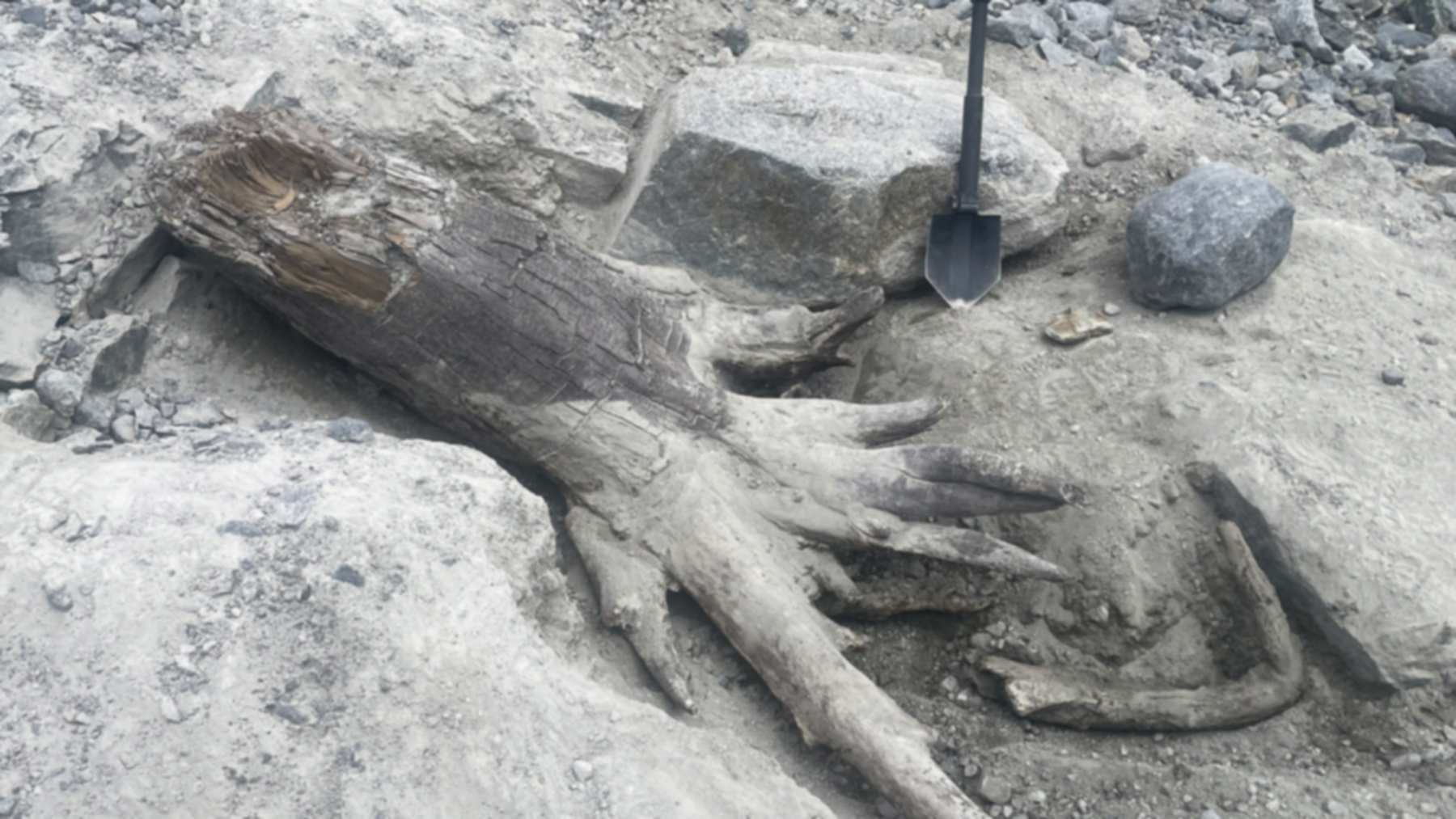
A Swiss glacier in the Engadin Valley has uncovered a larch trunk that stopped growing about 10,300 years ago. Its roots are still attached. Geologist Christian Schlüchter of the University of Bern and four colleagues described it in E&G Quaternary Science Journal on July 28, 2026.
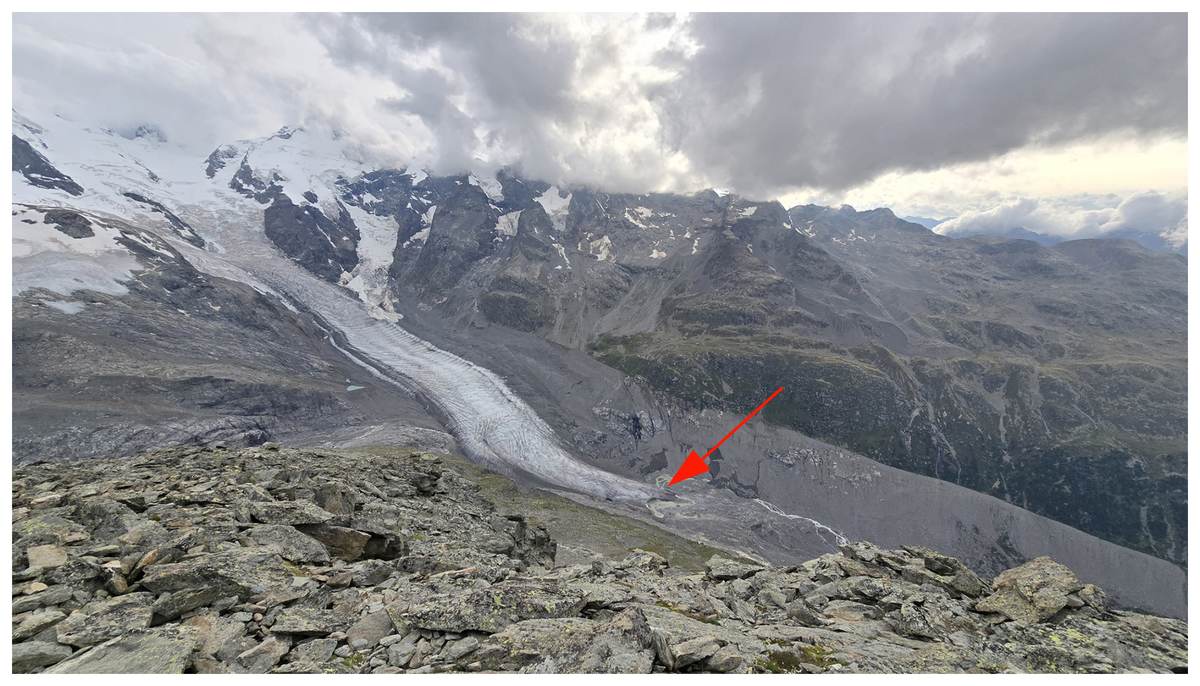
The tree lay at 2,156 meters (about 7,073 feet) in front of Morteratsch Glacier. When the team dug it out, the ice margin was less than 20 meters (66 feet) away. Because the trunk barely moved, it marks ground that was free of ice early in the Holocene, the warm period after the last ice age.
Roots still gripping the till
On the team’s first visit, on June 24, 2025, about 60 centimeters (2 feet) of trunk stuck out of the till. That is the jumble of rock and grit a glacier leaves behind. A little digging showed roots underneath.
Tree-ring counts gave 118 rings, with about 10 more probably missing at the center. Radiocarbon dating measures the decay of carbon-14 in once-living tissue. Combined with a first tree-ring analysis, it placed the tree’s last year at 8350 BCE, give or take 20 to 25 years.
According to the authors, that is the youngest possible end year. The dragging ice bent and sheared off some roots. Enough survived to show the trunk had shifted a few meters, or a few tens of meters at most.
Hundreds of loose logs, one anchor
Over the past three decades, hundreds of samples of ancient organic remains have turned up in front of Alpine glaciers. Most rode inside or under the ice and were flushed out by meltwater. So nobody could say where those trees had actually grown, the paper explains.
What researchers wanted was a tree still near its growing spot. At Morteratsch, the first log turned up during the autumn 2014 survey of the ice front. It was about 30 centimeters (1 foot) long.
Since 2015 the glacier has melted back into a basin. That exposed a bedrock ridge that once squeezed the ice and trapped debris dragged along its base, including the larch.
A sister trunk from 2019
In August 2019, the team excavated a second larch about 500 meters (1,640 feet) away and 15 meters (49 feet) higher. It had 337 rings, preserved bark and bits of soil. It also stopped growing around 8350 BCE.
The seed of that older tree took root about 10,800 years ago, the study estimates. That was only some 800 years after the Younger Dryas cold spell ended. Another wood sample from the site dated about 200 radiocarbon years older still.
Their reading is plain: “At the time of tree growth, Morteratschgletscher was not at the present-day position, but more retired.” The front may have sat as far back as the junction of the Pers and Morteratsch glaciers, the authors suggest.
One valley against the globe
Finds like this are often used to claim that the Alps were warmer then, so today’s melting must be natural. The larch shows that one patch of one valley lacked ice. It does not measure the planet’s average temperature.
A 2019 study in Nature, led by Raphael Neukom of the University of Bern, compared 2,000 years of natural climate records. Past warm and cold spells, such as the Little Ice Age, peaked at different times in different regions. By contrast, “the warmest period of the past two millennia occurred during the twentieth century for more than 98 per cent of the globe.”
Early in the Holocene, Earth’s orbit and tilt sent stronger summer sunlight to the Northern Hemisphere. That favors northern melting without warming every place all year. These shifts, which also help pace the ice ages, are called Milankovitch cycles.
NASA says they work “on long time scales, ranging from tens of thousands to hundreds of thousands of years.” Over the last 150 years, the agency explains, they have barely changed the solar energy Earth absorbs.
For recent warming, a yearly climate indicators update led by Piers Forster of the University of Leeds, published in June 2026, points elsewhere. It put observed warming for 2016 to 2025 at 1.26 degrees Celsius (about 2.3 degrees Fahrenheit) above 1850 to 1900. Of that, 1.24 degrees came from human activity, it found.
273 gigatonnes of ice a year
Glaciers worldwide lost 273 gigatonnes of mass a year from 2000 to 2023, according to a 2025 assessment in Nature. The yearly loss rose 36 percent between the first and second halves of that period. About 5 percent of the world’s glacier ice is gone.
That melt adds to polar ice loss that pushes up sea levels. In Switzerland, shrinking ice keeps giving up old objects. A museum in Lucerne now shows relics from melting Swiss glaciers, from 8,000-year-old antler to modern litter.
Two dates cannot fix a plateau
The report runs just five pages, and its authors are careful about its reach. Both trees’ dates fall on sensitive parts of the radiocarbon calibration curve. Still, “two dates only do not allow the definition of a statistical plateau,” they write.
The ice may also have overrun the larch and lodged it near, not exactly on, its original spot. More trees should appear as the glaciers shrink. “It is expected that further melting and retreat of the glaciers will expose more subfossil trees, eventually in an in situ growing position.”
The full study was published in E&G Quaternary Science Journal.
Image: Schlüchter et al. / E&G Quaternary Science Journal, CC BY 4.0