A Shire gelding named Sampson, foaled in Bedfordshire, England, in 1846, measured 7 feet 2.5 inches (2.19 meters) at the shoulder in 1850. Guinness World Records still lists him as the tallest horse ever documented, more than 175 years later.
The same entry says Sampson, later renamed Mammoth, was reported to have weighed 3,359 pounds (1,524 kilograms). Today’s tallest living horse, a young Shire called Hugo, stands about 8 inches (20 centimeters) lower.
Bred at Toddington Mills
Thomas Cleaver of Toddington Mills, in Bedfordshire, bred the horse, according to the Guinness record. Sampson was a gelding, the term for a castrated male. He reached his recorded height at about four years old.
For scale, Guinness notes that the average horse stands 14 to 17 hands, or 56 to 68 inches. Sampson cleared the top of that range by more than a foot and a half.
Guinness gives no details of the work Sampson did, what he ate or when he died. The page mentions only that big Shires were kept as working horses on farms and for transport.
Counted from hoof to withers
Guinness measures a horse from the hoof to the withers, not to the ears. The withers are the ridge over the shoulder blades, just behind the neck. They stay put when the animal lifts or lowers its head.
Horse people have used hands for centuries, Guinness explains, and one hand is exactly 4 inches. A tenth of a hand equals one inch, so 17.2 hands means 17 hands plus 2 inches.
Sampson’s 86.5 inches work out to 21 hands and 2.5 inches. A 6-foot person beside him would have had the top of their head about 14 inches below his withers. The same unit measures the miniature horses that calmed 61 teenagers in a UC Davis study.
Big Jake’s 82.75 inches
For more than a decade, the best-known giant horse was Big Jake, a Belgian gelding from Poynette, Wisconsin. He lived at Smokey Hollow Farm with owner Jerry Gilbert and his family.
Measured without shoes on January 19, 2010, he stood 20 hands 2.75 inches, or 82.75 inches (210.19 centimeters). That made him the tallest living horse, a title Guinness keeps separate from Sampson’s all-time record. He was still nearly 4 inches shorter than the Victorian Shire.
According to Guinness, Big Jake weighed 240 pounds at birth and later ate two full buckets of grain and a bale of hay a day. In a 2018 interview, Gilbert said the family enjoyed “the reactions and when people leave our farm happy from the experience of seeing Jake.” Big Jake died in 2021 at age 20.
Hugo and the hop-up stool
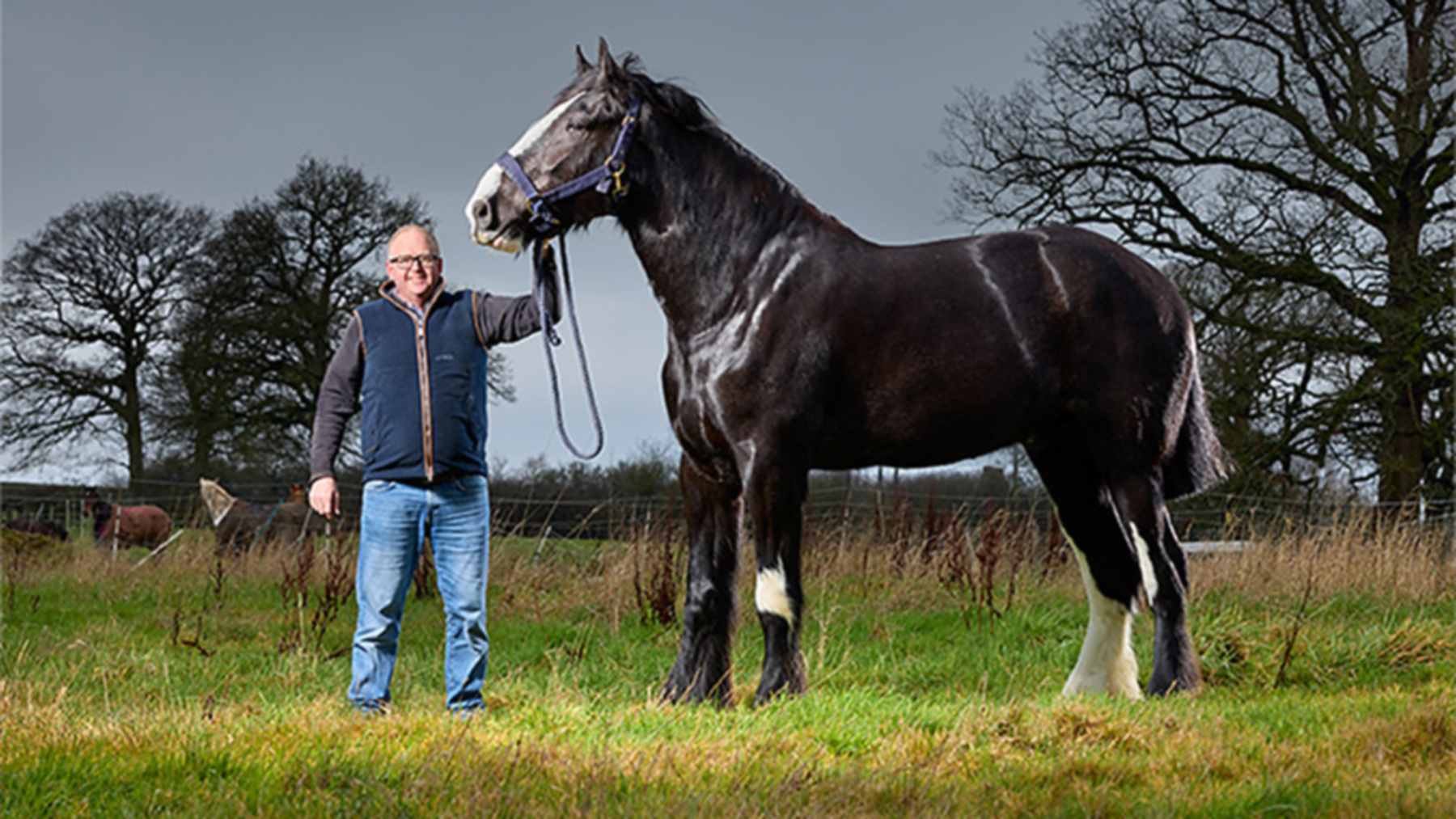
The current holder is Hugo, a Shire from Towcester, Northamptonshire, in England. On December 2, 2025, when he was four, a veterinarian measured him three times without shoes. The result was 199 centimeters (6 feet 6.3 inches), or about 19.2 hands.
Guinness announced Hugo’s title on September 15, 2026, with its 2027 book. He is believed to weigh about 1,960 pounds (890 kilograms). Since he was 18 months old, he has lived on the farm of Brett and Lisa Masters.
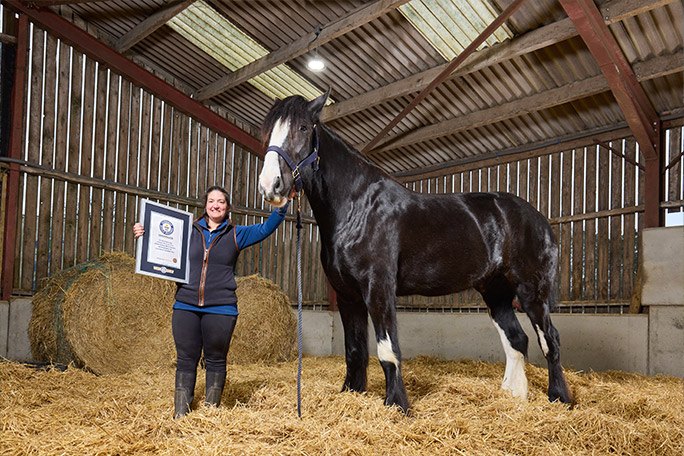
Lisa Masters told Guinness his size came as a surprise, since his mother was around 17 hands and his father 18 to 19. Once she is up, riding him feels like riding any other horse, though her head sits about 9.8 feet (3 meters) off the ground. But “getting on and off is the tricky part as I’m not very tall myself,” she said, so the family uses a decorating stool called a hop-up.
She expects him to keep growing “up until he is at least seven or eight years old.” To match Sampson, Hugo would still need roughly 8 more inches.
Shires that pulled Britain’s loads
Shires are draft horses, bred to pull heavy loads. The Rare Breeds Survival Trust traces the breed to England’s Midlands and Fenlands. The breed plowed heavy clay soils and hauled wagons and barges, the trust says, and became the backbone of British farming and transport in the Industrial Revolution, relied on by breweries, mills and farms.
Most stood far lower than Sampson. The Livestock Conservancy puts the average Shire at 17.2 hands, about 70 inches, with adults weighing 1,900 to 2,200 pounds. By that yardstick, Sampson stood more than 16 inches above a typical member of his breed.
Body shape matters in other pulling animals, too. Ancient sled dogs on Russia’s Chukotka coast had legs about 6 percent shorter than other canids. In Shires, the trust says, feathered legs and big hooves evolved to cope with mud and water.
Demand fell once farming and transport were mechanized after World War II. Shire numbers hit their lowest point in the early 1960s, according to the conservancy, and brewery hitches later helped them recover slowly.
The conservancy still rates the breed critical on its priority list, and the British trust classes it as “At Risk.” Other rare horses have rebounded where people stepped back, like the Przewalski’s horses in the Chernobyl exclusion zone. Shires, by contrast, depend on breeders.
Who measured Sampson is unrecorded
The Guinness entry does not say who measured Sampson in 1850, with what tool or whether he wore shoes, three details that modern records spell out. His weight carries an extra hedge, since the record says only that he “was later said to have weighed” 3,359 pounds.
The conversions are not tidy either. Guinness gives his height as 21.25 hands in the record entry and 21.2 hands in its Hugo announcement. Neither figure converts exactly to the 7 feet 2.5 inches both pages print.
Photo: Guinness World Records