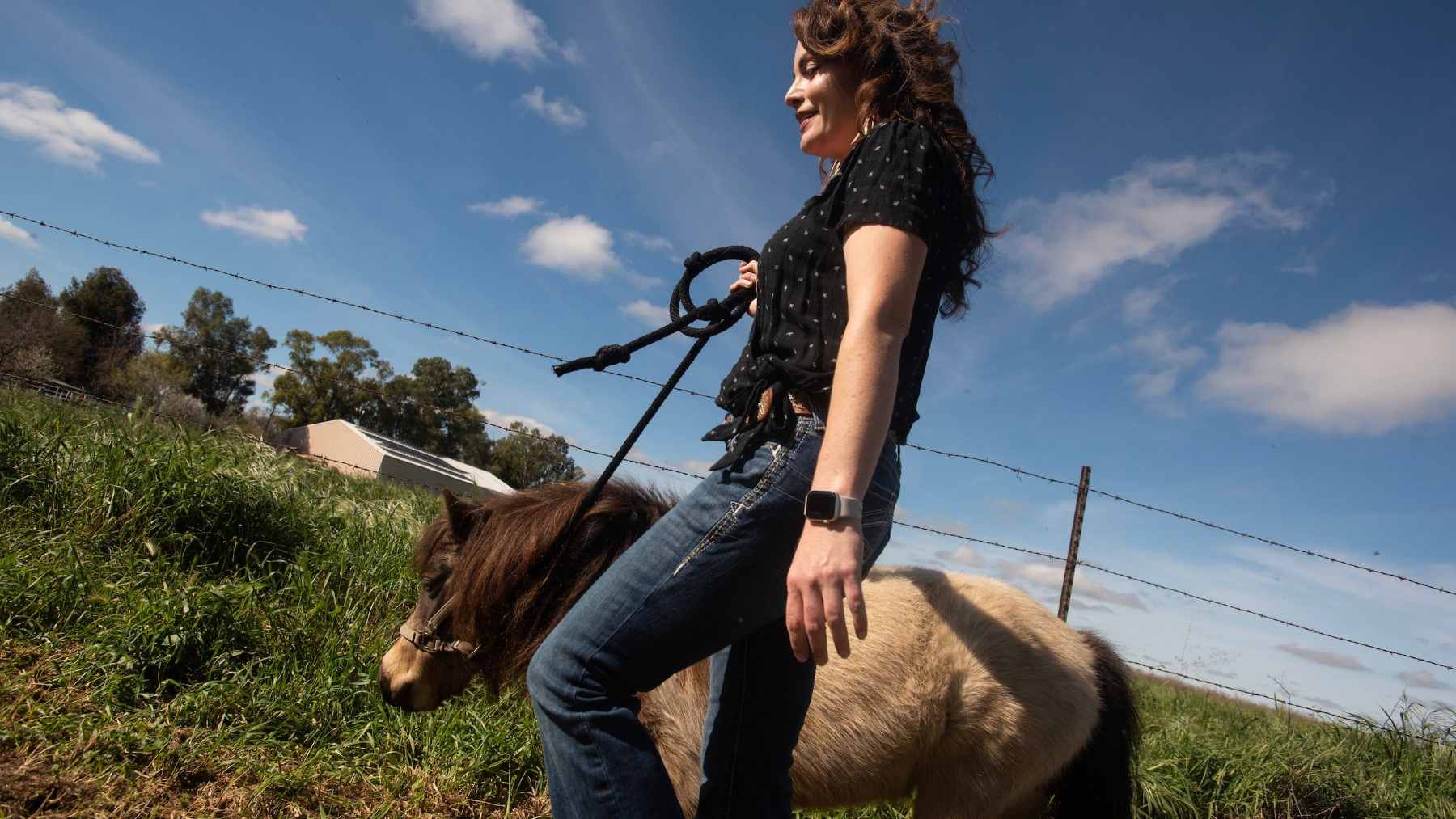
Claire Short noticed it first with her own hands. The miniature horses and donkeys she worked with at the University of California, Davis, reacted differently depending on how she touched them. “I noticed that the mini equines in our lab would react differently depending on how I pet them, and that it made me feel good to make them feel good,” Short said in the university’s announcement.
Short, who started in the lab as an undergraduate and now manages it, turned that hunch into an experiment with 61 teenagers. After three minutes with the animals, the teens said they felt calmer and less nervous, sad and lonely. The ones who saw a horse or donkey walk away from them reported a bigger drop in sadness than the ones who didn’t, Short and her co-author reported Sept. 15 in Scientific Reports.
She had been reading studies of animal-assisted therapy at the time. “Then when I was reading papers on animal-assisted interventions, I saw that the results weren’t very consistent,” she said. “I wondered if that was partly because different people interacted with the animals in different ways.”
Four rescued animals and a summer camp
The study took place in summer 2025 at Skyheart Sanctuary, a nonprofit that cares for rescued animals at Pine Trails Ranch in Davis, during a weeklong animal behavior camp, according to the paper. The herd was two miniature horses, Olivia and Randy, and two miniature donkeys, Mary and Memphis. Each pair was a mother and her son, and the teens were told to leave one of the mothers alone because she was more reserved.
Every session ran between 10 and 11 a.m. on the first day of camp, before the teens had spent much time around the animals. First came a 10-minute lesson with photos and a video on two signals. Lip wiggling was presented as a possible sign that the animal was enjoying itself, and walking away as a sign it wanted to disengage. A short quiz followed.
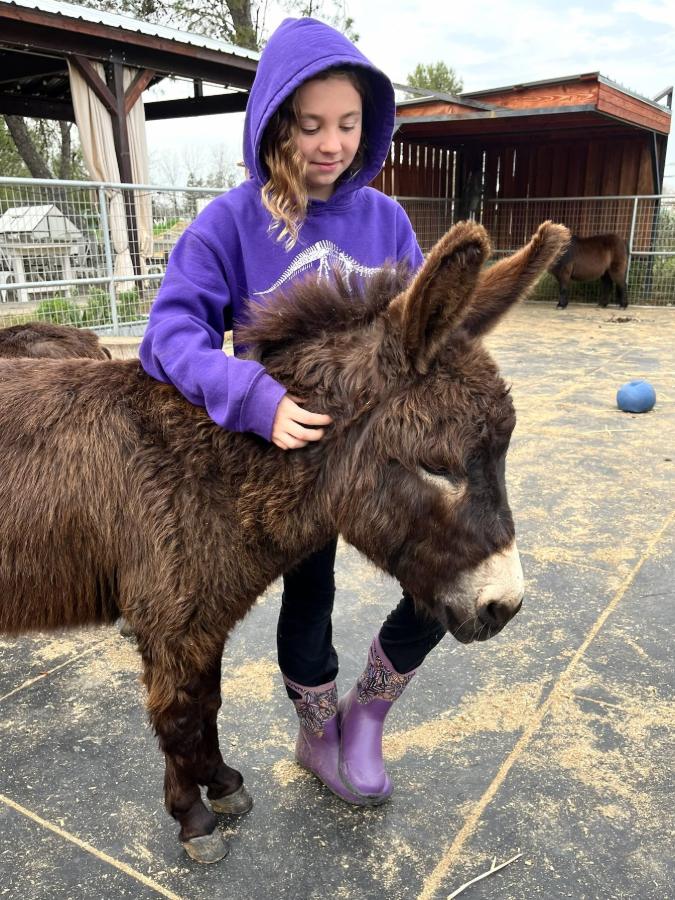
Then the teens went into the animals’ 20-by-40-foot enclosure in groups of two to four. Half had been told to stroke the animals’ backs gently. The other half were told to scratch firmly along the neck with small finger movements, the way horses and donkeys groom each other. Neither group knew the other set of instructions existed.
Neck scratches won
Of the 51 teens who answered both behavior questions afterward, 75% of the scratchers saw lip wiggling, against 48% of the petters. Walking away went the other way. Of the petters, 89% saw an animal leave, compared with 42% of the scratchers. The walking-away gap was statistically significant, the paper says, and the lip-wiggling gap was not, with a p-value of 0.073.
“This really isn’t a story about the best way to pet a donkey, as cute as that would be. It’s a story about reciprocity,” said Rebecca Calisi Rodríguez, an associate professor of neurobiology, physiology and behavior who directs the Green Care Lab at UC Davis and wrote the paper with Short.
Small shifts in how the teens felt
The teens rated five feelings by number before and after the visit, on a scale that topped out at 7. Nervousness fell from 2.57 to 1.97 on average, loneliness from 2.05 to 1.59 and sadness from 1.62 to 1.33. Calmness rose from 4.75 to 5.39. Excitement dropped as well, from 4.99 to 4.52, which the authors put down to the eagerness many teens showed before going in. All five changes were statistically significant, and both groups moved the same way. A fingertip monitor showed no matching change in heart rate.
The animals’ behavior made a smaller difference on top of that. After accounting for where each teen started, those who saw lip wiggling ended up with loneliness scores about 0.2 points lower than those who didn’t. Those who saw an animal walk away had sadness scores about 0.1 points lower.
“I love that this unexpected result challenges the assumption that more animal engagement is always better,” Calisi Rodríguez said. “A meaningful interaction may not require an animal to engage with us continuously.”
The paper offers two possible explanations for the walking-away result. Seeing an animal exercise choice may make the encounter feel more genuine, or short breaks in contact may take some pressure off. It says neither was tested.
What three minutes can’t show
No group of teens spent the time without animals, so the study can’t say how much of the mood change came from the horses and donkeys themselves. The authors say that was a choice, since they set out to compare two ways of touching the animals.
The animals’ behavior was reported by the teens after the visit, not recorded by observers, and the paper notes that those reports may have been colored by the teens’ own moods. It measured one session, right after it ended. Most participants were girls: 67% identified as female, 25% as male and 7% as nonbinary or gender-fluid. Parents reported autism, ADHD or both in eight of them.
The authors suggest brief visits like these could serve as a low-intensity preventive resource for teens outside therapy settings. Whether the effect lasts, or helps with persistent loneliness, the study didn’t test.
The animal’s side of the visit
Short’s question about inconsistent results is where the paper ends up. It argues that what an animal does during a session, and how people treat it, may help explain why animal-assisted programs get such different results. Learning to read an animal’s body language was part of the experiment for that reason.
“You can’t stand in a pasture watching a child and a donkey interact and pretend only one of them is having an experience,” Calisi Rodríguez said. “They’re watching each other, they’re responding to each other, they’re both making choices.”
She said she would like animal-assisted programs to teach people to give care to the animals as well as receive it. The study was paid for with academic enrichment funds from UC Davis, and the authors have posted their data and code online.
Photo: UC Davis