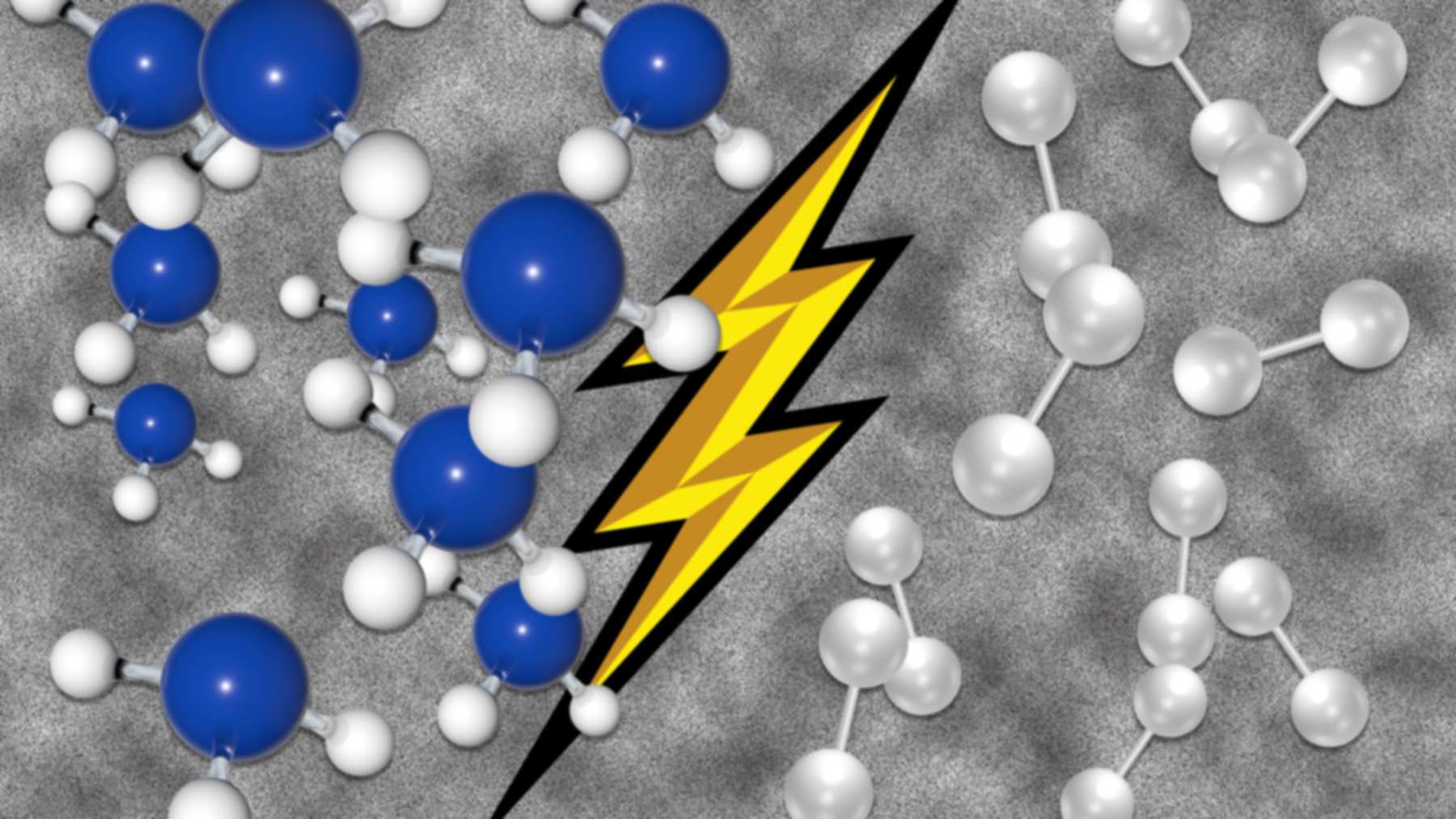
Chemists at MIT have found a way to turn ammonia into pure hydrogen at 250°C (482°F). Their device uses electricity to pull the gas through a palladium-based membrane as soon as it forms. In lab tests it converted up to 91 percent of the ammonia, according to a study published September 9, 2026, in Nature.
Conventional ammonia cracking needs more than 500°C (932°F) to run at high rates, MIT says. The gas that comes out must then be cleaned. The new design releases and purifies hydrogen in one unit, though the authors call it a proof of concept.
Three hydrogen atoms per molecule
Chemical plants, chip fabs and fuel cells on hydrogen trains all use hydrogen, yet shipping the gas means squeezing it hard or chilling it into a liquid.
So chemists park hydrogen inside other molecules and free it on arrival. Ammonia, NH3, packs three hydrogen atoms onto every nitrogen atom, and it is already produced and shipped across long distances.
Unlocking it again is where the bill comes due. Cracking leaves a mix of hydrogen, nitrogen and leftover ammonia. The hydrogen then has to be separated before a fuel cell can use it.
Yogesh Surendranath, a professor of chemistry and chemical engineering at MIT, led the study as corresponding author. He said the team wanted hydrogen so pure that it “could be used directly in a fuel cell or other application that requires a high purity hydrogen stream.”
Palladium membrane, molten hydroxide
In the MIT setup, a catalyst made with ruthenium and cesium first strips hydrogen from the ammonia. The gas then reaches a palladium-based membrane. This metal sheet lets hydrogen through and holds back nitrogen and unreacted ammonia.
On the far side of that membrane sits a molten hydroxide electrolyte, a hot liquid salt that carries charge. The membrane acts as the anode of an electrochemical cell. Hydrogen splits there into protons and electrons, which recombine as pure gas at a second electrode.
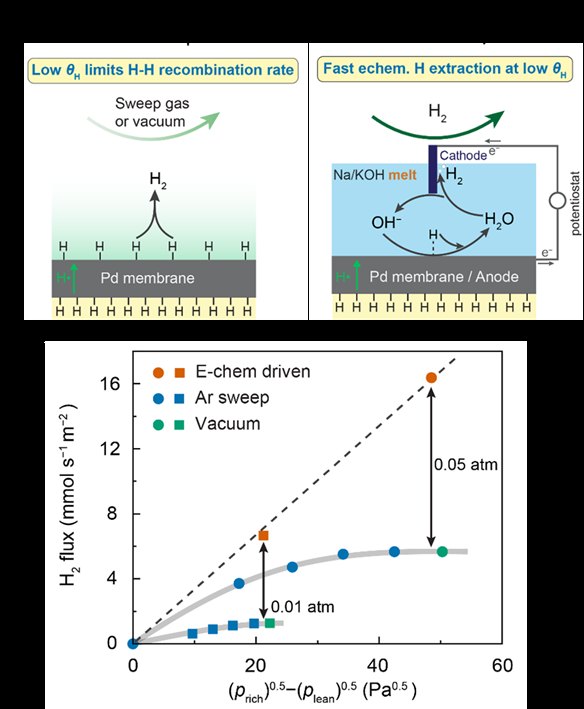
According to MIT, the electrical gradient works like a “vacuum” for hydrogen. Ordinary membrane reactors need a pressure difference instead. That limits how fast the gas flows and how concentrated it ends up.
“Using this electrochemical process, we’re able to do this active pumping of hydrogen from a low concentration to a high concentration,” Surendranath said. Elsewhere he described the trick as a way to use electrochemistry to drive “thermodynamically uphill and kinetically difficult dehydrogenation reactions,” since hydrogen piling up would otherwise choke the cracking.
Up to 91 percent at 482°F
At 300°C (572°F), the electric membrane moved hydrogen four times faster than a pressure-driven setup, the paper reports. It took a weak feed of 0.05 atmospheres of hydrogen in argon. Out came a pure stream at 1 atmosphere.
Linking the membrane to the catalyst lifted ammonia conversion to as much as 91 percent at 250°C. The team also tried methylcyclohexane, a liquid organic hydrogen carrier. It reached up to 94 percent conversion at the same temperature.
That 91 percent figure is the share of the feed that reacted, and it says nothing about the energy bill. The authors add that less than 0.3 volts at the anode was enough. At that point, hydrogen crossed the membrane as fast as diffusion allowed.
Curtis Berlinguette, a chemist at the University of British Columbia, was not involved in the work. In MIT’s release he said it “opens a credible pathway for transporting hydrogen in stable chemical carriers and releasing it where and when it is needed.”
Fuel cells and chip factories
The researchers see uses in cars, buses and ships, and in electronics manufacturing. A fuel cell, as the Department of Energy explains, combines hydrogen and oxygen to make electricity without combustion, so the quality of the incoming gas matters.
Chipmakers use pure hydrogen in several production steps, where MIT says it raises yields and cuts surface defects. Dropping the downstream purifier would also save the extra energy that step needs, according to the university.
Other labs are chasing hydrogen from odd sources, such as a reactor that turns plastic bottles and bags into hydrogen. Electrochemistry is also being tested to turn carbon dioxide into methane with a cheap blue pigment.
Palladium cost and scale still open
Palladium is an expensive metal, and MIT says the group is trying to use less of it in the membrane. The team is also working to scale up the process. No cost estimate or pilot-size result has been published yet.
Whether any of this cuts emissions hinges on how the ammonia got made in the first place. The International Energy Agency’s ammonia roadmap says just over 70 percent of production runs on natural gas. Most of the rest uses coal, and the sector takes around 2 percent of the world’s final energy.
Better extraction would still need cleaner ammonia and cheaper ways of making hydrogen. The electricity that drives the membrane would have to be low-carbon too.
Lead author Rui Zeng did the work as an MIT postdoc. He joined Harbin Institute of Technology, Shenzhen as a professor in August 2026. The National Science Foundation funded the research, and the full study was published in Nature.
Image: Christine Daniloff, MIT; iStock