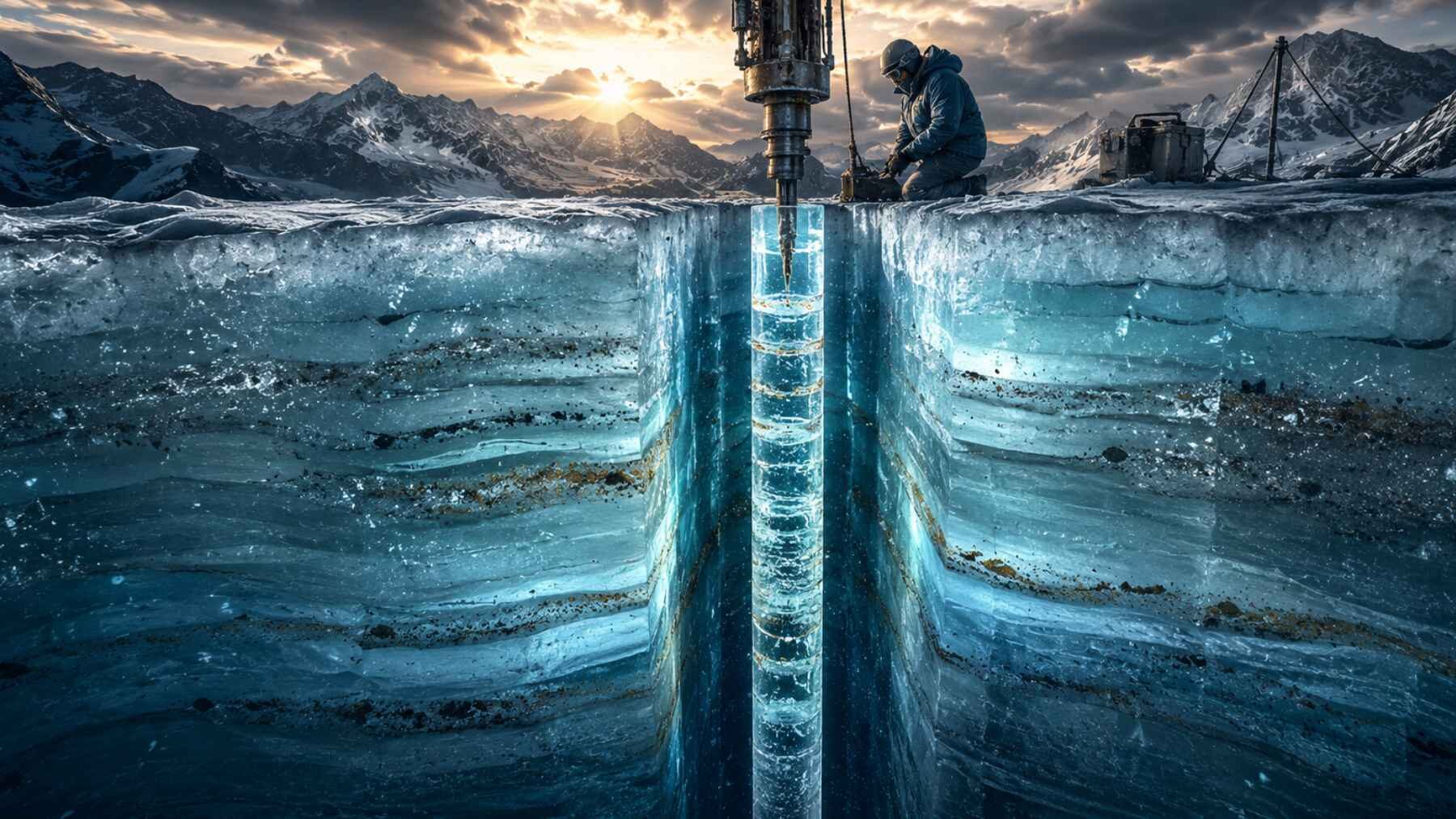
High on Weißseespitze in the eastern Alps, scientists have recovered almost 2,000 years of European environmental history from an ice core barely 33 ft. long. Its upper section preserves a timeline from the Roman era around 128 through 1641, including metal traces, fire smoke, mineral dust, and volcanic fallout.
This is not a sealed bottle of air that Romans breathed. Each snowfall captured tiny particles, then buried them beneath the next layer. That record is now shrinking because the ice at the drilling site fell from 33 ft. deep in 2019 to roughly 18 ft. by 2025.
A history book made of ice
At about 11,480 ft. above sea level, the summit ice cap receives dust, smoke, salts, and metals carried by the wind. Snow compresses them into layers that researchers can read much like tree rings. “These remarkable climate archives function much like a history book,” said lead author Azzurra Spagnesi of Ca’ Foscari University of Venice.
Spagnesi worked with Pascal Bohleber of the Alfred Wegener Institute and Andrea Fischer of the Austrian Academy of Sciences, plus colleagues at Heidelberg University. The team analyzed 18 trace elements, organic acids, microscopic charcoal, and levoglucosan, a compound made when wood burns. Statistical tests helped separate likely human pollution from natural dust, salts, biological material, and volcanic emissions.
Medieval mines left a metal trail
Between the years 700 and 1200, lead and other metals often remained at low levels. Starting around 950, however, the ice recorded sharper peaks in arsenic, lead, copper, and silver. Those rises line up with periods when mining and metalworking expanded across medieval Europe.
Smelting silver and copper ores can release arsenic and lead into the air. The pattern fits activity in mining districts across the Italian Alps, other Alpine valleys, and Germany’s Harz Mountains. Volcanic debris and ordinary rock dust sometimes increased at the same time, though, making individual peaks harder to interpret.
The researchers estimated that direct human emissions made up only about 7% of the recorded pollution. Natural sources dominated for the most part. That makes the core a valuable baseline from before factories, heavy fossil fuel use, and traffic exhaust transformed Europe’s atmosphere.
Fire smoke settled in the snow
What does a medieval fire look like inside a glacier? One clue is levoglucosan, a chemical produced when plant material burns. The ice showed a major rise dated between 902 and 1280, while a peat core from a bog about 12 miles away preserved a similar surge in microscopic charcoal between 822 and 1092.
The peaks do not land on precisely the same year, and the dating still carries uncertainty. Even so, their overlap points to repeated or prolonged fires across the region rather than one blaze. The glacier and the bog appear to tell the same broad story.
A warm and dry phase from about 950 to 1040 may have left Alpine vegetation easier to ignite. Meanwhile, people expanded farmland, managed grasslands, and cleared terrain with fire. Climate created the tinder, while land use likely supplied some of the sparks.
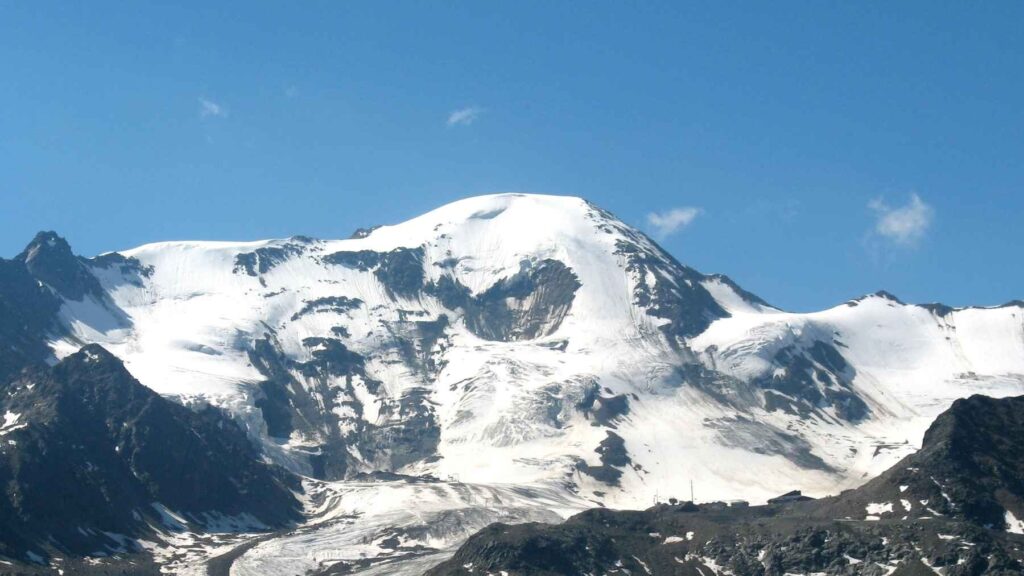
Volcanoes also reached the Alps
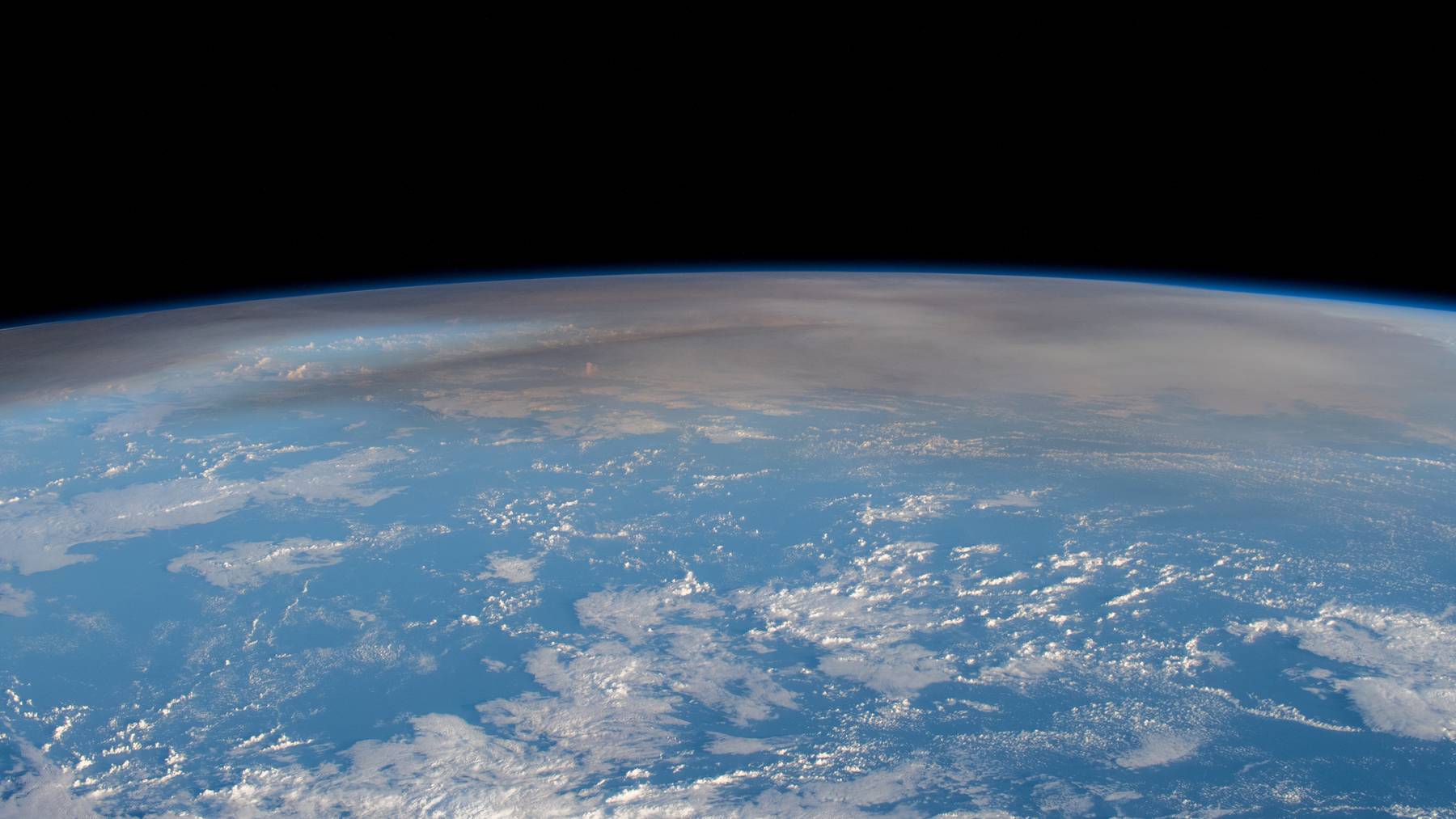
The ice contains sulfate peaks paired with unusual metal concentrations around 1235 and 1580. Sulfate aerosols are fine particles that form after volcanic gases enter the atmosphere, sometimes traveling across continents before falling with snow.
The thirteenth-century signal matches major eruptions recorded in Greenland and Antarctic ice. The 1580 layer looks more complicated, with evidence of volcanic material and increased mineral dust. A chemical spike, in other words, cannot always be assigned neatly to one volcano.
Even a small Alpine glacier can record events that happened hundreds or thousands of miles away. Think of it as a mountain mailbox receiving whatever the atmosphere delivers, from nearby smoke to fallout circulating across the Northern Hemisphere.
The newest ice is centuries old
The team combined radiocarbon dating with argon-39 dating, which counts extremely rare radioactive atoms to estimate when ice formed. The results showed that even the glacier’s surface in 2019 was roughly 400 years old. Younger layers had already melted away.
That explains why the core captures preindustrial Europe but not a complete modern industrial record. Earlier research from 2023 showed that its chemical and climate signals remained readable despite surface loss. A separate dating study later established a continuous timeline reaching about 6,000 years in the deepest remaining ice.
The new chemical analysis focuses mainly on the upper 28 ft., covering Roman times through the early modern period. By placing each metal, smoke, and sulfate peak on an improved calendar, researchers could compare the glacier with peat bogs, other Alpine cores, and known historical activity.
The archive is melting away
Measurements indicate that the drilling site lost nearly 15 ft. of ice between 2019 and 2025. A companion analysis estimated that the summit glacier could vanish within 10 to 20 years if recent average losses continue. The industrial-era layers are already gone.
When glacier ice melts, scientists lose more than frozen water. Particles, gases, and chemical clues wash away with it and cannot be reconstructed. “It is about safeguarding the memory of Earth’s climate,” Spagnesi said.
Preserving cores from threatened mountain glaciers could give future laboratories material to study with tools that do not yet exist. For now, Weißseespitze shows how mining, land use, drought, fires, dust, and volcanoes once shared the same European sky.
The official study was published in Frontiers in Earth Science.