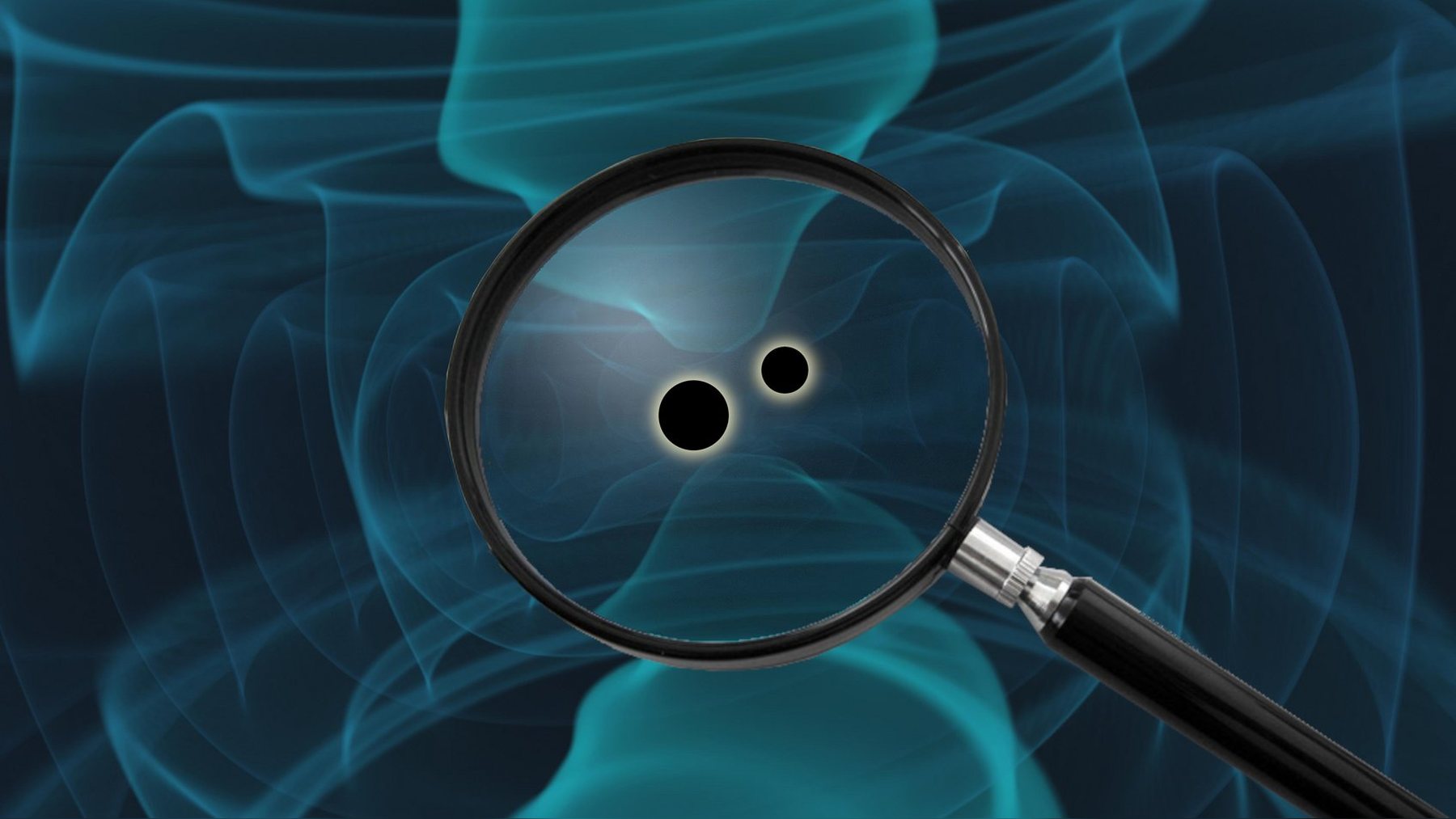
One of the heaviest black hole collisions detected through gravitational waves may have looked bigger than it really was. Researchers propose that warped spacetime amplified and distorted its signal, potentially reducing the pair’s estimated combined mass from about 230 times the sun’s mass to around 140.
The event, called GW231123, remains a real cosmic collision. What is being questioned is how scientists interpreted its brief message, and an August 2026 study from researchers associated with the Max Planck Institute for Gravitational Physics offers a possible explanation. Even if lensing occurred, some of the mystery would remain.
A tenth of a second
On November 23, 2023, the two U.S. LIGO observatories recorded a gravitational-wave signal lasting roughly one-tenth of a second. That date marks its arrival at Earth, after a journey across space.
The original analysis estimated that the two black holes contained about 137 and 103 times the sun’s mass. Allowing for uncertainty, their combined mass fell between 190 and 265 solar masses, and both appeared to spin unusually fast.
Those figures came from comparing the observed signal with computer models of merging black holes. Scientists were reconstructing an event from the tiny stretches and squeezes it produced in spacetime, which makes the accuracy of those models essential.
Why the masses were puzzling
The difficulty centers on the “pair-instability mass gap,” often placed at roughly 60 to 130 solar masses. Standard stellar models predict that certain massive stars either shed substantial material or explode completely, making it difficult to leave black holes in that range.
But “impossible” needs some perspective. A black hole could grow through earlier mergers, so the gap concerns a particular formation route rather than an absolute ban on objects of those masses.
It also applies to each black hole individually. Adding two masses together and comparing their total with the gap can therefore give readers the wrong impression about whether the problem has been solved.
A cosmic magnifying glass
What could change the apparent size of something so enormous? According to Einstein’s general relativity, matter curves spacetime, bending the paths that signals follow through the universe.
Astronomers already observe gravitational lensing in light, where foreground objects can magnify distant galaxies or produce multiple images. Gravitational waves can also follow different paths around a massive object and reach Earth with altered amplitudes.
Smaller lenses can introduce interference, creating recognizable patterns as different contributions to the wave overlap. Think of ripples crossing on a pond, where some crests reinforce one another and others cancel out. These patterns offer clues about what a signal encountered on its journey.
How distance changes the answer
The new analysis by Srashti Goyal, Héctor Villarrubia-Rojo, and Miguel Zumalacárregui combines distortion from a compact lens with magnification from its larger surroundings, such as a galaxy. Their lensing model gives a combined source mass of approximately 100 to 180 solar masses.
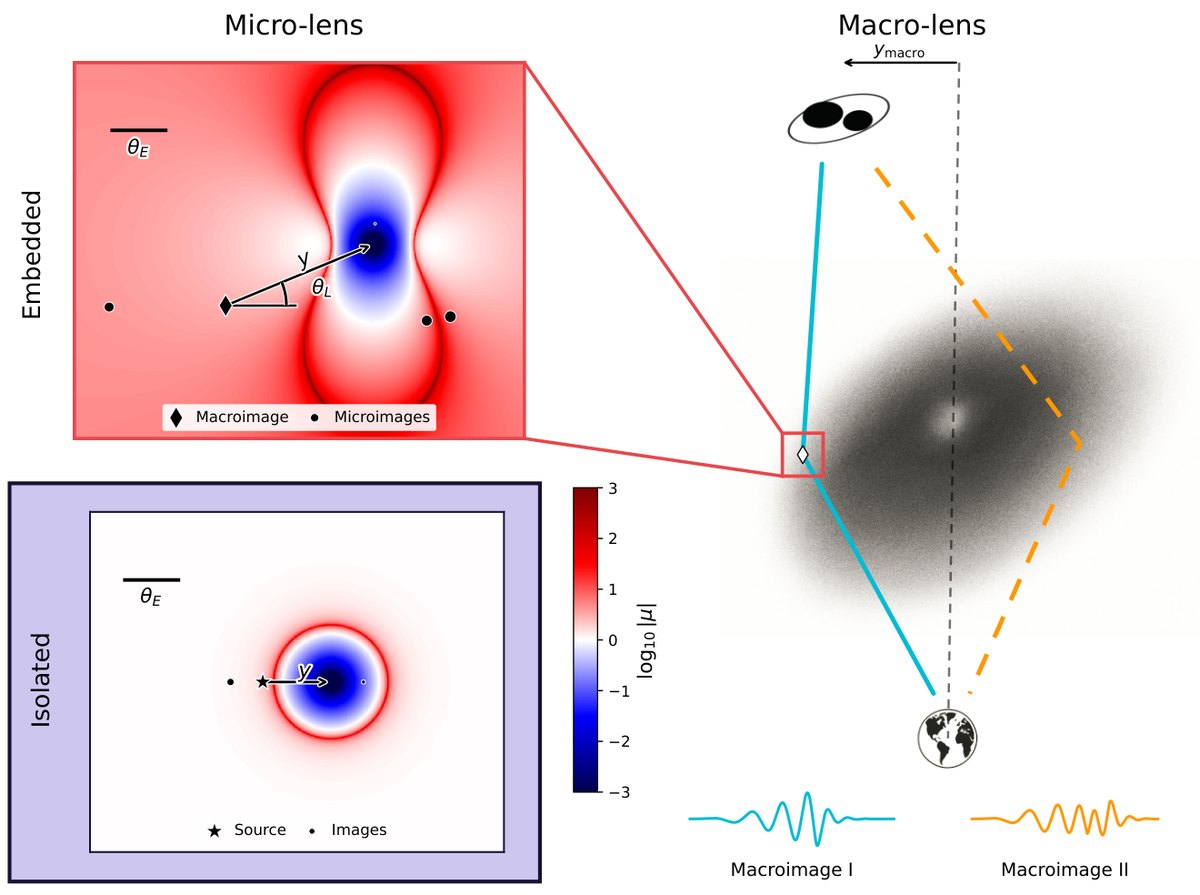
The explanation involves two separate effects. Cosmic expansion stretches gravitational waves and lowers their frequencies, while lensing can strengthen a distant signal so that its source appears closer than it actually is.
If researchers underestimate that distance, they also underestimate how much expansion stretched the waves. Too much of the observed low frequency can then be attributed to heavier black holes. In everyday terms, getting the distance wrong can throw off the cosmic weighing scale.
Smaller, but still unusual
The institute summarizes the revised total as around 140 solar masses. “Moreover, the lensing interpretation does not require unusually high spins,” Goyal said in its announcement.
That would make the system less extreme, but it would not automatically move both objects out of the troublesome mass range. In the paper’s baseline galaxy-lens model, the heavier black hole still has a median mass of about 92 suns, within the commonly cited gap.
Stronger assumed magnification could lower that estimate further. For now, the inferred masses depend partly on the intervening lens, whose properties are not firmly established.
The missing piece
The proposed compact lens would have an inferred mass of roughly 190 to 850 suns under the team’s assumptions. Finding a suitable object along the signal’s path presents another puzzle, and the researchers also consider more complicated arrangements of matter.
A separate preprint posted in July 2026 illustrates why a better-fitting signal alone cannot settle the question. Its authors found that conclusions depend strongly on how common suitable lenses are assumed to be, while noting that a surrounding gravitational field could change the assessment.
The LIGO-Virgo-KAGRA collaboration has also identified GW231123 as an unusual lensing candidate, while emphasizing the need to examine alternative explanations. A promising match is a reason to investigate further.
What comes next?
Researchers can search for additional delayed copies of the signal and improve their models as detector sensitivity increases. If gravitational-wave lensing is confirmed, it could help reveal more distant mergers and investigate matter lying between those collisions and Earth.
For now, GW231123 shows how much the journey of a signal can matter when scientists reconstruct its source. The official press release was published on the Max Planck Institute for Gravitational Physics website.
Simulation: I. Markin (University of Potsdam), H. Pfeiffer (AEI), T. Dietrich (University of Potsdam and AEI); Collage: B. Knispel, M. Zumalacárregui (Max Planck Institute for Gravitational Physics)