Can planting more trees put local water supplies under pressure? Ethiopia’s experience with eucalyptus shows how a useful source of timber and firewood can also compete for water that farms and communities depend on.
A review published February 24, 2026, by Yohannes Gelaye and Kiros Getachew brings that trade-off into focus. Drawing on earlier research, the authors describe economic benefits alongside risks to water, soil, and biodiversity, with outcomes depending heavily on where and how plantations grow.
Why Ethiopia turned to eucalyptus
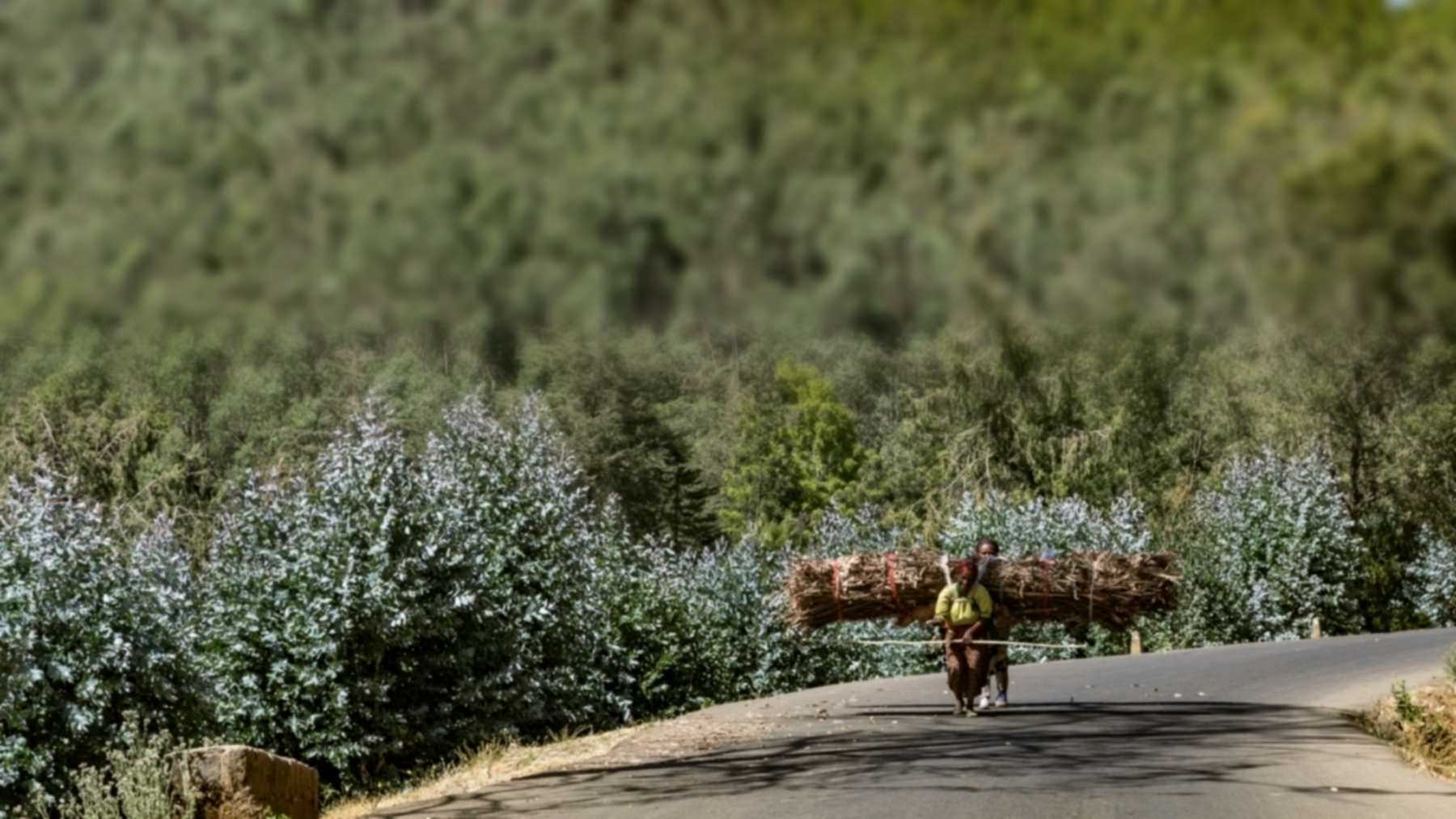
Eucalyptus arrived in Ethiopia in the late 19th century to help meet demand for firewood and construction timber around Addis Ababa. Its rapid growth made it appealing, and government planting programs encouraged further expansion during the 1980s. For households needing cooking fuel or poles for building, the attraction was practical.
A 2025 review by Kiros Getachew Belachew and Wondwosson Kibrie Minale describes how these woodlots provide income and an alternative to harvesting natural forests. That helps explain why farmers continue planting them despite environmental concerns. A tree that produces something people can sell has an immediate value that a household cannot easily set aside.
Where the water pressure begins
Fast growth comes with a demand for water. Eucalyptus roots can reach moisture deep underground, while water taken up by the trees eventually returns to the atmosphere through their leaves. Together with evaporation, this process is called evapotranspiration, and it can leave less water available for other uses.
The effects can change with the season. In a 2013 field study in the Koga watershed near Lake Tana, researchers found that soil moisture declined faster within 30 meters (about 98 feet) of eucalyptus trees, although moisture was not affected during the monsoon. They also measured lower soil nutrients and maize yields within 20 meters (roughly 66 feet) of the trees.
Farmers interviewed for that study reported drying springs, too. Those accounts are distinct from the team’s field measurements, but they help explain the local concern. For someone growing corn beside a woodlot, the question is how much moisture remains when the rains ease.
A growing plantation footprint
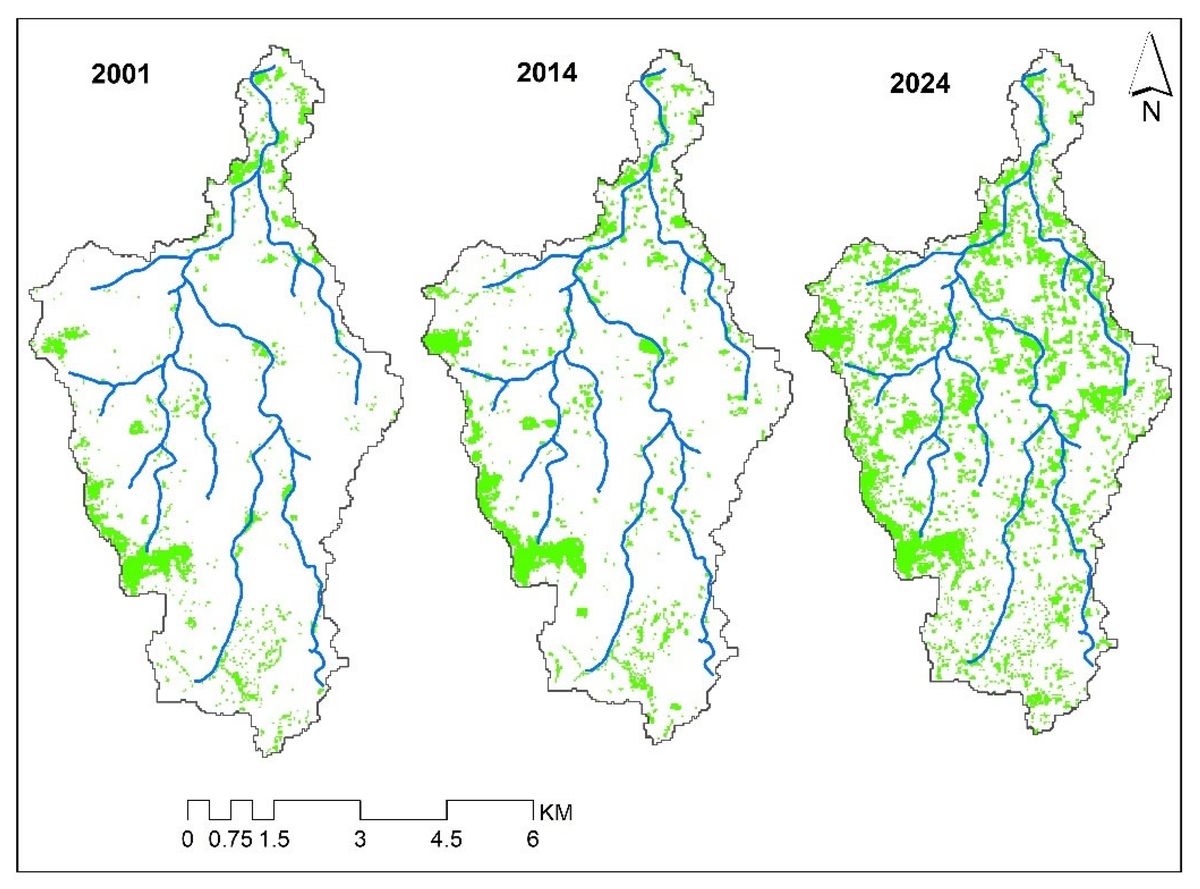
A study published in Hydrology in May 2025 examined the Amen watershed, an area of about 15 square miles in Ethiopia’s highlands. Satellite images showed eucalyptus coverage expanding from 238 hectares in 2001 to about 800 hectares in 2024. That is more than a threefold increase.
Using satellite estimates alongside rainfall and streamflow records, researchers found eucalyptus evapotranspiration was up to 30% higher than that of other land uses during January through March. They also identified a decline in baseflow, the water that sustains streams between rainfall events. Their analysis linked plantation expansion to reduced water storage in the watershed.
Why does that distinction matter? A landscape can receive substantial seasonal rain yet have less water available between rainy periods. This study helps explain that pattern, although its findings come from one changing watershed and should not be applied uniformly across Ethiopia.
Less erosion brings another trade-off
The picture becomes more complicated in places where excess water helps drive erosion. A nine-year study in the Debre Mawi watershed followed conditions from 2010 through 2018 as farmers expanded eucalyptus planting and government soil conservation measures were introduced. Eucalyptus coverage tripled to about 5% of the watershed.
The researchers associated these changes with reductions in runoff and sediment concentrations. Trees planted on vulnerable bottomlands appeared useful for controlling gully erosion, showing that eucalyptus can provide environmental benefits under particular conditions. Because several interventions occurred, the results cannot be attributed entirely to tree planting.
What does that mean for restoration? Reducing the water that carries soil away can be helpful, while reducing water available farther downstream creates a different concern. Judging success requires looking beyond whether a hillside has more trees.
Choosing where trees belong
The 2026 review calls for “improved management rather than complete exclusion of Eucalyptus from farming landscapes.” Its recommendations include careful site selection, control of plantation density, and mixed planting with indigenous trees such as Cordia africana and Faidherbia albida.
The authors also call for longer-term monitoring and local participation in land-use decisions. These proposals offer ways to balance wood production with environmental protection, although their effectiveness needs evaluation in the landscapes where they are used.
Ethiopia’s experience suggests that tree-planting success should be judged partly by what happens to nearby crops, soil, and water supplies.
The latest review was published in The Scientific World Journal on Wiley Online Library.
Photo: Ninara / Wikimedia Commons, CC BY 2.0