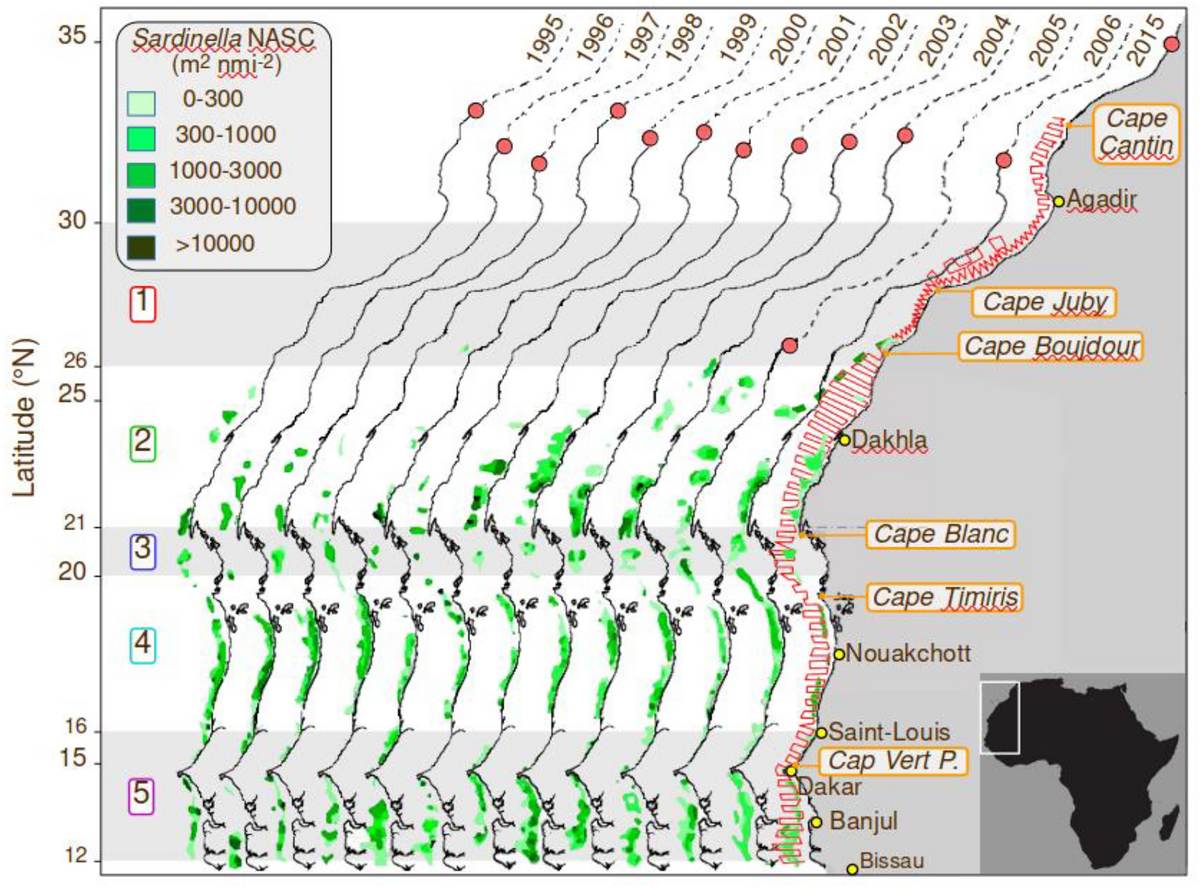
Round sardinella, the most abundant small fish off Senegal and Mauritania, is moving north as the sea warms. Its northern edge advanced about 112 miles (181 kilometers) per decade after 1995, according to a study in Scientific Reports.
Over the same period, its share of biomass north of Cape Blanc climbed from 38 to 65 percent. Cape Blanc sits on Mauritania’s northern border, at roughly 21 degrees north. Biomass here means the total weight of fish detected by sonar.
Abdoulaye Sarre of the Oceanographic Research Center of Dakar-Thiaroye, in Senegal, shared lead credit with two researchers from French institutes. They are Hervé Demarcq of the MARBEC laboratory in Sète and Patrice Brehmer of the IRD. Ahmed Mohamed Jeyid of IMROP, Mauritania’s fisheries research institute in Nouadhibou, was among the coauthors.
Sonar tracks from the Nansen
The data came from the Norwegian research vessel Dr Fridtjof Nansen, part of a program run with the FAO. The ship surveyed the coast each November and December from 1995 to 2006, and again in 2011 and 2015.
Its survey lines ran from Casamance in southern Senegal to Cape Cantin in Morocco. In total, the authors analyzed some 105,600 miles (170,000 kilometers) of acoustic transects and more than 2,200 trawl hauls. Those hauls confirmed which species produced each echo.
Cape Blanc as a dividing line
Until the 1970s, scientists put the northern limit of the fish’s seasonal migration at about 24 degrees north. The new analysis centers on Cape Blanc instead. South of the cape, upwelling runs all year, while to the north it is seasonal.
In their conclusions, the authors write that Cape Blanc “emerged as a natural ecological boundary for numerous species.” Tropical fish have been crossing it more often over the past decades, they add.
One of those newcomers, the Atlantic bumper (Chloroscombrus chrysurus), saw its northern limit move from about 18.5 to 20.4 degrees north. That works out to roughly 121 miles (195 kilometers) per decade, by the study’s figures.
Warmer water and thinner plankton
Along this coast, winds push surface water offshore and cold, nutrient-rich water rises to replace it, a process NOAA describes as upwelling. Those nutrients feed plankton, which in turn feed sardinella and other small fish. When that supply falters, the effects can be sharp, as fishers saw when Panama’s seasonal upwelling failed in 2025.
Sea surface temperature rose fastest between Senegal’s Cap-Vert peninsula and Cape Blanc. There, the authors measured about 0.72°F (0.4°C) of warming per decade over the past 40 years.
South of Cape Blanc, upwelling held steady while primary productivity, the plankton growth that feeds the food web, declined. Sarre’s team ties the move north to that warming and to weaker plankton production in the south. Similar reshuffles have followed heat elsewhere, such as the surge of hybrid crabs after a Bering Sea heatwave.
Bigger sardines, fewer spawners
A second paper, published online on March 10, 2026, in Marine Environmental Research, examined the European sardine (Sardina pilchardus). It is a different species from round sardinella. Both are small pelagic fish, meaning they live in open water rather than near the seabed.
Richard Kindong of Shanghai Ocean University and his colleagues used length-at-age data from commercial catches between Morocco and Mauritania. “Results reveal faster growth in the southern stock compared to the central stock,” they write in the study’s abstract.
Their models also estimated higher fishing mortality and a lower spawning potential ratio in that southern stock, under warmer and more productive conditions. The spawning potential ratio compares a fished stock’s egg output with what it would spawn if nobody fished it.
By contrast, “the central stock showed greater resilience with lower F and higher SPR,” the team reports. F stands for fishing mortality. Bigger, faster-growing fish in the south did not shield that stock from heavy fishing.
Fishmeal plants and shared stocks
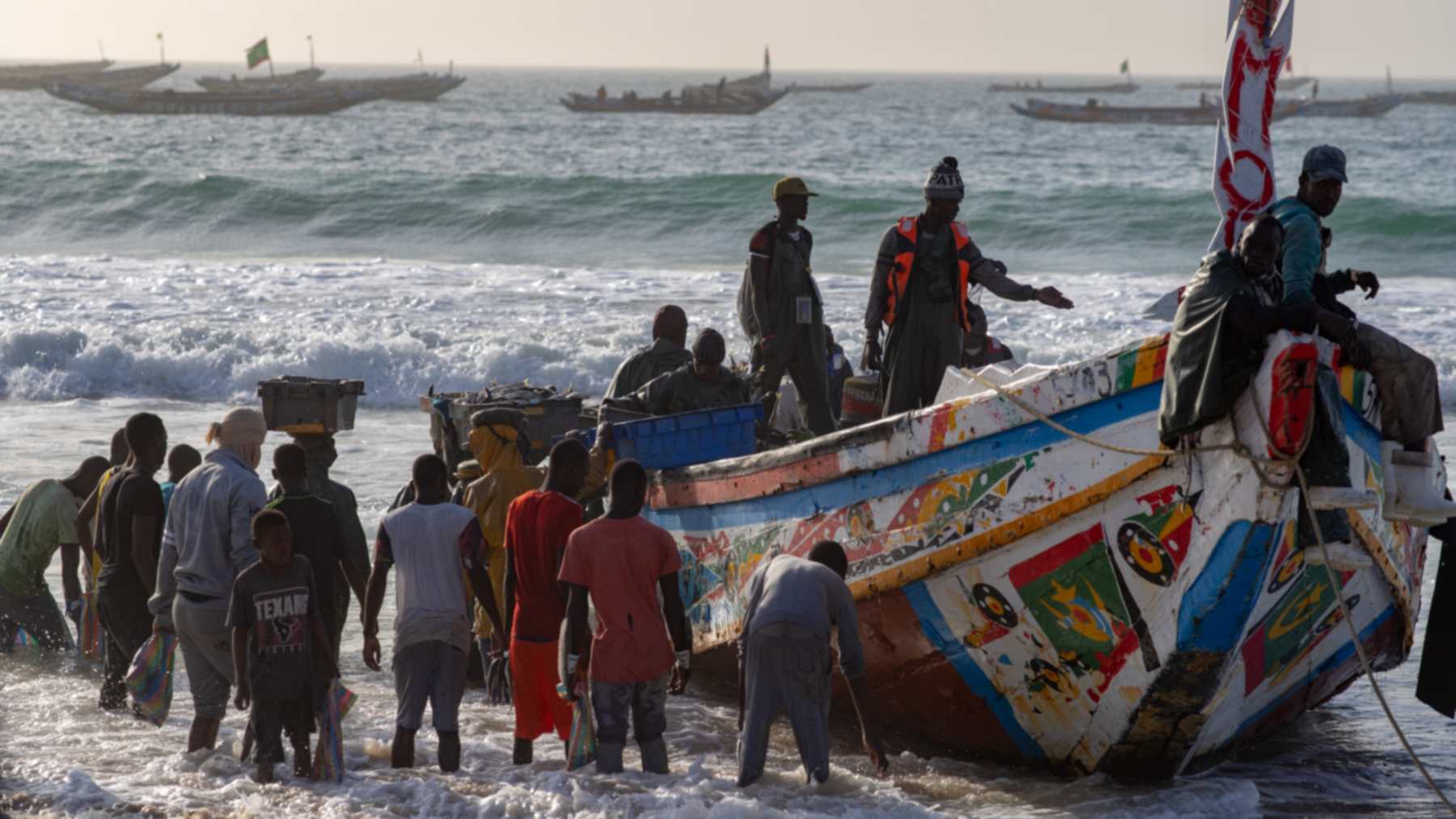
In Mauritania and southern Morocco, fisheries make up a significant part of gross domestic product, the Scientific Reports team notes. Major investments have gone into fishmeal factories that process these small fish.
Pressure rose further with those plants and with the arrival of semi-industrial purse seiners and trawlers. The paper states that “S. aurita is now especially overexploited.” Next door, Senegal’s artisanal fleets already face heavy competition from foreign industrial vessels.
According to the World Bank, each fisherman’s job in Mauritania creates 1.04 additional jobs onshore. Because the sardinella stocks cross borders from Morocco to Senegal, the authors call for common regional policies on food security.
No survey data after 2015
The sardinella record stops in 2015. After 2006 the Nansen came back only in 2011 and 2015, and this dataset says nothing about the years since.
Sonar biomass shows where the fish were in November and December, not how many swim off West Africa across a whole year. A bigger slice north of Cape Blanc can mean fish moved, numbers fell in the south, or both.
Sarre and his coauthors do not pin it all on heat. They also point to stronger winds and lower plankton output south of the cape.
The figures from Kindong’s sardine paper come from its published abstract. That work relied on commercial catches, not on research cruises like the Nansen’s. The full study on sardinella was published in Scientific Reports.
Photo: Valerian Guillot / Wikimedia Commons, CC BY 2.0