On a rain-soaked island, running out of water sounds almost impossible. Yet Catrumán, a rural community near Ancud on Chile’s Chiloé Island, spent years relying on tanker trucks after wells and springs failed. Now residents have restored their own supply and no longer depend on those emergency deliveries.
Their solution paired native forest restoration, infiltration trenches, and a constructed wetland with a gravity-fed pipe network, hydrologic monitoring, and community maintenance. The network has been operating for nearly seven years. More than a new set of pipes, it is a lesson in treating the watershed itself as essential infrastructure.
A rainy island with dry faucets
Ancud receives about 87 inches of rain in an average year, according to a long-term rainfall analysis. However, much of it falls in winter, while summer rainfall has trended downward and small streams can stop flowing for up to four months.
Before the intervention, 64% of families used tanker water at least partly, and 37% depended on it entirely for six months or longer. Municipal records show deliveries during the 2014 to 2015 crisis averaged just 2.4 gal. per person per day. Try stretching that across drinking, cooking, washing, livestock, and a vegetable garden.
Nature became water infrastructure
Rather than treating the watershed as scenery around a pipe, the project made it the first piece of the water system. Residents and researchers mapped Catrumán’s 36 microcatchments, found a stream that flowed year-round, and worked with upstream landowners to protect the source.
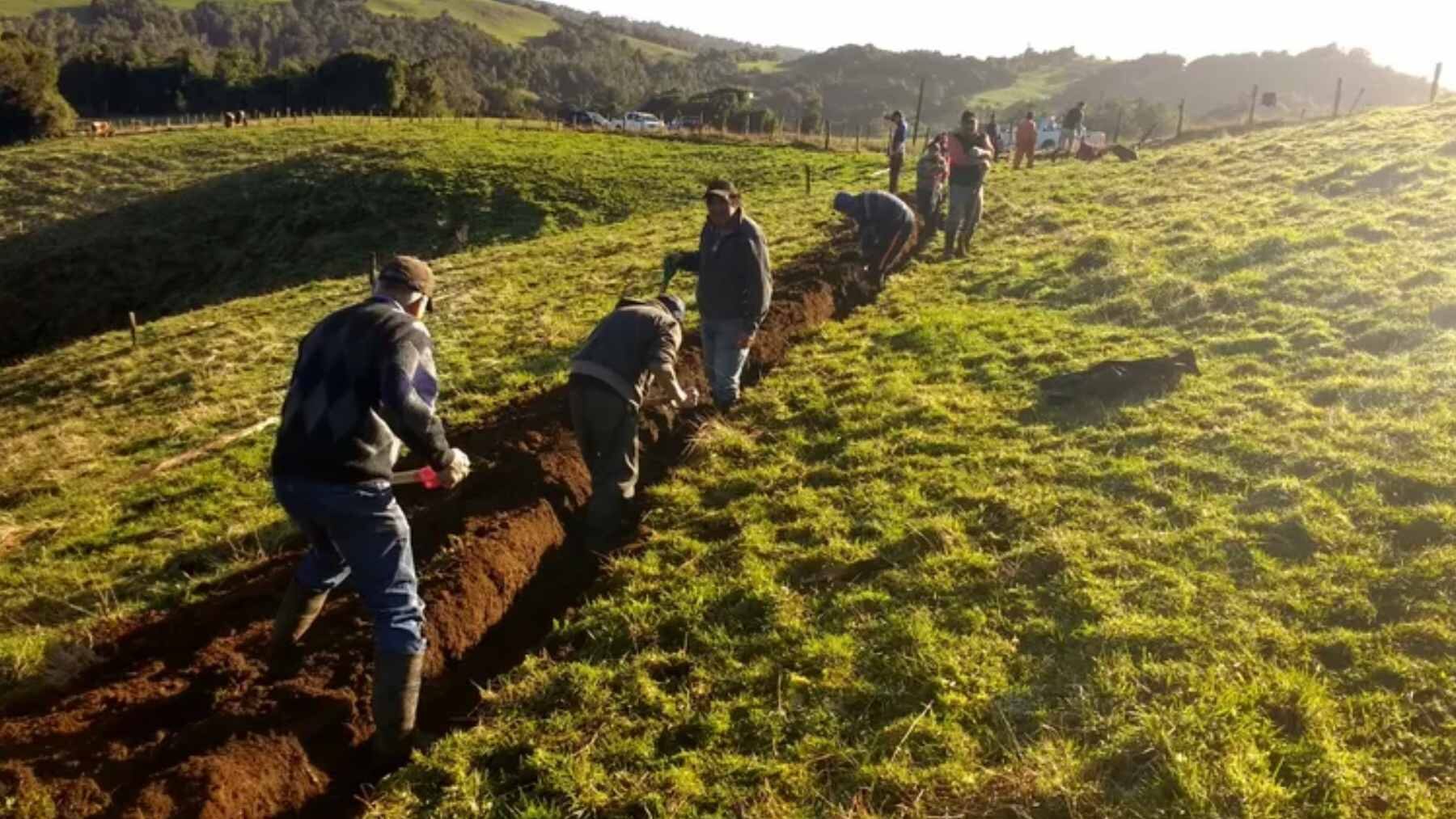
More than 500 native trees, including ulmo, coihue, canelo, luma, and arrayán, were planted around degraded land and an old spring. Small infiltration trenches on slopes slowed runoff so more rain could soak into soil and vegetation instead of racing downhill.
A network powered by gravity
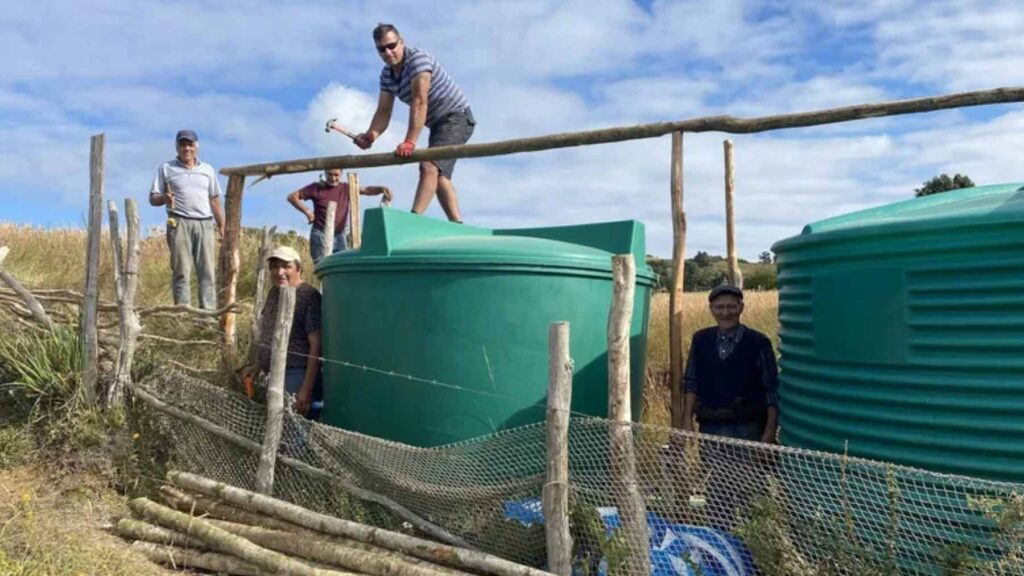
Water enters at an intake, passes through filters, and moves into a storage system holding about 6,600 gal. before reaching homes by gravity. That reduces the need for pumps and electricity, which matters in a dispersed rural community where another monthly bill can become a real barrier.
At the lowest measured late-summer flow, the source supplied about 6.3 gal. per minute, or roughly 9,100 gal. a day. The network’s estimated peak demand was about 2,640 gal. daily for 14 families and the civic center, leaving much of the flow in the stream for the ecosystem downstream.
A wetland protects the source
The team also built a constructed wetland near a home and small cheese-making operation upstream of the intake. Plants and microorganisms help clean household wastewater so it can be reused for irrigation or allowed to infiltrate, rather than carrying pollution toward the community’s water.
That detail matters. A community can capture more water and still lose the battle if sewage, livestock, or graywater contaminates the source. Catrumán’s approach linked water quantity with water quality, not one or the other.
People built the system
Residents did much of the work through “mingas,” traditional collective work gatherings, and were trained to maintain pipes, filters, and restoration areas. They also created a local organization to collect fees, manage repairs, and coordinate with agencies and landowners.
“Before, we lived with a lot of uncertainty. Today, we have a system that works,” community leader Galicia Mansilla said. Researcher Cristián Frêne described the turning point just as plainly, saying, “We could not normalize the water truck model.”
Why the system lasted
Planting trees alone would not have ended tanker truck dependence. The project combined ecological repair with filters, storage, pipes, monitoring, legal water access, property agreements, public funding, and a maintenance plan. Effectively, nature-based did not mean infrastructure-free.
A June 2026 update from the Institute of Ecology and Biodiversity says the network has been operating for nearly seven years. That longevity is the real test, since many pilot projects look promising at the ribbon-cutting and struggle once outside experts leave.
A guide for other rural communities
The experience has now been turned into a manual called “Water Management in Rural Areas, Experience in Catrumán, a Community in Southern Chile.” It organizes more than a decade of learning into four stages, “understand, diagnose, plan, and implement,” and its launch in Ancud drew 200 participants.
Could the model work everywhere? Not as a copy-and-paste design, since each watershed, landowner network, water source, and health requirement is different. But the sequence is broadly useful, starting with the land, measuring the water, protecting the source, designing the pipes, and leaving local people with the skills and authority to keep it running.
Water security starts uphill
Catrumán’s biggest achievement is not that nature replaced engineering. It is that forest, soil, wetland, pipes, and neighbors were treated as one system. For rural communities facing dry taps and the rumble of another tanker truck, that may be the most practical lesson of all.
The official statement was published on Instituto de Ecología y Biodiversidad’s website.