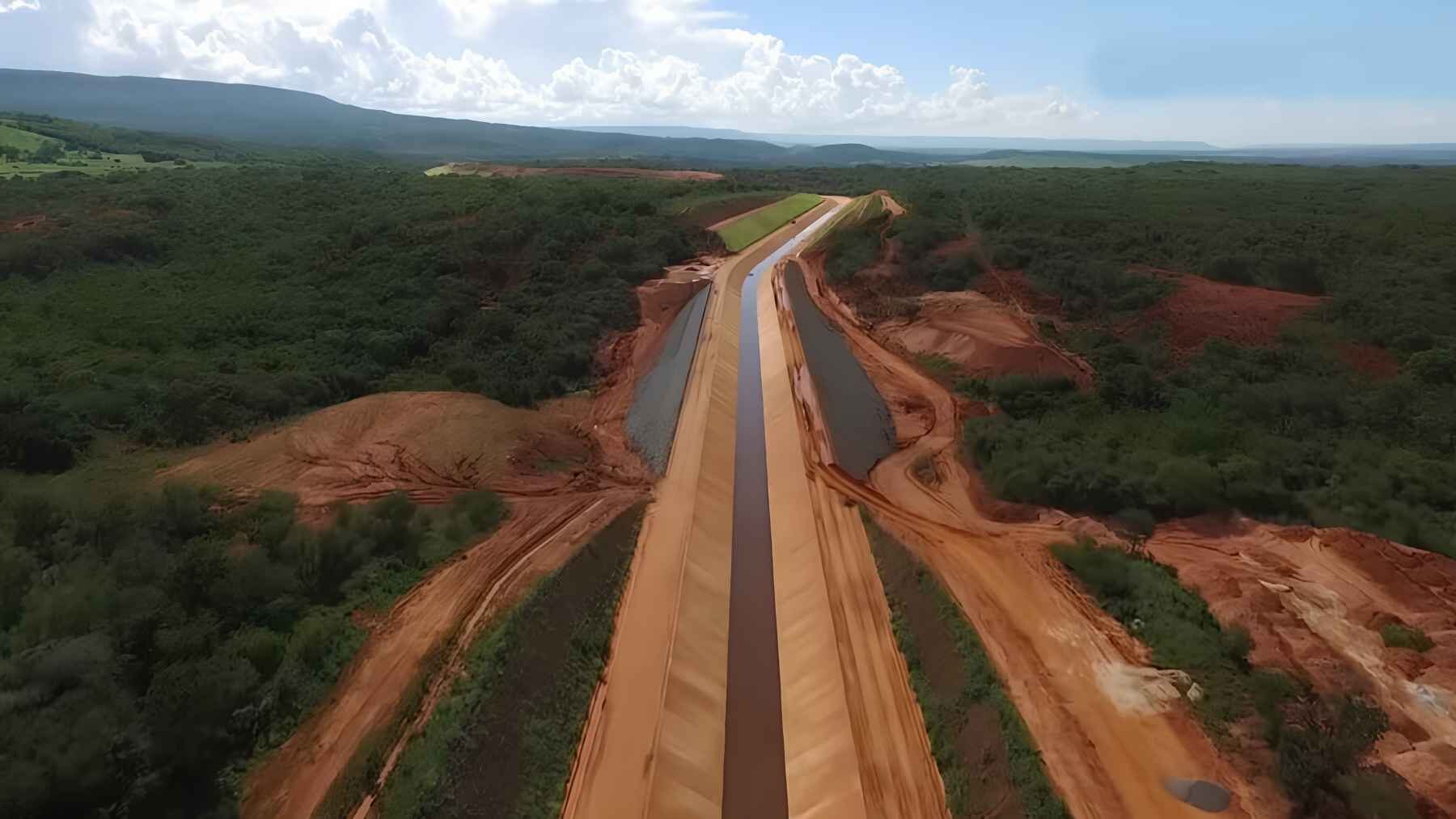
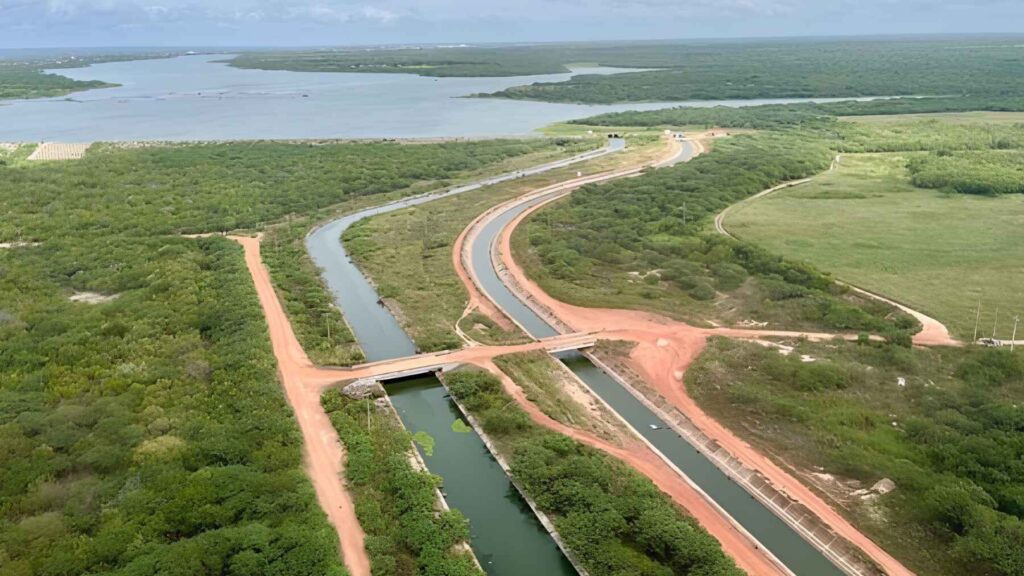
In Brazil’s northeast, water can decide whether a crop survives, a reservoir holds, or a family has enough for ordinary daily life. That is why Ceará’s Water Belt has drawn so much attention: it is a nearly 90-mile hydraulic corridor often described as an artificial river, built to move water through one of the driest parts of the region.
The project has not created new water. It is trying to move existing water more reliably from the São Francisco River integration system into Ceará’s interior, where long dry spells have shaped daily life for generations. A December 2025 state update said the work had reached 91 percent and was expected in June 2026, while a newer July 2026 federal update put it at 92 percent and moved full delivery to 2027.
A river built by engineers
The official name is Cinturão das Águas do Ceará, or Water Belt of Ceará. The Secretariat of Water Resources of Ceará describes it as a system of open-air canals, tunnels, and siphons running about 90 miles from Jati Dam, on the northern axis of the São Francisco Integration Project, toward the headwaters of the Cariús River in Nova Olinda.
A siphon, in this case, is not a kitchen gadget or a straw trick. It is part of the hydraulic structure that helps water cross difficult terrain, including low areas and obstacles, while keeping the flow moving along the route.
The planned capacity is about 1,060 cubic feet per second, or roughly 476,000 gallons per minute, although real operation depends on water availability and management rules. That number helps explain why the project is often described as one of Brazil’s largest state water-transfer works.
Why Ceará needs it
The sertão, Brazil’s dry inland backcountry, has always lived with rainfall that can be late, uneven, or missing for too long. In practical terms, that means stressed reservoirs, anxious farmers, and towns watching water levels the way people watch the electric bill.
Ceará is especially vulnerable because many communities depend on reservoirs, aquifers, and emergency supply systems when drought tightens. The Cariri and Alto Jaguaribe regions are central to the plan, while Fortaleza’s wider water security is also part of the long-term picture.
The project is meant to strengthen supply for homes first, then other uses such as industry, tourism, animals, and irrigated farming. That ordering matters, because in a dry year the question is not just whether water exists somewhere, but who receives it, when, and under what rules.
What changed in 2026
The most recent official update does not describe a finished project. It describes a major step forward, with a section delivered in Barbalha and water available up to about the 62-mile mark.
The federal ministry said the Water Belt is divided into five lots. Lots 1, 2, and 5 are complete, about 9 miles of lot 3 were inaugurated on July 1, 2026, and lot 4 had reached 75 percent completion.
Giuseppe Vieira, Brazil’s national secretary for water security, said the latest stage showed that “the water is already here.” Now comes the quieter but crucial work of connecting distribution networks so that the water can actually reach homes and communities.
Not a magic fix
The phrase “artificial river” sounds simple, almost like turning on a tap. But the system depends on enough water in source basins, good-quality water, clear operating rules, maintenance, and fair distribution once the flow reaches the canals.
A 2017 study in Water Alternatives by Philippe Roman of IHEAL-CREDA described the wider São Francisco transfer as one of Brazil’s biggest hydraulic infrastructure projects and a long-running social and political controversy. In other words, these projects are never just concrete and water.
That is where the hard part begins. A channel can move water, but it cannot, by itself, solve leaks, sanitation gaps, wasteful use, or disputes among farms, cities, and industry.
What the artificial river can do
If it works as planned, the Water Belt could make Ceará less exposed to dry years by linking reservoirs and supply systems more effectively. For families, that could mean fewer emergency measures and more predictable taps, especially in places where drought is not an abstract climate story but part of ordinary life.
For agriculture, the gain is more complicated. More reliable water can protect crops and animals, but it can also increase pressure to expand irrigated farming.
That is why experts usually watch not only flow rates, but also governance, environmental monitoring, and whether smaller communities actually get access. The project’s most immediate value may be stability, not endless water, not a cure-all, but a better chance to act before scarcity turns into crisis.
The bigger question
Large water projects can change maps, budgets, and political expectations. They also change daily routines, from the sound of pumps near a canal to the hope that a town will not need emergency water trucks again.
Researchers keep warning that water security is not only a matter of pipes and concrete. A 2024 article in Land by Jaqueline Guimarães Santos of the Federal University of Paraíba and Antonio A. R. Ioris of Cardiff University argued that large water projects in Brazil’s Northeast can reshape land, power, and access to water, especially for vulnerable rural communities.
That is the less flashy side of Ceará’s artificial river. Building the channel is one challenge. Making sure the water reaches the people who need it most is another.
What happens next
With the project at 92 percent, the story is no longer just about whether Ceará can build a 90-mile hydraulic corridor. The next test is whether it can connect that corridor to local distribution networks, reduce losses, and manage water fairly through wet years and dry ones.
At the end of the day, the Water Belt is a compass for Ceará’s drought policy, not the whole map. It points toward greater security, but the state will still need conservation, watershed protection, sanitation, and careful monitoring to make the investment count.
The official update has been published by Brazil’s Ministry of Integration and Regional Development.