When summer turns hot and dry in the Colorado River’s headwaters, plants do not always “shut down” to save water. A Princeton-led study suggests vegetation can keep evapotranspiration high by tapping shallow groundwater, leaving less water to reach streams during the toughest part of the season.
That matters because the Colorado River is already under pressure. About one in ten people in the United States relies on the river for drinking water, often far from the channel itself. If heat makes plants pull harder on groundwater near streams, forecasts that focus mainly on snowpack can miss a key part of the water budget.
The hidden water draw in mountain watersheds
In their under-review preprint, the researchers note that roughly 1.4 billion people depend on snowmelt-driven mountain watersheds. They also point to the Colorado River as a case where headwaters dynamics shape water security for tens of millions of people.
For the Colorado River system, the mountain source matters because most of its flow begins in the Upper Colorado River Basin headwaters. The preprint says those headwaters supply over 90% of the river’s total flow, which is why small changes upstream can ripple downstream.
Warming adds another layer. The United States Geological Survey reports that Upper Colorado River Basin temperatures have risen about 2.5 degrees Fahrenheit over the last century, which increases atmospheric demand for water. If water is available, that demand can drive more evapotranspiration.
The “drought paradox” in plain language
Evapotranspiration is water leaving the landscape in two main ways. Some water evaporates from soil and water surfaces, and plants release water vapor through leaves as they transpire.
The old assumption was simple. When soils dry out, plants should close their pores and transpiration should drop, keeping streamflow from falling as sharply. But recent research has documented the “drought paradox,” where transpiration stays steady or even increases during dry periods.
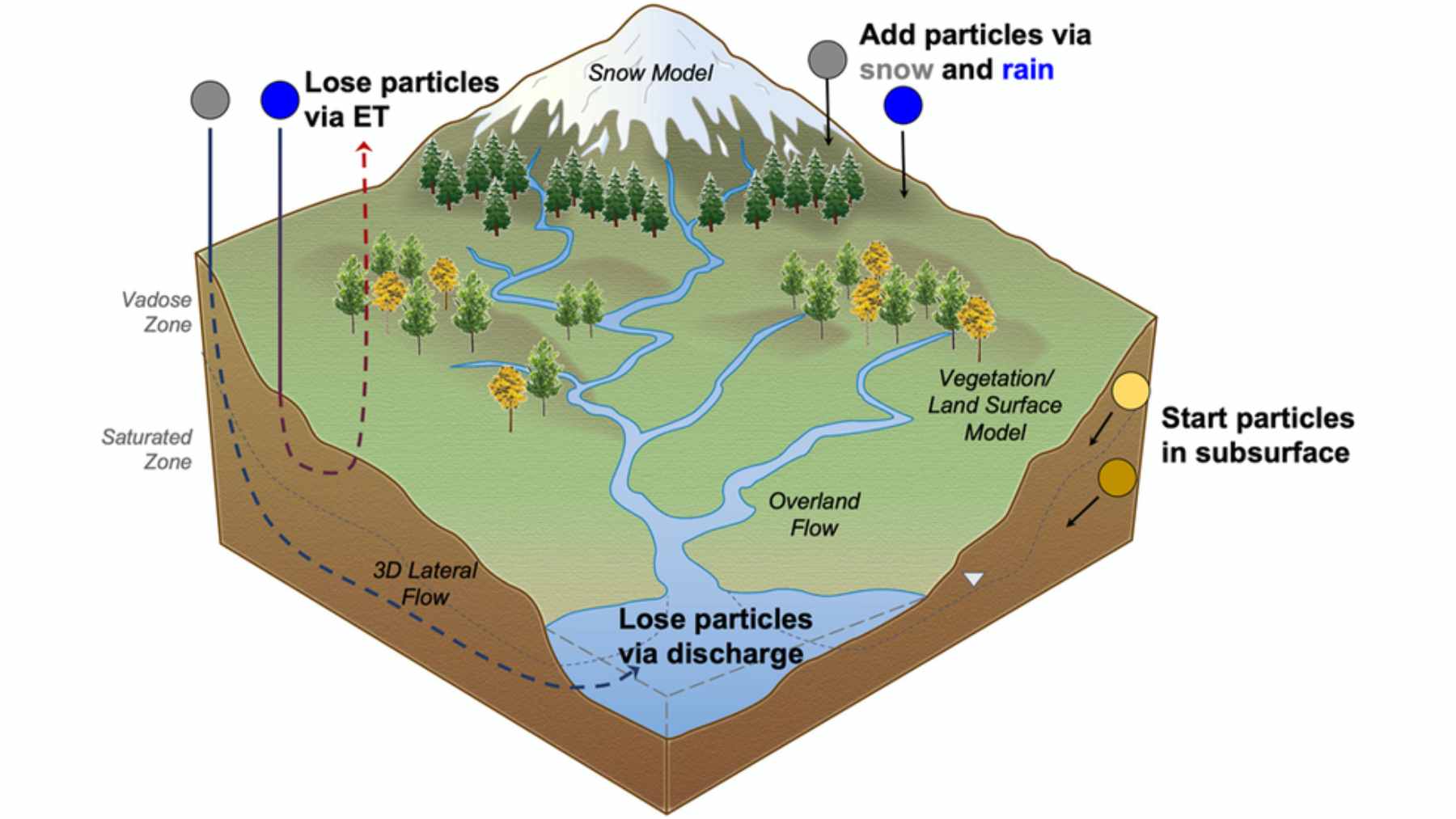
So where does the water come from when the surface is parched? The new analysis argues that groundwater near streams can act like a backup tank, sustaining plant water use while reducing the groundwater that would otherwise feed late-summer streamflow.
What a 200-acre test basin revealed
To pin down the mechanism, the team instrumented an 81-hectare catchment (about 200 acres) in Colorado’s East River watershed near Mt. Crested Butte. The site spans roughly 1,350 feet of vertical relief, from about 9,700 to 11,000 feet above sea level.
They used a dense mix of sensors to track water moving from snow to soil, groundwater, and streamflow. The preprint describes hydrologic monitoring paired with three eddy flux towers that measured evapotranspiration, plus sap flow sensors on trees that showed similar patterns.
The year-to-year contrast is part of the proof. The paper describes 2023 as a high-snowpack year followed by a hot, dry summer, while 2024 had moderate snowpack and a cool, wet summer.
When summer heat rivals snowpack
In the dry season, soil moisture dropped toward extreme lows, yet evapotranspiration stayed elevated. In fact, the authors report that evapotranspiration did not fall below 25% of “potential” levels even under the driest conditions, which points to plants shifting to alternative water sources.
Then the team zoomed out to the basin scale. Using 625 “gage-years” of late-summer flow data from 18 minimally impacted headwater catchments across four decades, they tested whether summer temperature affects streamflow even after accounting for peak snowpack.
Their numbers show why this is not a small tweak. The snowiest third of years produced about 50% more late-summer flow than average, but the warmest third produced only about 80% of the median flow, while the coolest third exceeded about 118%. Put plainly, a warm summer can pull a “great snow year” down toward average streamflow.
Why Colorado River planning feels the squeeze
Water planning in the West often starts with snow surveys and runoff forecasts. The preprint argues that growing-season temperature can quietly change the output by driving plants to intercept groundwater that would otherwise sustain streams.
The stakes are huge in the Colorado River Basin. Public agencies estimate that nearly 40 million people in seven states depend on the Colorado River system, and the river irrigates about 5.5 million acres of farmland.
The study also flags a modeling risk that water managers care about. It warns that models that ignore this vegetation-groundwater pathway may underestimate summer flow declines and overestimate supply, including in years with substantial snowpack.
It is an ecology story, too
It is tempting to frame this as “plants versus people,” but mountain ecosystems are part of the water system, not an add-on. Forests, meadows, and riparian vegetation stabilize soils, influence water quality, and support wildlife, even as they use water.
Still, reduced late-summer flows can tighten ecological bottlenecks. Lower flow often means warmer water and less habitat space when fish and aquatic insects are already stressed by heat and low oxygen.
There is also a human echo. Late summer is when irrigation demand stays high and when many households feel that spike in outdoor watering, so the timing of these losses matters as much as the total.
Better forecasts may save water
The authors emphasize a practical point that is easy to overlook. Mountain hydrology is hard to observe directly, and sparse measurements can hide important pathways, which is why dense sensor networks can shift what models assume is happening.
Over time, better representation of evapotranspiration and groundwater could improve seasonal forecasts and long-term planning. That may sound abstract, but in a basin where every acre-foot counts, better numbers can translate into smarter, earlier conservation choices.
This is an “under review” preprint, so the results may change as it goes through peer review, but the mechanism it highlights is physically plausible and testable.
The original preprint was published on Research Square.