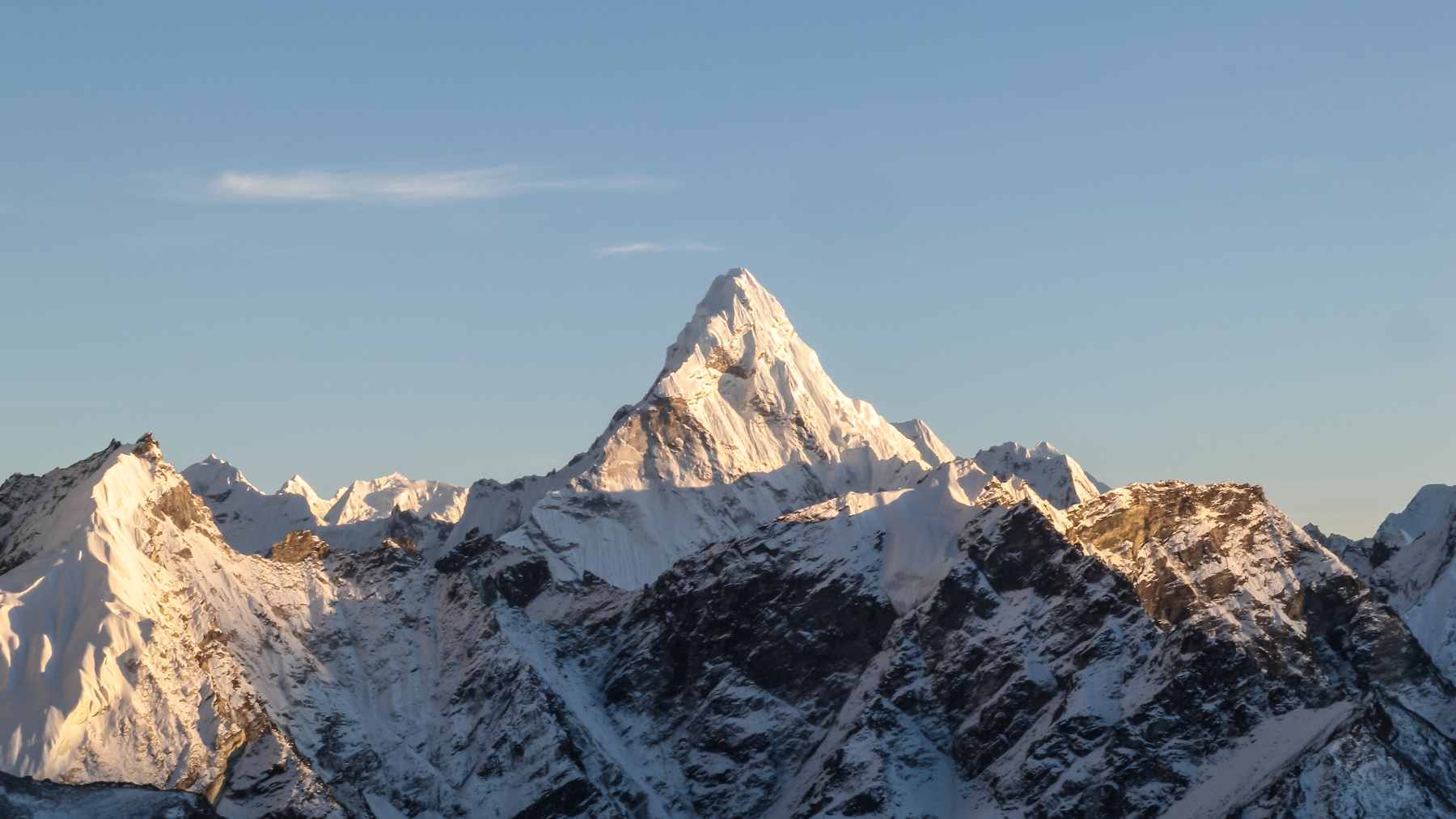
Mount Everest still holds the title most of us learned in school. At 29,031.69 feet above sea level, it is the highest mountain on Earth when measured from the ocean’s average surface, but there is another way to measure a mountain, and it changes the winner.
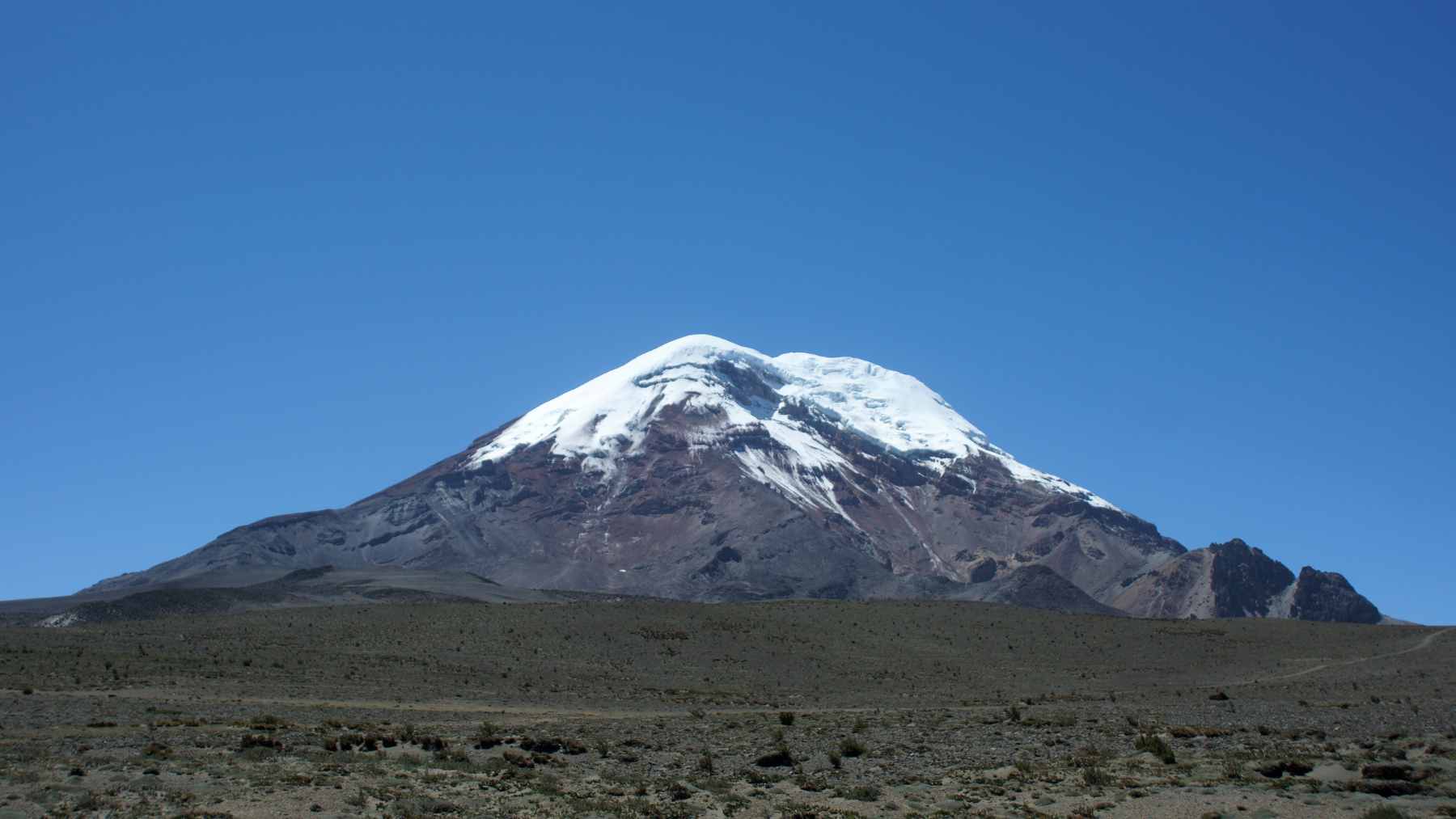
Ecuador’s Chimborazo, an inactive volcano in the Andes, rises only about 20,564 feet above sea level, yet its summit sits farther from Earth’s center than Everest’s summit does. In that very specific sense, Chimborazo is the closest piece of land to outer space.
Everest is highest, but not farthest out
Nepal and China jointly announced Everest’s official height in 2020 as 29,031.69 feet. That measurement settled a long-running disagreement over the mountain’s elevation and confirmed Everest’s place as the highest point above mean sea level.
Chimborazo is much shorter by that familiar standard. Its summit is roughly 8,465 feet lower than Everest’s when both are measured from sea level.
So why does Chimborazo win the other contest? The answer is not really about the mountain. It is about the planet underneath it.
Earth is not a perfect sphere
Earth looks round from space, but it is not a perfect ball. Because the planet spins, it bulges around the equator and is slightly flattened near the poles.
That bulge matters. NOAA’s National Ocean Service explains that Chimborazo sits just south of the equator, where Earth’s middle is thickest. Everest, on the other hand, is nearly 28 degrees north of the equator.
Chimborazo starts from a better launchpad. The ground near the equator is already farther from Earth’s center before the volcano adds its own height.
The numbers flip the story
Measured from Earth’s center, Chimborazo’s summit is about 3,967 miles away. Everest’s summit is about 3,966 miles from the center.
That difference is small, but real. Chimborazo reaches about 1.3 miles farther from Earth’s center than Everest, despite being far lower above sea level.
NOAA puts the same idea in plain terms. Chimborazo’s summit is more than 6,800 feet farther from Earth’s center than Everest’s peak, making it the farthest point on Earth’s surface from the planet’s core.
What “closer to space” really means
Here is where the wording gets tricky. Saying Chimborazo is “closer to space” is true only if we are talking about distance from Earth’s center.
If space is measured by altitude above sea level, Everest is still closer. It rises higher into the atmosphere and stands about 5.5 miles above the ocean’s average surface.
However, if the question is which point of land sticks farthest outward from the middle of the planet, Chimborazo wins. Same Earth. Different ruler.
Not closer to the Sun
Some versions of this fact go a little too far. Chimborazo is not meaningfully “closer to the Sun” than Everest in any useful everyday sense.
Earth’s distance from the Sun changes by about 3.1 million miles during the year because our orbit is not a perfect circle. Compared with that, a difference of about 1.3 miles between two mountain summits is tiny.
The Sun also moves across the sky as Earth rotates. No single fixed mountain can honestly claim to be closest to it all the time.
A discovery rooted in old science
The reason Chimborazo holds this title goes back to one of the great scientific puzzles of the 18th century. Researchers wanted to know whether Earth was stretched at the poles or flattened there.
The French Geodesic Mission worked near Chimborazo in the 1730s and 1740s to measure a degree of latitude close to the equator. Comparing that result with measurements taken farther north helped confirm that Earth is an oblate spheroid, meaning wider at the equator than from pole to pole.
It is a neat twist. The same region used to prove Earth’s bulge is now home to the summit that benefits most from it.
Chimborazo’s quiet claim to fame
Many believed Chimborazo was the world’s highest mountain. Alexander von Humboldt tried to climb it in 1802, when that belief still had power.
Today, we know Everest is higher above sea level. We also know Mauna Kea in Hawaii is taller than Everest if measured from its underwater base to summit, rising more than 33,500 feet from the Pacific seafloor.
That is the point. “Highest,” “tallest,” and “farthest from Earth’s center” are not the same thing. One mountain can win one category and lose another.
A small fact with a bigger lesson
At first glance, the Chimborazo fact feels like trivia. It is the kind of thing you might bring up on a hike, in a classroom, or while staring at a globe on a desk.
But it also shows why precision matters in science. A simple question like “What is Earth’s highest point?” depends on what we mean by “highest.”
Everest remains the king of altitude. Chimborazo, thanks to Earth’s swollen equator, holds the stranger title. It is the place where solid ground reaches farthest from the center of our planet.
The official explanation was published on NOAA’s National Ocean Service.