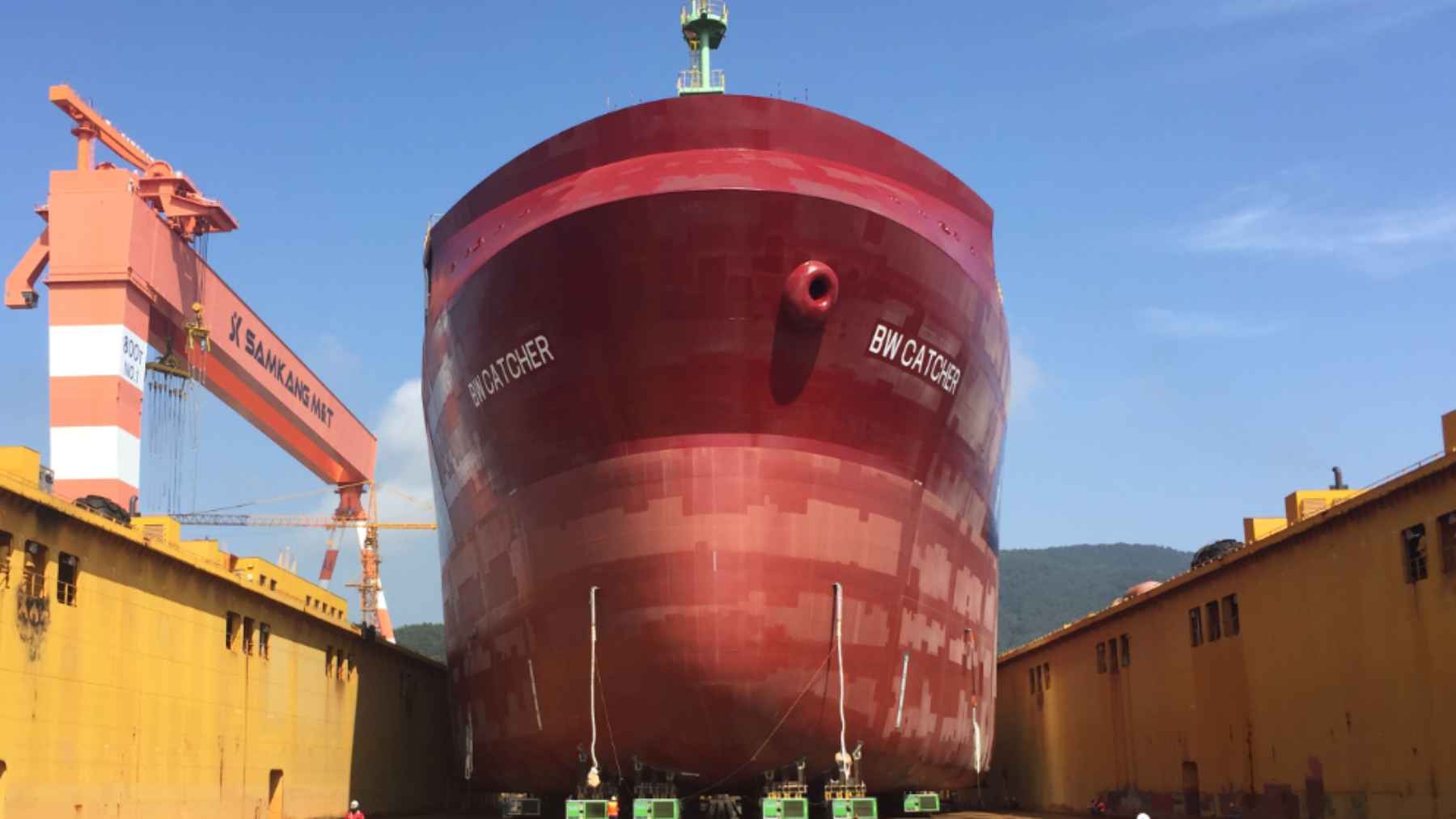
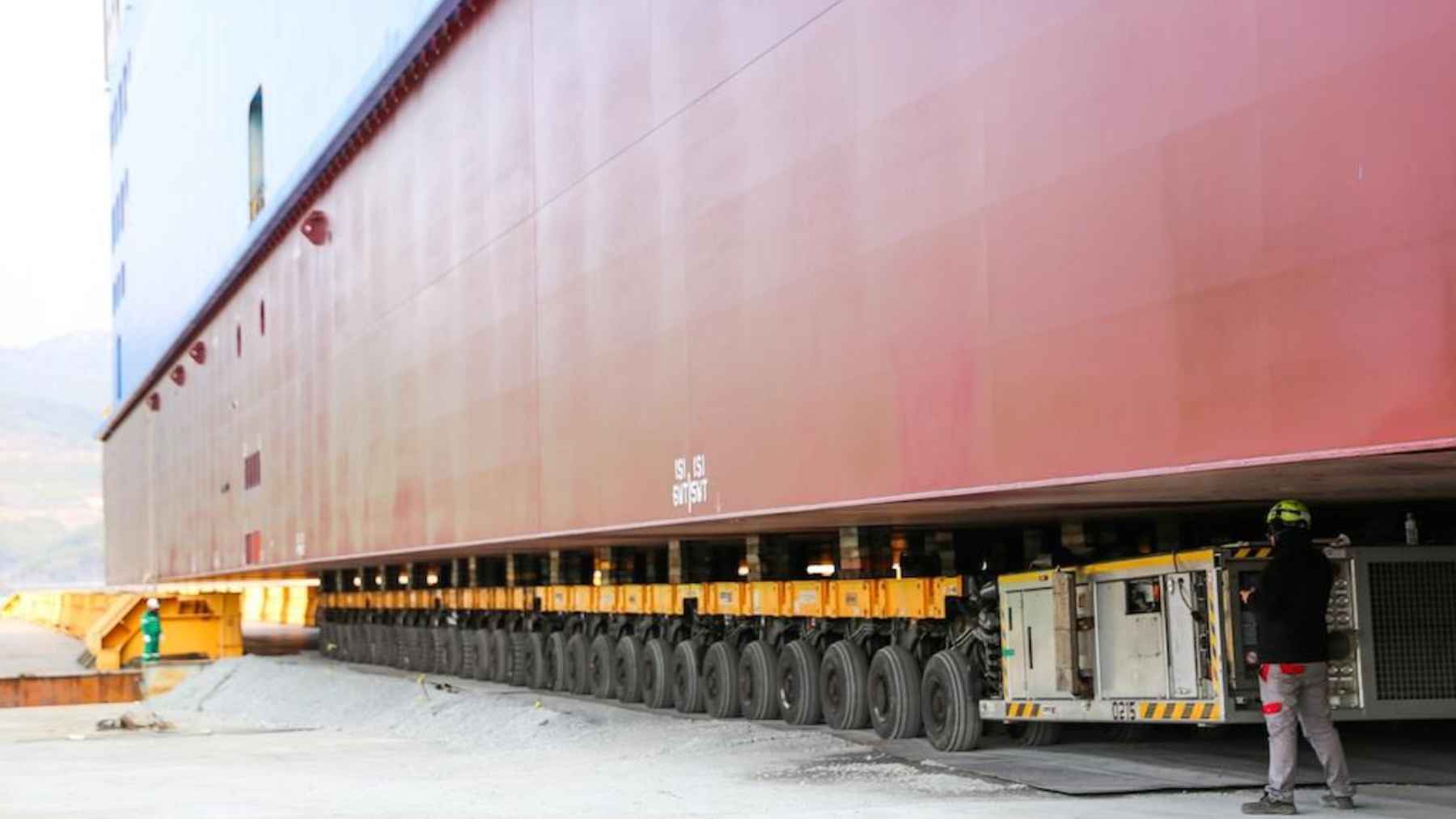
In South Korea, KCTC moved a single naval block weighing 16,263.71 U.S. tons across land on a self-propelled modular transporter, or SPMT, with 324 axles. The operation took place in Goseong on June 23, 2016, and Guinness World Records lists it as the heaviest load moved by self-propelled modular trailers.
At first glance, it sounds like a pure engineering story, but it also opens a window into the hidden machinery behind modern shipbuilding, where giant pieces of vessels are assembled, moved, floated, and shipped across the world. In an era when maritime transport is under pressure to cut greenhouse-gas emissions, even the way ships are built and moved is getting more attention.
A record on wheels
KCTC Co., Ltd. achieved the record with a naval block that weighed 14,754.19 metric tons, equal to 16,263.71 U.S. tons. To picture that, think less about a truck and more about a slow-moving industrial platform carrying a section of a future ship.
The block itself was enormous. Guinness lists its dimensions as 110.5 meters long, 50 meters wide, and 40 meters high, which is about 363 feet long, 164 feet wide, and 131 feet high. That is taller than many apartment buildings and wider than a city street.
The record surpassed an earlier Guinness mark held by Lamprell, which stood at 13,191.98 tonnes, or about 14,541.76 U.S. tons, according to the background material provided.
How the move worked
The key machine was a 324-axle SPMT. These transporters are designed for loads that ordinary trucks could never touch, with multiple axle lines spreading weight across a large footprint and allowing careful steering at very low speed.
No traffic jam you have ever sat in compares to this kind of movement. Every turn, stop, surface condition, and weight shift has to be controlled because the cargo is not just heavy – it is also tall, wide, and structurally complex.
KCTC’s official heavy cargo page describes its work with oversized cargoes such as power generation equipment, chemical equipment, and ship blocks. The company says it uses specialized equipment and professionals to move cargo from manufacturing sites to final destinations in Korea and overseas.
From shipyard to floating dock
The operation began at the Samkang MNT shipyard in Goseong. From there, the SPMT carried the naval block to the dock, turning a piece of shipbuilding work into a carefully staged logistics operation.
After that, the same transport system rolled the block onto a floating dock with a reported deadweight capacity of 80,000 tonnes, or about 88,185 U.S. tons. That step mattered because the load then had to shift from land-based movement to water-based transport.
Was it fast? Almost certainly not. With cargo this large, speed is not the point. Control is.
Out into Jinhae Bay
Once the block was on the floating dock, the next stage moved toward Jinhae Bay with help from a tugboat. Crews then used the dock’s ballast system to launch the naval block into the water.
From there, crews transferred the block by flotation to a nearby semi-submersible vessel. That ship then carried the structure by sea toward Singapore, completing a chain that started inside a Korean shipyard and ended as an international maritime shipment.
That sequence is easy to overlook. IUltimately, this record was not only about one giant trailer. It was about land transport, dock engineering, ballast control, tugboat support, and ocean shipping all working together.
Why SPMTs matter
Self-propelled modular transporters are one of those technologies most people never see, but modern infrastructure quietly depends on them. They help move bridge sections, refinery modules, power-plant components, offshore structures, and ship blocks that would be impossible to transport in one piece by conventional means.
There is a simple reason industries use them. Moving a giant section as one unit can reduce the need to break it apart, reassemble it, and handle it repeatedly. That does not make the process simple, but it can make certain megaprojects possible.
Still, bigger is not automatically better. These operations require planning, reinforced routes, safety controls, specialized labor, and, often, a mix of land and marine equipment. The record shows what is technically possible, not what should be done casually.
The climate question
The environmental angle is not that a 16,263-ton ship-block move is “green” by itself. The public Guinness record does not provide fuel use, emissions, or a life-cycle assessment for the operation. That matters because big industrial logistics can carry a real environmental footprint.
At the same time, the broader shipping sector is being pushed toward cleaner operations. The International Maritime Organization adopted a 2023 strategy aiming for net-zero greenhouse gas emissions from international shipping by or around 2050.
The United Nations Conference on Trade and Development (UNCTAD) has also warned that shipping carries more than 80% of world trade volume and accounts for nearly 3% of global greenhouse-gas emissions. That is why the hidden systems behind ships, ports, and heavy cargo movement deserve more attention than they usually get.
A heavy lesson from Korea
KCTC’s record remains a striking example of how far heavy transport technology has advanced. A load that would once have seemed almost immovable was carried across land, rolled onto a floating dock, launched, transferred, and sent overseas.
There is something almost unreal about it. A block the size of a building moved not by magic, but by axles, hydraulics, planning, and patience.
For the public, the story is a reminder that global shipping begins long before a finished vessel reaches the sea. It starts in shipyards, on docks, and sometimes on hundreds of tiny wheels moving one impossible load a few feet at a time.
The official record was published in Guinness World Records.