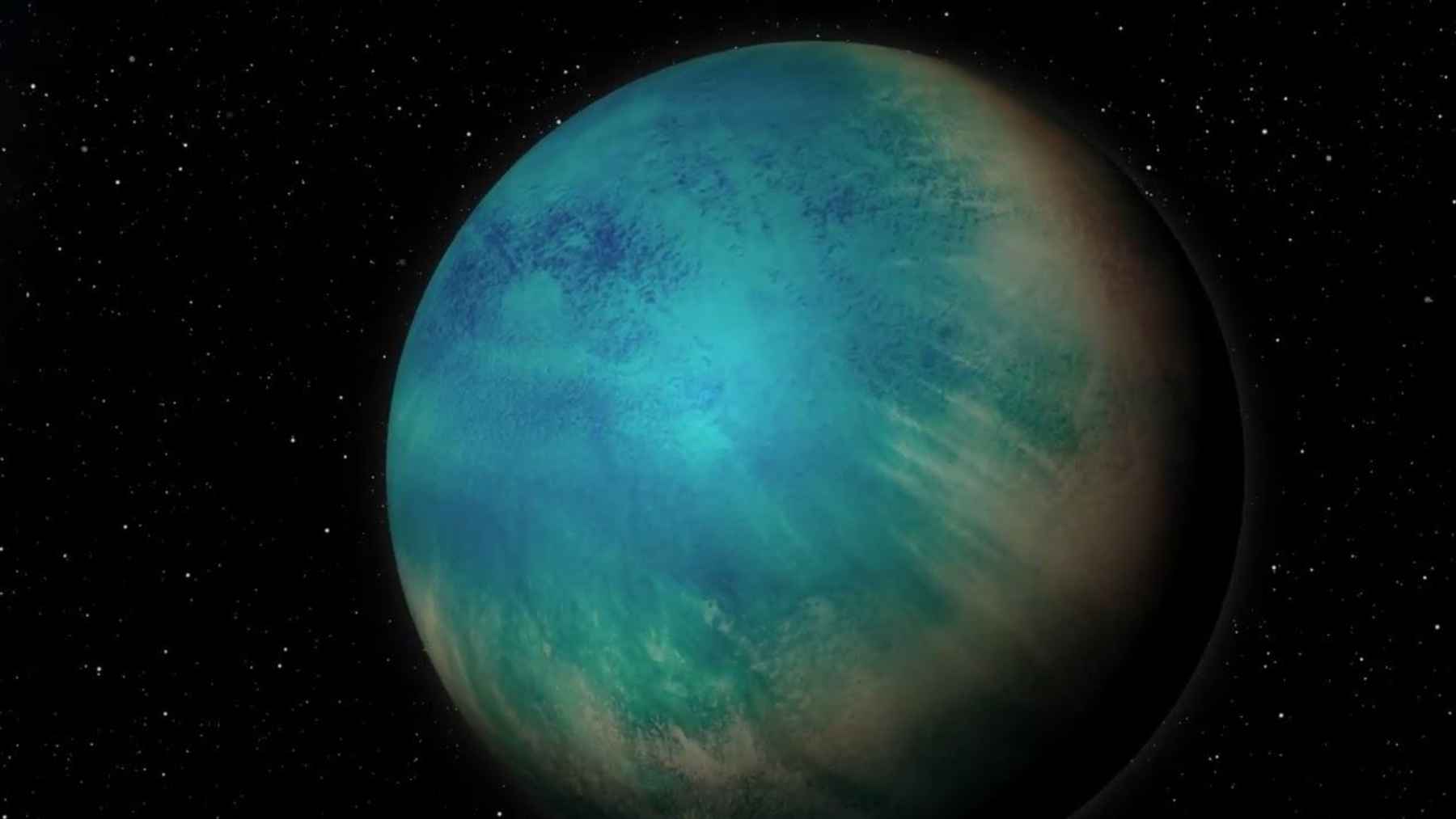
Imagine a planet where every horizon is water. No coastlines, no deserts, no mountains rising above the waves – just a global ocean wrapped around a world larger than Earth. That is the strange possibility surrounding TOI-1452 b, a super-Earth about 100 light-years away in the constellation Draco.
Astronomers say the planet is about 70% larger than Earth and roughly five times as massive, but its density is the detail that has everyone paying attention. It could be a rocky planet covered by an extremely deep ocean, although NASA cautions that other explanations are still possible, including a huge rock with little atmosphere or a rocky world wrapped in hydrogen and helium.
A planet that almost fooled TESS
The first clue came from NASA’s Transiting Exoplanet Survey Satellite, better known as TESS. The telescope noticed a tiny dip in starlight every 11 days, the kind of signal that can reveal a planet passing in front of its star from our point of view.
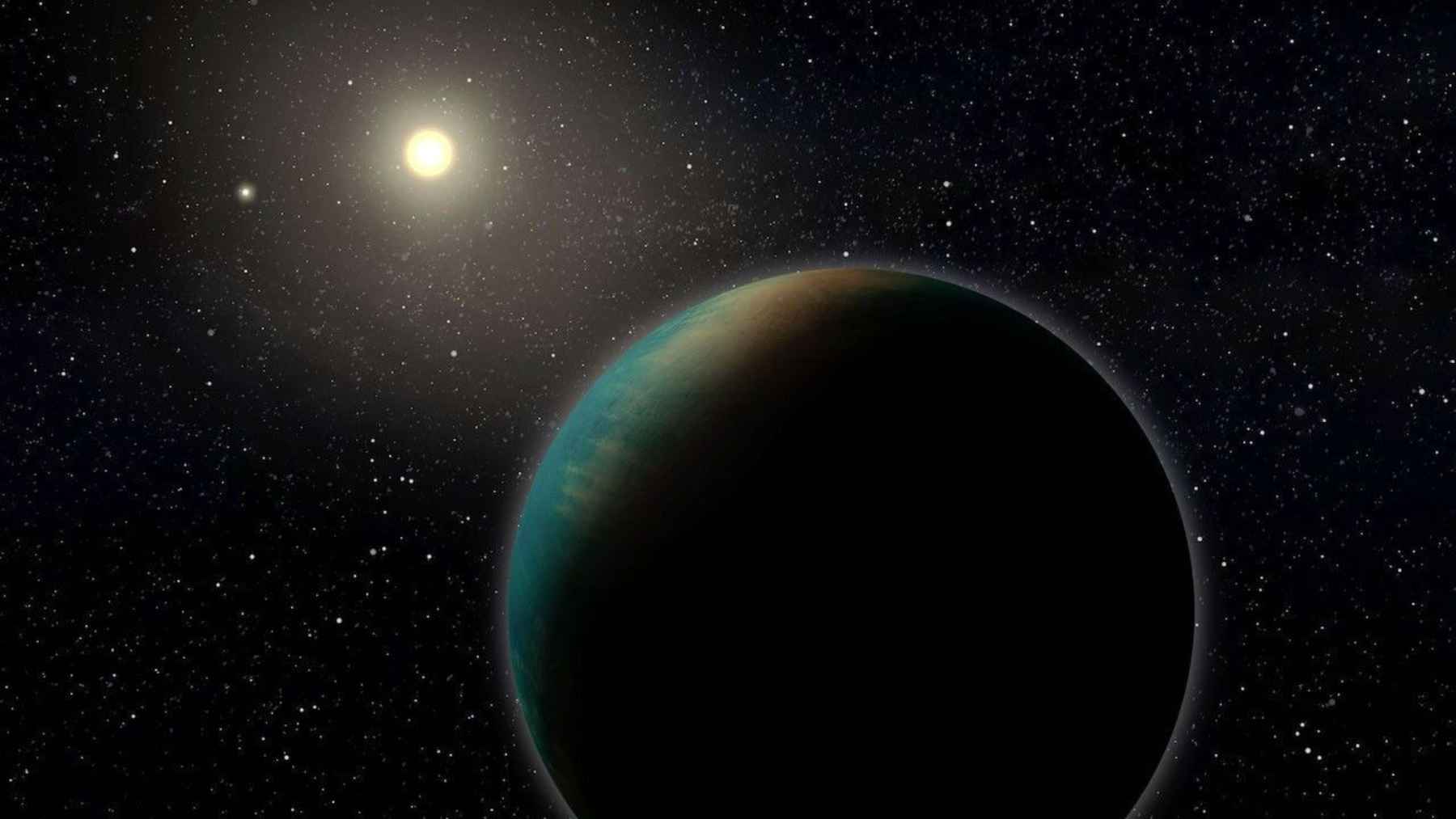
That signal was not simple to confirm. TOI-1452 b orbits one of two small red-dwarf stars in a binary system, and the pair is close enough that TESS saw them as one point of light. Ground observations from the Observatoire du Mont-Mégantic helped separate the two stars and confirm that the planet was circling TOI-1452.
Why scientists see water
Here is the simple version. Earth is called the Blue Planet because oceans cover about 70% of its surface, but water makes up less than 1% of Earth’s total mass. On TOI-1452 b, modeling suggests water could make up as much as 30% of the planet’s mass.
That is why researchers are taking the ocean-world idea seriously. “TOI-1452 b is one of the best candidates for an ocean planet that we have found to date,” said Charles Cadieux, who led the discovery team as a Ph.D. student at the Université de Montréal.
Still, best candidate does not mean confirmed. The official study describes TOI-1452 b as consistent with a rocky core surrounded by a volatile-rich envelope, and NASA’s own explanation says more follow-up is needed. This means the planet is promising, not proven.
An ocean unlike Earth’s
If TOI-1452 b really is water-rich, its ocean would not be like the Atlantic or Pacific. We are talking about a planet-sized layer of water that could be vastly deeper than anything on Earth, more like a hidden planetary engine than a familiar sea. No beach day there.
At those depths, pressure changes everything. Research on water-rich worlds shows that enormous pressure can freeze water from below into dense high-pressure ice, even when upper layers remain liquid. That ice could separate the ocean from the rocky interior, raising a big question for habitability.
Why does that matter? On Earth, water, rock, heat, and chemistry constantly interact, helping move nutrients through oceans and the crust. Experts warn that high-pressure ice could limit that exchange, although newer work suggests salty ice may still allow some chemical transport.
The red dwarf problem
TOI-1452 b sits very close to its star. NASA’s catalog lists its orbital distance as 0.061 astronomical units, which is roughly 5.7 million miles, and its year lasts only 11.1 Earth days. Around our Sun, that would sound scorching. Around a cooler red dwarf, the picture is more complicated.
That is where the mystery deepens. The host star is much smaller and cooler than the Sun, so a close orbit does not automatically rule out liquid water.
Red-dwarf planets, however, can face challenges, including strong stellar activity and possible tidal locking, where one side keeps facing the star. Scientists still need atmospheric data before they can say what the climate is really like.
Why Webb could change the story
TOI-1452 b is especially interesting because it is close enough, by cosmic standards, for future atmospheric study. NASA says its relatively bright star could allow the James Webb Space Telescope to capture a spectrum of starlight filtered through the planet’s atmosphere, a chemical fingerprint of what surrounds it.
That matters because an atmosphere could make or break the ocean-world idea. Water vapor, clouds, hydrogen, carbon-bearing gases, or the lack of certain signals could all help scientists narrow the possibilities. At the end of the day, the planet’s air may tell us whether the ocean story holds up.
Water is not the same as life
Liquid water is one of the key ingredients for life as we know it, but it is not a magic switch. A world can have water and still lack the chemistry, energy flow, or long-term stability needed for living systems. That is the nuance that often gets lost when a planet is called “habitable.”
Even so, TOI-1452 b expands the map of where scientists should look. It may be unlike anything in our solar system, even though watery moons such as Ganymede, Callisto, Titan, and Enceladus offer useful comparisons. A planet with no dry land would be strange, but the universe has never promised familiar scenery.
For now, TOI-1452 b remains a compelling candidate rather than a confirmed alien ocean, but that is exactly what makes it exciting. The next round of observations could help reveal whether this distant super-Earth is a giant rock, a world wrapped in gas, or one of the clearest examples yet of a planet covered by water.
The study was published in The Astronomical Journal.