Is water ice really common around other stars, or is our solar system a lucky exception? Thanks to the James Webb Space Telescope, astronomers now have one of their clearest answers so far.
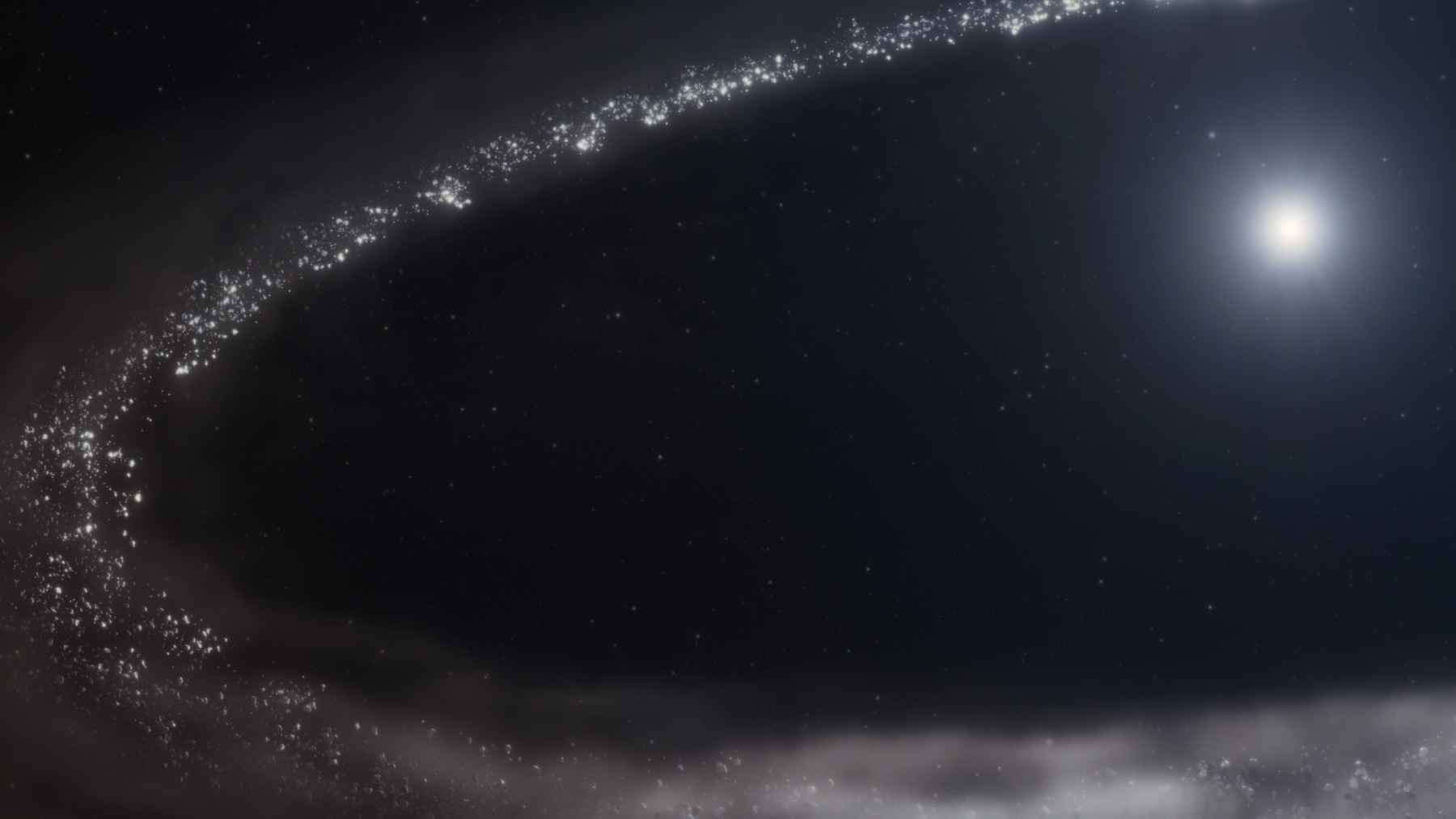
Webb has spotted crystalline frozen water drifting through a dusty ring around a young star called HD 181327, about 155 light years from Earth. It is the first definitive detection of solid water ice in a debris disk around another star.
This ring of material behaves a bit like our own Kuiper Belt at the edge of the solar system. It is packed with icy fragments that crash into one another and grind down into fine, frosty dust. Webb’s instruments reveal that this dust is loaded with water ice, forming what scientists describe as tiny “dirty snowballs” mixed into the debris.
For anyone who has ever wondered how a blue planet like Earth ended up with oceans, this is big news. The new measurements support the long-standing idea that young planetary systems store huge reservoirs of frozen water in their outer regions.
Over time, comets and other icy bodies can fall inward and deliver water to rocky planets. In other words, the water in your glass might once have ridden in on an ancient cosmic snowball.
A young, noisy neighborhood in space
HD 181327 is a young F-type star, only about 23 million years old. Our Sun by comparison is 4.6 billion years old and firmly middle aged. The new observations show a clear gap between the star and the debris ring that surrounds it, leaving an inner zone mostly free of dust. Beyond that gap lies a bright, broad belt of icy rubble that astronomers see as a close cousin of our Kuiper Belt.
“HD 181327 is a very active system” explained astronomer Christine Chen. She noted that frequent collisions between icy bodies keep kicking up fresh grains of dusty water ice that are just the right size for Webb to pick up in infrared light.
Crystalline ice with a clear fingerprint
To make this detection, the team used Webb’s Near Infrared Spectrograph, or NIRSpec. Instead of taking a simple picture, they broke the light from the disk into many wavelengths and looked for the subtle fingerprints of specific materials. In that spectrum they found a broad feature around three microns in wavelength, along with a sharp peak near 3.1 microns.
Together, those signals are a textbook signature of crystalline water ice made of relatively large grains.
This form of ice is the same general type seen in Saturn’s rings and on icy bodies in the Kuiper Belt. Astronomers had suspected for decades that similar ice might coat debris disks around other stars, and even had hints from older space telescopes. Webb finally has the sensitivity to confirm it beyond doubt.
Where the frozen water hides
The ice is not spread evenly across the system. Webb’s data show that the outer part of the debris disk is especially rich in water ice, with frozen water making up more than 20% of the material in that zone. In the middle region, the ice fraction drops to roughly 8%. Closer in, near the star, the signal from water ice almost disappears.
Why the sharp drop off near the star? The team points to intense ultraviolet radiation that likely vaporizes exposed ice in the inner disk. Some of the remaining water may also be locked inside larger rocky bodies known as planetesimals, which are too big and too dark for Webb to see directly.
The result is a system where ice is constantly destroyed near the star and constantly replenished in the colder outskirts when icy objects collide.
A blueprint for building blue worlds
Water ice plays several roles in the birth of planets. It helps solids stick together more easily in the cold outer disk, which speeds up the growth of giant planets. Later on, leftover icy bodies can act as delivery trucks, bringing water to young rocky planets that form closer to the star.
The new observations suggest that HD 181327 has exactly the kind of icy reservoir that could feed future Earth like worlds over the next few hundred million years.
Scientists now want to repeat this kind of study for many more systems. If icy exo Kuiper Belts turn out to be common, then the basic recipe that made Earth wet to a large extent might be playing out all across the galaxy. And that makes every quiet sip from the tap feel a little more connected to the wider universe.
The study was published in Nature.