The universe loves to play tricks on us. That’s because, just as we think we understand how things work out there, a discovery emerges that shatters all our certainties. That’s exactly what happened recently: a new world appeared in data from the James Webb Space Telescope and left astronomers scratching their heads. We’re not talking about something billions of light-years away; in fact, this “new world” is practically in the cosmic neighborhood. It’s already breaking patterns, even in what seemed most straightforward: its colors.
A giant in the glare: JWST spots a faint world
Imagine trying to observe a firefly next to a spotlight turned up, that’s roughly what astronomers face when trying to find planets near bright stars. However, in August 2024, JWST achieved the impossible: using its MIRI instrument with a coronagraph mask, it blocked the glow from the site and revealed an object 10,000 times fainter than it.
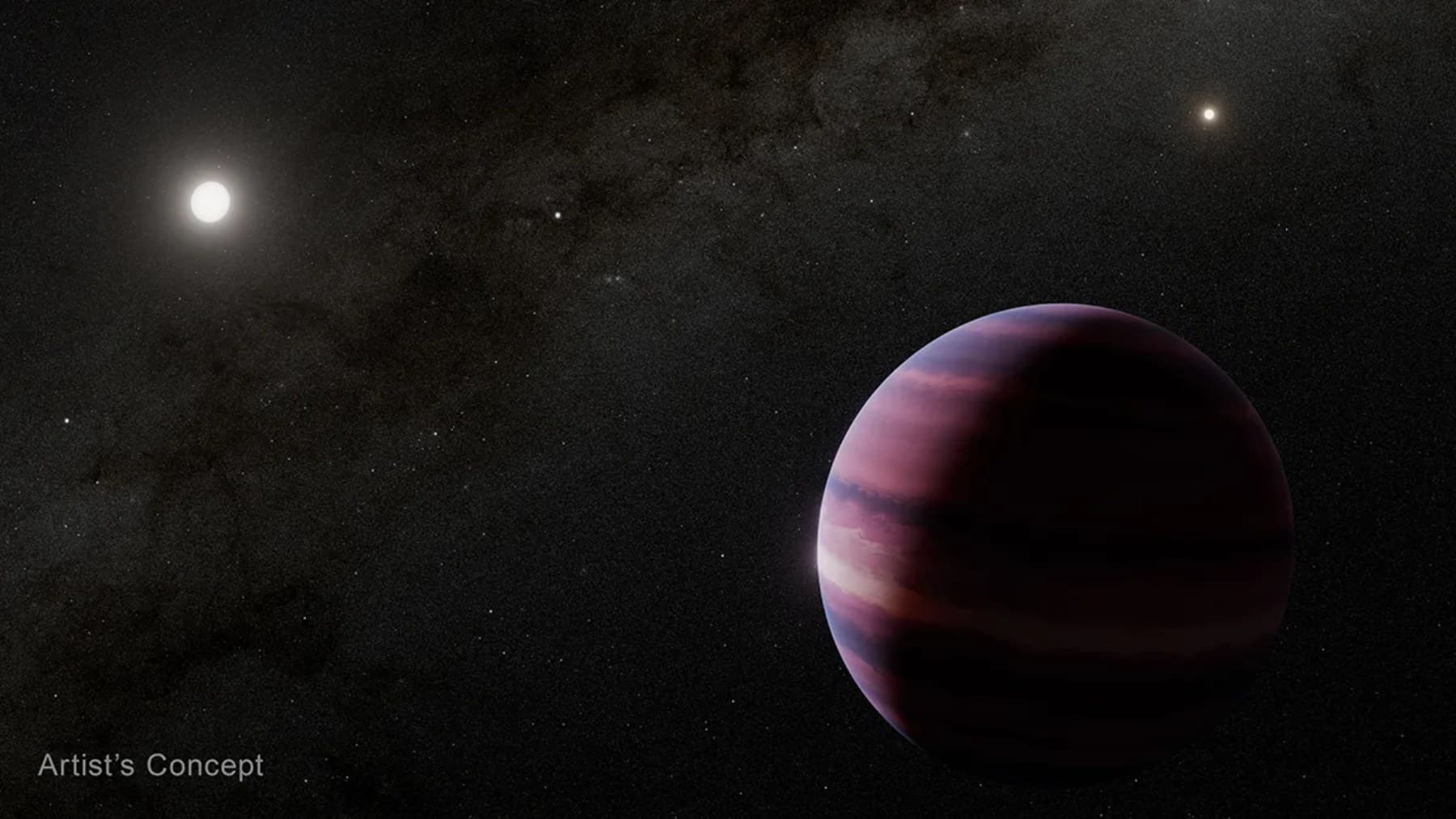
This object is about 4 light-years from Earth, orbiting Alpha Centauri A, a star practically twin to the Sun. It is in the habitable zone, the region where liquid water could exist if it were a rocky planet. But it isn’t. And everything indicates that we are looking at a gas giant, likely with a mass similar to that of Saturn.
Colors that defy the cosmos: what’s behind Alpha Centauri A’s strangely hued giant?
Now, the most intriguing detail: its appearance. The images suggest that this planet has bands in shades of beige, orange, and dark red, a pattern reminiscent of Jupiter, but with unusual combinations and intensities. Scientists still can’t explain precisely why, but they’re already putting forward hypotheses:
- Unusual atmospheric composition: gases and particles different from those found in known gas giants.
- Gravitational interactions of the binary system: the presence of Alpha Centauri B can affect winds and cloud formations.
- Extreme weather events: large-scale storms and currents that alter light reflection.
“[The planet’s] very existence in a system of two closely separated stars would challenge our understanding of how planets form, survive, and evolve in chaotic environments,” said Aniket Sanghi, who co-led the research with Beichman.
And the most curious thing is that, although we’re used to seeing planets with varied colors in artistic illustrations, in real life, gas giants tend to follow more predictable patterns. Not so here, because the contrast and intensity of these bands don’t match anything observed so far (just as NASA was surprised to find 102 new colors hidden in the most distant galaxies in the universe).
Tracking the elusive giant orbiting Alpha Centauri A
If confirmed, this will be a planet with many “firsts” under its belt. This is because it will be the first gas giant ever directly imaged around a star so similar to the Sun and so close to Earth; closer to its star than any other planet captured by direct imaging. It also represents an unprecedented opportunity to study the composition, orbit, and climate of a world outside the Solar System. The problem is that not everything was straightforward after this initial detection, as observations in February and April 2025 failed to find the planet again. This raised suspicions, but simulations showed that, in half of the possible orbits, it would simply be too close to the star to be visible on those dates.
Regarding next steps, JWST should continue monitoring Alpha Centauri A in the coming years (in addition to continuing its historic discoveries, such as the discovery of over 800,000 galaxies in the dark). And the Nancy Grace Roman Space Telescope, a new telescope scheduled for 2026/2027, will provide data in the visible spectrum to complement infrared observations. Ultimately, these two telescopes together will be able to measure not only atmospheric composition but also reflectivity and even estimate possible moons.