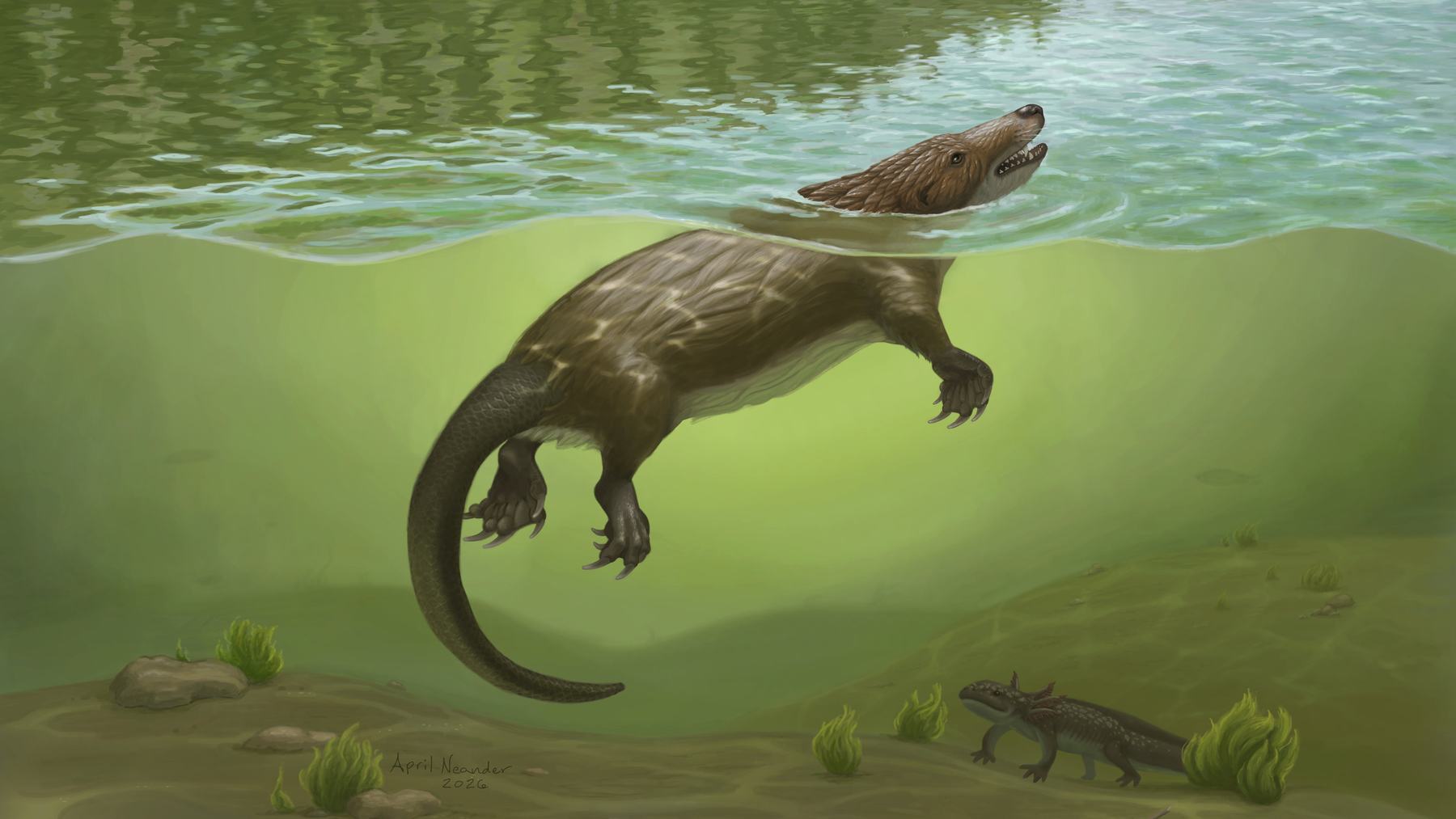
A Jurassic mammal relative that lived about 165 million years ago in what is now Inner Mongolia, China, swam with a broad, flat tail. Its throat bones were also arranged much like ours, according to a study published October 7, 2026, in Nature.
The animal, named Megacauda sungei, belongs to an extinct group called docodonts. It measured roughly 16 to 20 inches (40 to 50 centimeters) long and weighed an estimated 2.2 to 4.4 pounds (1 to 2 kilograms). Nature’s press office calls it the largest known Jurassic mammaliaform, the group that covers mammals and their closest extinct kin.
A slab split for the scanner
The fossil is kept at the Paleontological Museum of Liaoning in Shenyang. Yikun Li of Shenyang Normal University is the paper’s first author. The senior author is Zhe-Xi Luo, the Mila Pierce-Rhoads Professor of Organismal Biology and Anatomy at the University of Chicago.
Co-author Chang-Fu Zhou of Shandong University of Science and Technology arranged the imaging during the COVID-19 pandemic. He took the specimen to several labs around China for CT scans and X-ray fluorescence photography, according to the University of Chicago. The big slab had to be cut into smaller pieces first.
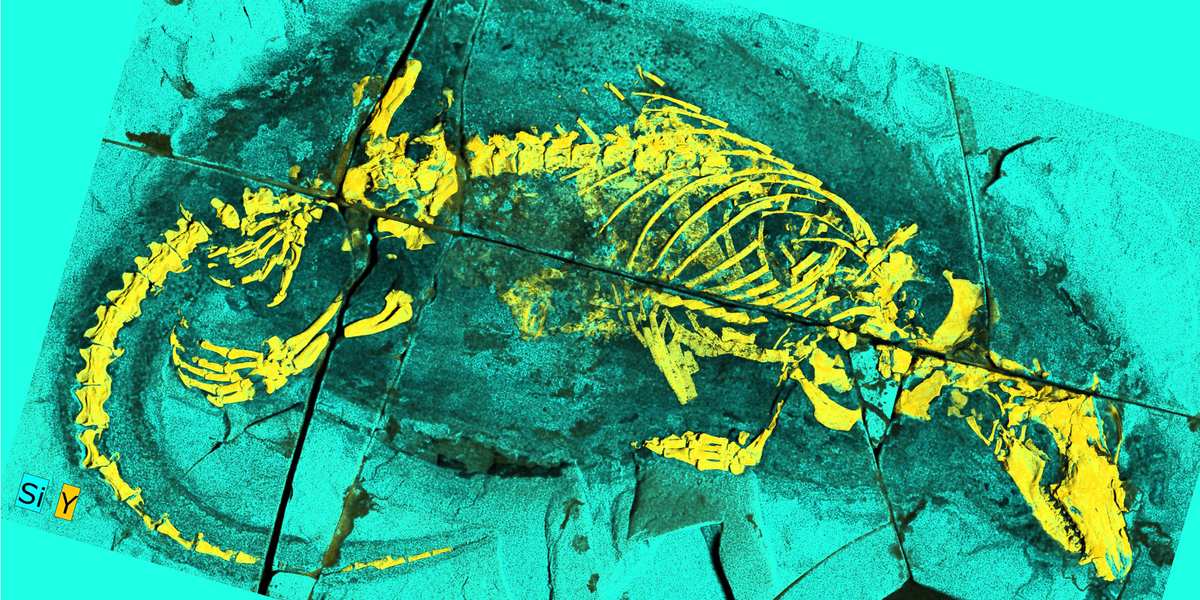
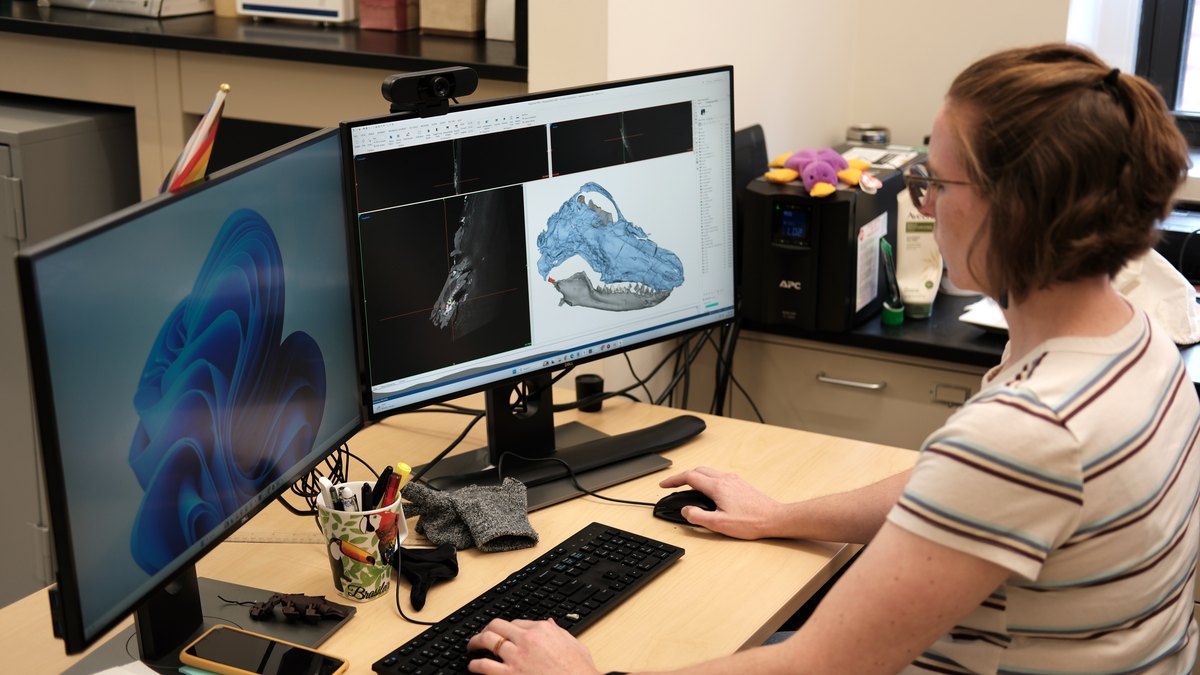
From those scans, UChicago scientific artist and CT expert April I. Neander visualized its structures in fine detail. Nature’s press summary dates the animal to roughly 168 to 163 million years ago, in the Middle Jurassic.
Throat bones like an opossum’s
All modern mammals, humans included, carry hyoid bones. These small bones form a U-shaped saddle that links the mouth and throat to the esophagus and the larynx.
That frame lets adult mammals swallow chewed food one lump at a time, the university explains. An alligator, by contrast, gulps down huge bites or whole prey. The same bones also let babies suckle milk.
“This is an incredibly important evolutionary innovation. After mammals chew their food, be it plants or meat, they all swallow it in the same efficient and effortless way,” Luo said in the university’s announcement.
Megacauda keeps those fragile throat structures better than other fossils do. According to co-author Peishu Li, now on the faculty at Ohio University, this anatomy is comparable to the throat muscles of a modern opossum.
Two small hooks on the palate
On the roof of the mouth, the team found a pair of tiny bony projections. According to Ohio University, they closely resemble features in marsupials and placental mammals. In those animals, the hooks support the soft palate and the muscles for suckling, swallowing and guarding the airway.
Those hooks sat right beside older bony ridges known from earlier mammal ancestors. Since both show up in the same skull, the modern hooks probably did not grow out of the old ridges. Scientists had long assumed they did.
Platypuses and echidnas, the egg-laying monotremes, take in milk another way and lack some of these features. So did they lose them? That is the reading in the Ohio release, which says monotremes likely dropped parts of the ancestral suckling apparatus.
“For decades, scientists have wanted to know when the soft-tissue structures necessary for suckling and complex swallowing first appeared,” Luo said in that release.
Big tail, sharp cheek teeth
Megacauda means “big tail,” and you can see why on the slab. Wide, H-shaped vertebrae run down a broad tail outline, the kind a river otter uses to push itself through water.
The back feet had long outer digits like a platypus, an animal that keeps surprising biologists. Neander also singled out its pelvis, which is more complete than any other specimen known from that time.
The skull held robust canines and shearing cheek teeth for cutting and chewing meat. Ohio University likens those blade-like teeth to a modern seal’s.
Tiny bits of vertebrate bone survive in the stomach area, a bit like the ichthyosaur fossil from Queensland that kept its last meal. The team thinks Megacauda hunted small animals, probably including salamanders. Their fossils are common in the same beds.
Nature’s press office adds that it may have sheltered in burrows on land. In the water, it likely foraged for fish, salamanders and invertebrates.
Older than Castorocauda
Luo’s team described another swimming docodont, Castorocauda, back in 2006. Neander noted that the new fossil “is particularly interesting because it’s older than Castorocauda.” Both animals filled the same niche in the water, according to Neander, but Megacauda is the more complete of the two.
In 2019 the same group named Microdocodon gracilis, a tiny tree-dwelling docodont of about the same age. It also had mammal-like hyoid bones.
Swimmers and climbers show how varied these animals were in Jurassic ecosystems ruled by dinosaurs. Other early mammal relatives turn up too, such as the tiny creature identified from a single tooth in Greenland.
“Docodonts are the most speciose group of the stem mammals across North America, Europe, and China, and this is probably one of the two most complete specimens for the group,” Luo said.
Suckling is read from bone
The fossil keeps the bony throat passage and the hyoid bones, not the working muscles themselves. What the team describes as a swallowing and suckling system is rebuilt from those bones and from the spots where muscles once attached, while the burrows and the diet appear in Nature’s summary as things the animal may have done.
Nobody has pinned those stomach scraps on a species yet. Salamanders are a good bet, given how many lie in the same rock, but a bet is all it is for now, and most of the paper’s figures and methods sit behind Nature’s paywall.
The study, “A Jurassic mammaliaform swimmer and transformation of the mammalian pharynx,” was published in Nature.
Image: April I. Neander / University of Chicago