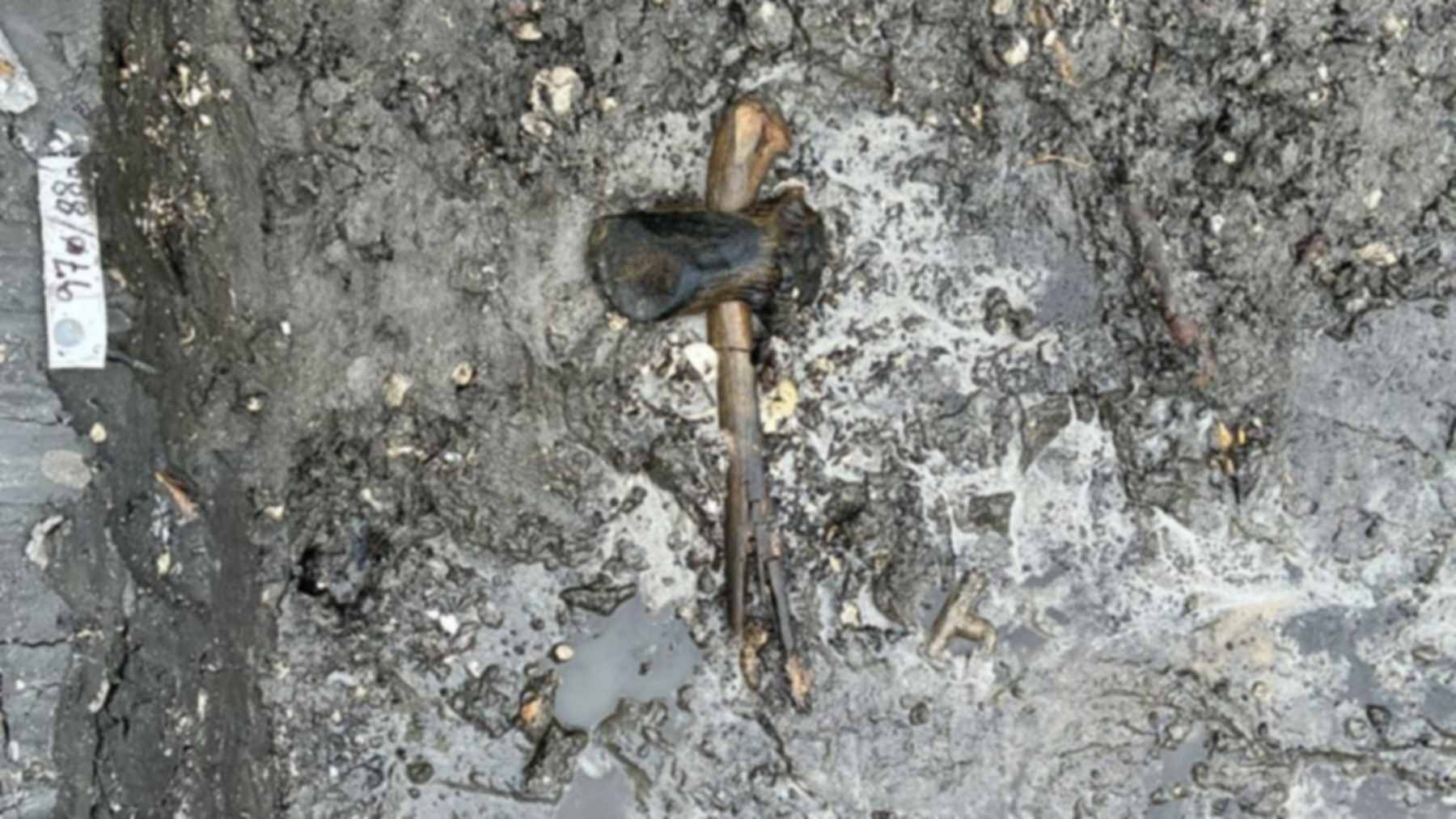
Archaeologists in northern Denmark have recovered a Stone Age axe that still has its wooden handle. The find comes from Egholm, a small island in the Limfjord next to Aalborg. It is about 8,400 years old.
Torben Birk Sarauw, head of cultural heritage at North Jutland Museums (Nordjyske Museer), announced it in a post on LinkedIn on October 6, 2026. The head is made of deer antler, and the wooden shaft is preserved.
The axe belongs to the late Maglemose culture, hunter-gatherers of the Mesolithic, or Middle Stone Age. Antler axes are known from several sites of that period. Yet Sarauw wrote in Danish that examples with a preserved wooden shaft are among “the absolute rarities.”
A motorway dig on Egholm
The excavation is part of the archaeology for the third Limfjord crossing. This new motorway, about 12 miles (20 kilometers) long, will link Himmerland and Vendsyssel near Aalborg. The Danish Road Directorate is building it.
North Jutland Museums must investigate roughly 850 acres (345 hectares) along the route. Kystmuseet and Moesgaard Museum handle the underwater surveys.
Trial trenches on the island had already revealed a Maglemose camp. In a March 2026 update, the museum dated it to around 9,000 years ago. It also noted bone and antler, organic finds it called very rare on digs carried out on land.
Antler head, wooden shaft
In the photo released with the announcement, the axe still lies in grey, wet sediment. Its dark antler head is threaded onto a thin brown wooden shaft. A numbered find tag rests at the edge of the trench.
Most prehistoric tools reach museums as their hardest part only. Flint and bone can last for millennia in ordinary soil. Handles and bindings usually rot away, so archaeologists have to guess how a tool was gripped.
Wood does survive in exceptional settings, as with a 430,000-year-old piece of wood bearing cut marks. At Egholm, the antler head came out with its shaft still in place.
Sarauw wrote that the find carries “considerable potential” for research. He named tool technology, the use of raw materials and craft practice in the Maglemose culture.
Wet layers that kept the wood
According to Sarauw, the axe comes from an unusually well-preserved wetland deposit. In waterlogged layers oxygen is scarce. That slows the bacteria and fungi that would otherwise break down wood and bone.
The museum says the lowlands around the Limfjord have been alternately dry and flooded for thousands of years. Layers of sand and clay sealed the camps people left behind. The damp subsoil keeps what lies inside them.
Egholm has already produced large amounts of flint, bone, wood and other organic remains, Sarauw said. He called it a rare coastal settlement from the Early Stone Age in the Limfjord area.
Seen from the air, Egholm today is a low, green island of fields in the fjord. Aalborg spreads along the far shore.

Flint blades and birch tar
The axe is not the first notable find from the camp. In November 2025, the trial digs yielded microliths, small and finely worked pieces of flint. Hunter-gatherers set them into arrow shafts.
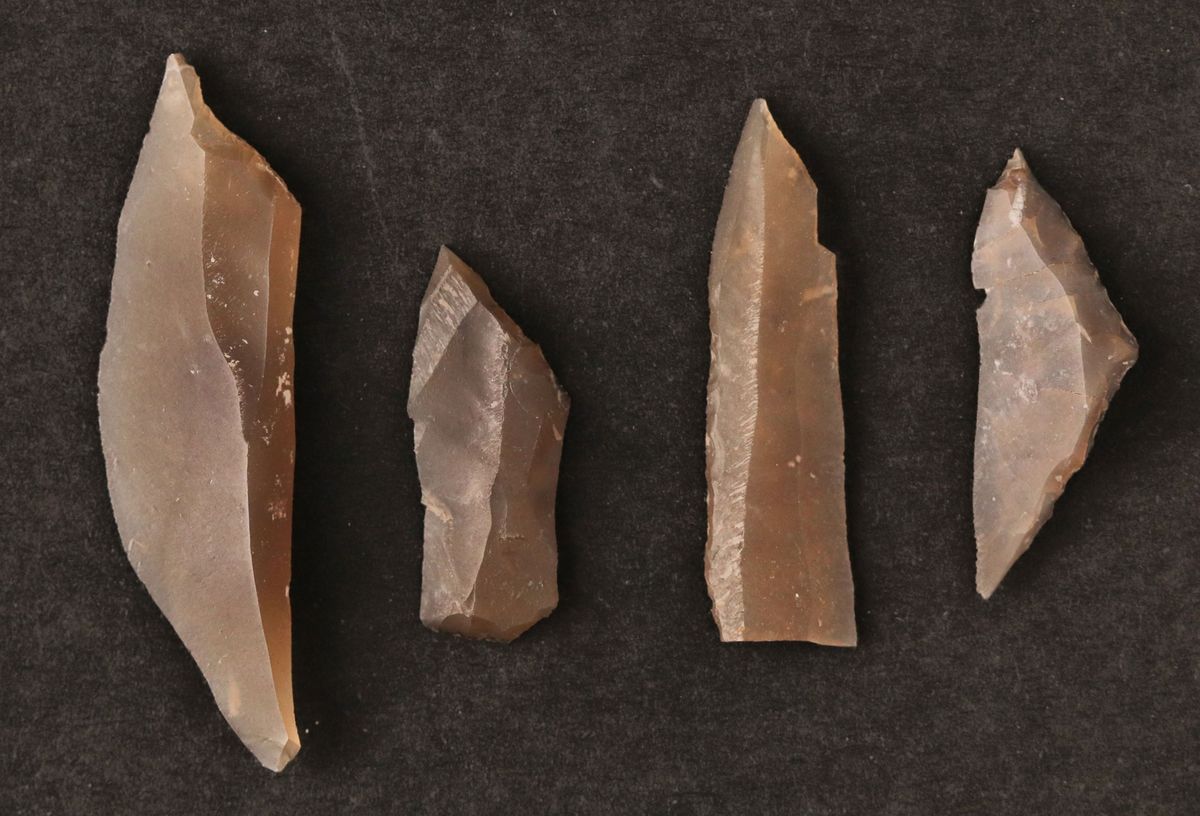
According to the museum, several microliths could sit side by side in one arrow shaft. Together they formed a cutting edge or a point. A broken piece could simply be swapped out.
The pieces were glued in with birch-bark tar, a dark and sticky substance. People made it by heating birch bark to about 572°F (300°C) in a pit.
Similar hunting gear has turned up elsewhere in northern Europe, including prehistoric arrows exposed by melting ice in Norway. At Egholm, stone, antler, wood and glue all appear in one toolkit.
Drowned camps in Storstrømmen
Waterlogged ground has protected other Danish sites from the same era. In Storstrømmen, off the island of Falster, the Viking Ship Museum has excavated a settlement about 8,000 years old. It now lies under roughly 16 feet (5 meters) of water.
When the sea rose around 6,000 B.C., that coast flooded and thick silt buried it. The museum reports worked wood, cracked hazelnuts and animal bones with marks from Stone Age tools. The team also recovered a lump of amber the size of a chicken egg, possibly an unfinished amulet.
Other sites point the same way, from Neanderthal spears and bark trays in Barcelona to ancient fabric from Italy’s sunken Gran Carro village. A collection made only of stone reflects what survived burial. It rarely shows everything people once made.
No lab results on the axe
For now, the axe is known only from a short announcement and its photos. No measurements, wood species or laboratory dating have been published. The 8,400-year figure is the museum’s approximate age.
The announcement also does not say what the axe was used for. Answering that would take a close study of wear on the antler and the shaft. The museum has not reported one yet.
Sarauw closed his post by praising the “unique archaeological potential” of Egholm’s soil layers. “We look forward to seeing what finds the area still holds,” he wrote.
The find was announced by Torben Birk Sarauw of North Jutland Museums on LinkedIn on October 6, 2026.
Photo: North Jutland Museums (Nordjyske Museer)