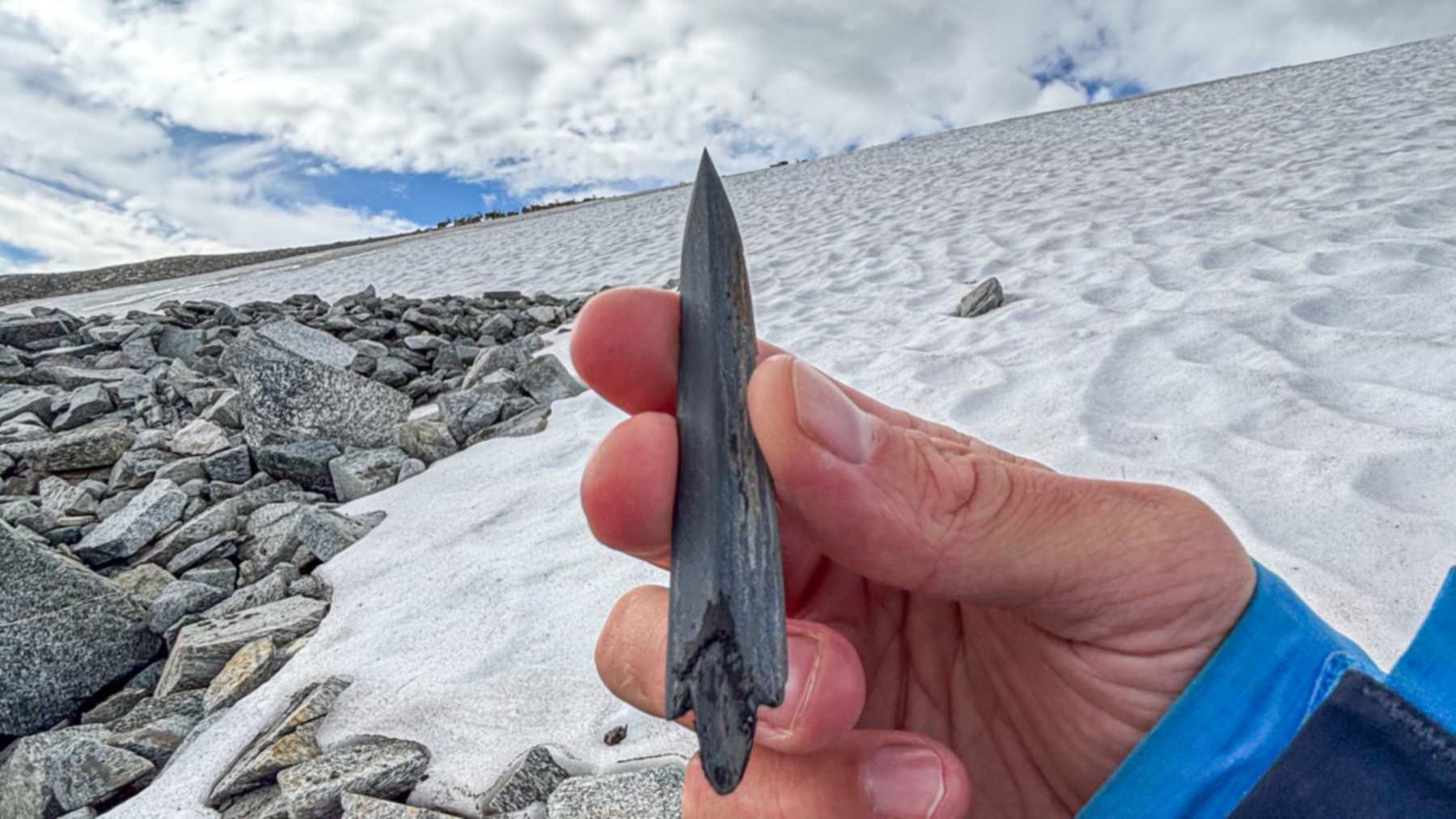
A slate arrowhead, found with parts of its wooden shaft at the edge of a shrinking ice patch in Norway’s Jotunheimen mountains, is estimated to be between 5,000 and 6,000 years old. It was one of 48 prehistoric arrows that archaeologists recovered from melting mountain ice this summer.
“This year, we found 48 prehistoric arrows. That’s a lot,” Espen Finstad told Science Norway.
The fieldwork was led by Finstad, an archaeologist at Innlandet County Municipality who heads Secrets of the Ice, the county’s glacier archaeology program run with the Museum of Cultural History at the University of Oslo. The team spent three weeks in the Kvitingskjølen mountain area, working the edges of three ice patches called Langfonne, Storfonne and Handklefonne.
A slate point and a cracking shell
Among the oldest finds is the arrow with the slate arrowhead and wooden shaft. Researchers estimated its age by comparing it with arrows found earlier, according to Science Norway, so the 5,000-to-6,000-year range is an estimate based on similar objects.
Many earlier arrows from these ice patches were dated by radiocarbon, which measures how much carbon-14 is left in once-living material such as wood. It is the same method researchers used to date 136 weapons and work out when the bow and arrow era began in North America.
The team also recovered an arrowhead cut from freshwater mussel shell, about 3,600 years old. “The arrowhead is fragile and has begun to split,” the archaeologists write in their field report.
A bone arrowhead found with parts of its shaft right next to the ice is put at about 5,000 years old. A separate piece of shaft, about 3,600 years old, had been reinforced with animal sinew and birch bark around the nock, the notched end that sits on the bowstring.
Kjetil Loftsgarden, an archaeologist at the Museum of Cultural History in Oslo, was photographed holding a complete arrow with a bone point and wooden shaft, roughly 1,800 years old. The more recent arrowheads are made of iron and are “only” between 1,000 and 1,500 years old, Science Norway reported.
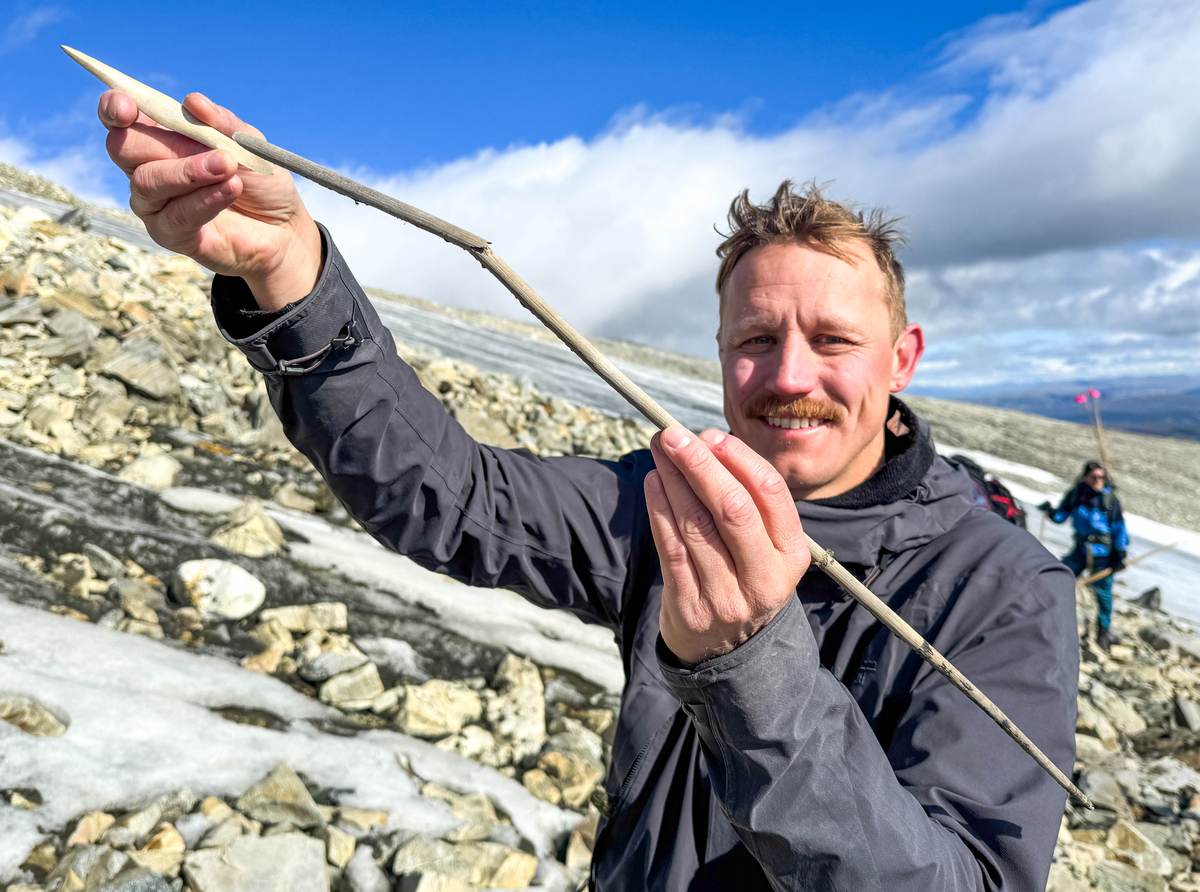
Finstad said the new finds mean that more than 100 arrowheads and arrow shafts have now been recovered from a single ice patch over the years.
Why hunters followed reindeer onto the ice
Reindeer explain why so many arrows ended up so high. In a 2020 study of Langfonne, the authors write that the hunts “probably took place mainly on hot days in July and August, when large numbers of reindeer congregate regularly on the ice and snow to cool and avoid botflies,” parasitic insects that plague the animals in summer.
The study was led by Lars Holger Pilø of Innlandet County Municipality and published in The Holocene. It counted 68 arrows and five loose arrowheads at Langfonne, which the authors called “the most arrow-rich known ice patch site in the world.”
The team also recorded eight stone-built hunting blinds near the ice. “During fieldwork at Langfonne, reindeer were regular visitors to the ice on hot days,” the authors write. “These are domesticated reindeer but behave much like wild reindeer.”
Why an ice patch keeps an arrow in one piece
An ice patch is a body of snow and ice that survives from year to year but barely moves, unlike a glacier that slowly flows downhill. In a glacier, the authors write, “the stress and strain of glacier movement tears objects apart.”
Langfonne sits between about 5,710 and 6,660 feet (1,740 and 2,030 meters) above sea level. Ground-penetrating radar, which sends radio waves through the ice to map its layers, showed that one of its patches was up to about 46 feet (14 meters) thick in March 2017.
“What makes finds from ice patches so special is the preservation of organic materials such as wood, hide, sinew and textiles,” the Secrets of the Ice team writes. “These fragile materials would normally decay.”
Since the program began in 2006, it has recorded 73 archaeological sites and recovered more than 5,000 artifacts, including bows, clothing, shoes and the remains of packhorses. Earlier finds from the program include a pair of 1,300-year-old skis that melted out in remarkable condition.
The oldest ice holds the oldest finds
In the program’s first years, most recovered objects were less than 2,000 years old, and many dated to the Viking Age. Now, the team writes, a growing share are older than that, many from the Stone Age and Bronze Age, and “the oldest are more than 6,000 years old.”
“The melting has been extensive. In many places, ice that has survived for thousands of years is now beginning to disappear completely. And this is where we see the connection: The oldest ice contains the oldest finds,” the archaeologists write.
The 2020 study offers one explanation for that link. An early cluster of Langfonne finds from about 6,000 years ago, the authors write, “may result from ice deformation which has brought early objects to the surface.”
During the Little Ice Age, a cold period that lasted from roughly 1450 to 1920, Langfonne covered nearly 1 square mile (2.5 square kilometers). By 2014, it had broken into three separate patches that together added up to about a tenth of that area.
Pilø wrote on the program’s website in 2020 that Langfonne had shrunk to less than 30 percent of its size two decades earlier, part of a wider retreat of mountain glaciers in Norway and worldwide “linked to global warming.” Researchers who measured a shrinking mountain glacier elsewhere have described the same fast loss of ice.
Finstad calls the backdrop brutal
Finstad said the work has always had two sides. “It’s fun going around looking for things. It’s exciting, and finding something is just really cool,” he told Science Norway.
“We have always acknowledged this contradiction and the reality behind our work. But this is the first time it has truly affected us on an emotional level,” Finstad said.
“This year, there was a much deeper sense of seriousness and sadness. Only patches of ice remain where we once had large ice patches. It’s brutal. And this year, that reality struck us more forcefully than ever before.”
“There has been ice here for 6,000-7,000 years,” he added. “Nature has been warning us and sending signals for many years. But now it’s giving up. Now it is simply going to melt.”
Pilø voiced the same mixed feelings in 2023, when the team recovered a 3,600-year-old arrow with a shell point. “The finds are incredible, but the reason they are melting out is sad,” he told Hyperallergic.
What the ice cannot tell us
The place where an arrow turns up is not always the place where it was lost. The Langfonne study concluded that the spread of artifacts there “is partly a result of displacement by ice movement, meltwater and other natural processes.”
On a day of heavy melting in September 2014, a team member watched meltwater carry an arrow shaft downslope. For the many finds that collect below the ice, the authors write, their position “does not represent where the finds were originally lost.”
This year’s ages are also approximate. The slate arrow’s age is an estimate based on comparison with similar arrows, and the new finds still have to be secured, documented and prepared for research and conservation.
Time works against that research. “Every field season matters,” the team writes, because the objects decay quickly once they come out of the retreating ice, and based on two decades of observations, the ice at many of its archaeological sites may be completely gone within 20 years.
From the ice edge to a refrigerated display case
Several of this year’s finds went straight into a refrigerated display case at the Norwegian Mountain Centre in Lom, where visitors could see them only days after they came out of the ice. In December, they will move to the Museum of Cultural History for further processing and conservation, according to Smithsonian magazine.
In a statement in Norwegian, Finstad said the team planned to use any good weather in the following weeks for more fieldwork. “Our goal is to collect and secure even more unique finds before winter really sets in,” he said.
The full field report was published by Secrets of the Ice on September 23, 2026.
“We expect to see more of the same in the years ahead,” the archaeologists write.
Photo: Åsa Rommetveit Celius / Innlandet County Municipality, Secrets of the Ice