The White Sands pupfish lives in just seven spots in a New Mexico desert, mostly on military land, and drying springs, floods and heat now have federal biologists proposing to list it as threatened
The White Sands pupfish lives only in a New Mexico desert basin, and federal biologists now propose listing it as a threatened species.

· 4 min read
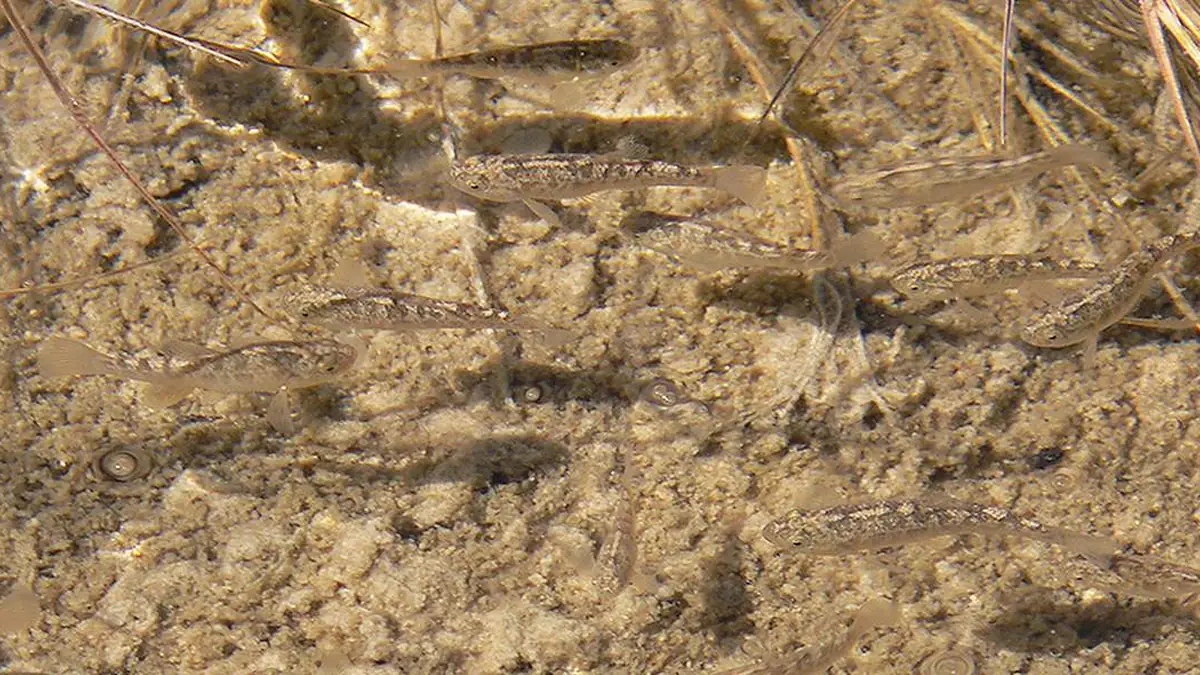
The White Sands pupfish is a fish under two inches long that lives only in a desert basin in southern New Mexico. On November 20, the U.S. Fish and Wildlife Service proposed listing it as threatened under the Endangered Species Act. The agency says it is not in danger of extinction today, but is likely to be in the foreseeable future, as its springs and creeks dry, warm and flood more often. The fish survives in seven places, mostly on military land, and only two of those populations are native. Biologists point to floods, drying, higher temperatures and dense invasive saltcedar as the main pressures. Because all qualifying habitat is on Department of War facilities, no critical habitat is proposed. Public comments are open until January 19, 2027.
Key points
- White Sands pupfish
- threatened species
- Endangered Species Act
- Tularosa Basin
The White Sands pupfish is a fish smaller than two inches that lives nowhere on Earth except a desert basin in southern New Mexico. On November 20, the U.S. Fish and Wildlife Service proposed listing it as a threatened species under the Endangered Species Act.
The agency says the species is not in danger of extinction today. But it is likely to get there in the foreseeable future, according to the proposal published in the Federal Register. Its springs and creeks are expected to dry, warm and flood more often.
All areas that would qualify as critical habitat are on Department of War facilities and are exempt from designation under the law, so the agency is not proposing any.
A tiny fish in salty water
The pupfish (Cyprinodon tularosa) measures less than 50 millimeters, about 1.97 inches. It is known only from the Tularosa Basin.
Breeding males turn a metallic, iridescent blue on their backs and carry a black band on the tail fin. Females and non-breeding males are grayish-blue on the sides and olive green on top. Females also have a "false eye" on the dorsal fin.
The species copes with conditions that would kill many fish. It lives in brackish to saline water, and readings in its habitats have ranged from 28.5°F to 100.4°F. It eats whatever is around, from algae and detritus to midge larvae and tiny crustaceans.
The breeding season runs from early April through October, and females lay several clutches of 12 to 15 eggs each season, according to White Sands National Park. The average pupfish lives about two years.
Seven sites, mostly on military land
Only two native populations exist, at Malpais Spring and Salt Creek. Genetic work suggests they split thousands of years ago. The service manages them separately to keep that genetic legacy.
Five more populations were introduced by people as backups: Lost River, North Mound Spring, Main Mound Spring, South Mound Spring and Bradford Spring. They largely occur on White Sands Missile Range and Holloman Air Force Base.
About 1.12 miles of Lost River, a stretch that does not always hold water, runs through White Sands National Park. The same park is where footprints left beside mammoths were dated to between 23,500 and 21,700 years ago.
Drying, floods and heat
Federal biologists name four main pressures: extreme floods, more drying, higher temperatures and dense vegetation such as invasive saltcedar. They looked at water use, non-native species, military operations, disease and water quality too. None of those was found to be a main driver of the species' future.
Air temperatures across New Mexico, including the Tularosa Basin, rose by roughly 2°F or more between 1970 and 2020, the proposal says. They are expected to keep rising. Intense storms are also projected to increase in the state.
Hotter, drier conditions shrink pools and concentrate salt. In Salt Creek, stream drying has already killed pupfish, and the lowest reach is mostly intermittent and very salty.
Floods are a separate danger there. A big one can flush fish from good habitat near the spring into poorer water downstream. A headcut, a vertical drop in the streambed, keeps them from swimming back up.
Saltcedar adds to the trouble because dense stands shade the water, draw it down through their roots and can push salt levels up. The shrub grows at the Lost River and Bradford Spring sites, where it is being managed.
What the models project
The agency ran projections through 2099. Between 2025 and 2049, Malpais Spring is expected to slip from high to moderate resiliency, and Salt Creek from moderate to low.
At Malpais Spring, the upper areas near the spring source should hold most of the fish later on. Those areas make up only 9.5 to 28 percent of today's wetted area, depending on the scenario, so a single extreme storm or drought there could hit the whole system.
The backup sites for Salt Creek are also losing habitat. That would make them less useful for restocking the native population after a disaster.
Decades of work on the base
New Mexico has listed the pupfish as threatened since 1975. In 1990, the state wildlife agency drew up a conservation plan with the Army and the Fish and Wildlife Service, later revised in 1994 and 2015. The plan led to a conservation team and to the backup populations.
The service calls the plan successful, but says it cannot fully address changing water conditions, heat and extreme storms.
The species' road to this proposal has been long. It became a candidate for listing in 1982, a status that ended in 1996 when that whole category of candidates was discontinued. A 2007 petition covering 475 species in the Southwest then included it.
The pupfish was not the only species in line for protection that day, as the agency also proposed listing the Mazama newt at Crater Lake as endangered.
What protection would change
If the rule is finalized, killing, harming, capturing or harassing the fish would be prohibited without authorization. The proposal makes exceptions for translocations and for research and monitoring, which the agency says have negligible impacts.
Four independent scientists reviewed the underlying assessment. One raised a 2024 study suggesting the two native groups might be separate species. The service concluded that the evidence is not yet enough to split them.
Public comments are open until January 19, 2027, under docket FWS-R2-ES-2026-1651 on Regulations.gov. Written requests for a public hearing are due by January 4, 2027.
Photo: National Park Service, White Sands National Park
Glossary for this story
- Endangered species
- A species at serious risk of disappearing. In the U.S., the Endangered Species Act protects those listed.
- Drought
- A long period of much-lower-than-normal rainfall that reduces the water in rivers, reservoirs and soil.
Jordi Company
Writer at ECOnewsJordi Company is a well-known figure in Catalan publishing and a pioneer of the free press model, with 40 years of experience in television, radio and print. He has founded and led several media groups and today heads ECOticias.com, an environmental news outlet read in Spanish and English around the world and an audience leader since 2004. He is a member of the International Network of Writers for the Earth (RIET), among other organisations.
More from Jordi CompanyComments · 0
Rules ›No comments yet. Be the first to share your view.