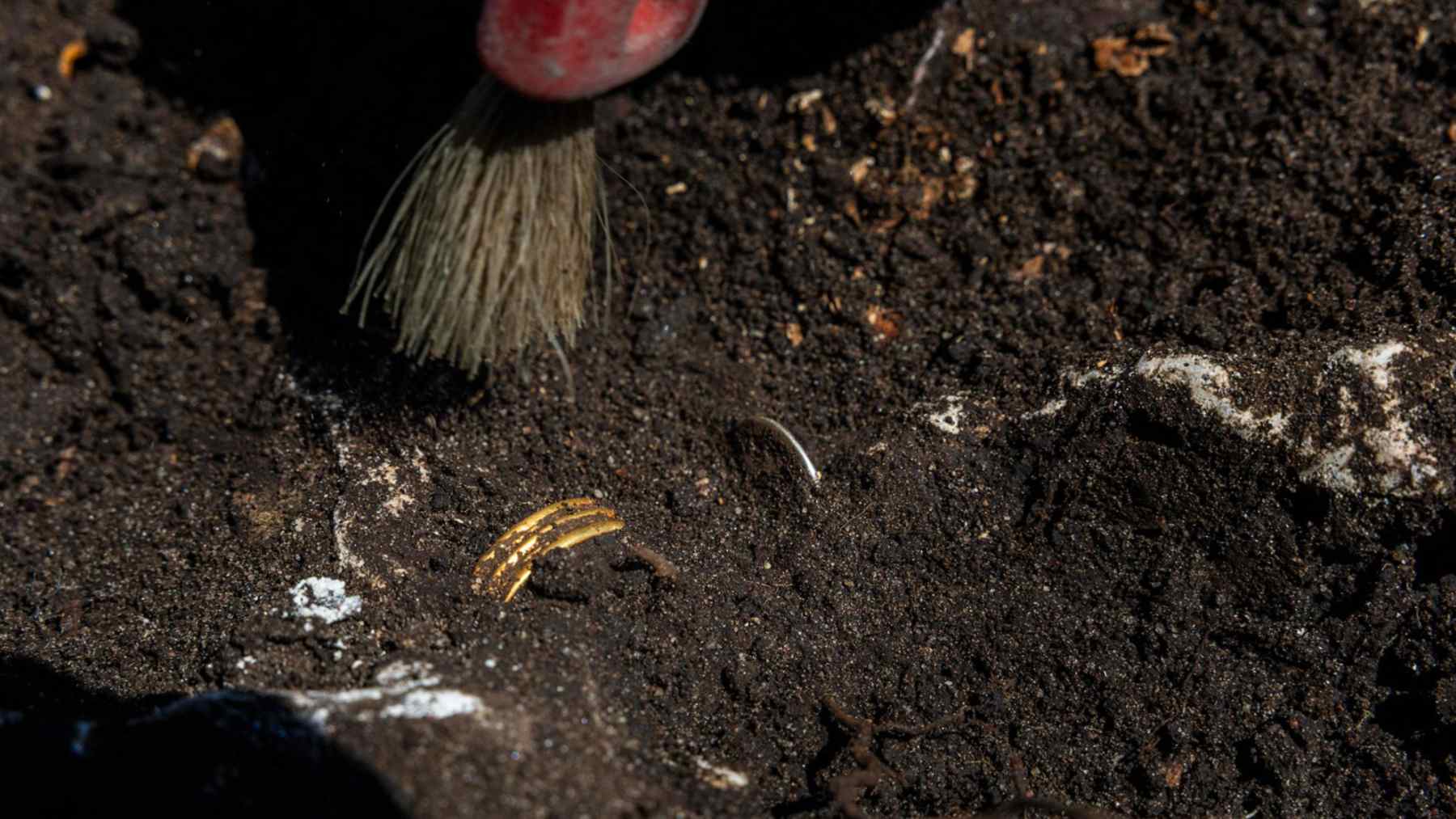
Archaeologists on Sweden’s Baltic island of Gotland have uncovered 45 Roman-era silver coins and a gold ring beside an ancient farm building. Researchers believe the objects entered the ground around AD 450, roughly 1,600 years ago. By then, the Roman coins may already have been circulating for generations.
The discovery came during archaeological work linked to the expansion of the Gotland Regiment near Tofta shooting range. In its September 1, 2026, announcement, Gotlands Museum described evidence of a surprisingly long life for the silver, with coins produced in the Roman world apparently remaining useful on the island centuries later.
A gold ring helps date the silver hoard
The museum places the Roman coinage within a span from AD 98 to 192, but that does not establish when the collection was buried. If the proposed date of around AD 450 is correct, the coins would have been roughly 260 to 350 years old when they entered the soil.
The gold ring provides a younger clue. “The gold finger ring looks like a type found from the middle of the fifth century,” museum archaeologist Per Widerström said, translated from Swedish. Its design helps explain why researchers favor a burial date centuries after the coins were made.
Bones recovered from one of the houses also yielded an initial radiocarbon date indicating that the building was used during the fifth century. That result supports the settlement’s timeline, although it does not directly date the moment someone deposited the valuables.
A final detector sweep revealed the treasure
Archaeologists from Gotlands Museum and the company Arendus investigated the site as military facilities expanded. The museum says earlier work revealed four buildings belonging to a farm complex, followed by investigations of two additional buildings during the spring.
According to the Swedish Armed Forces’ account, excavation of one house foundation was almost finished when a final metal detector sweep signaled something beside a foundation stone. The first small silver coin revealed a portrait of Emperor Antoninus Pius after it was cleaned. More coins and the ring followed.
The museum locates the deposit outside a house, near its gable end, and reports that pottery made up most of the other finds in the two buildings. Those less glamorous objects help place the treasure within a lived-in settlement, giving researchers more context than an isolated coin could provide.
Five emperors, four empresses and two imitations
The identified Roman issues represent five emperors, Trajan, Hadrian, Antoninus Pius, Marcus Aurelius and Commodus. Coins were also struck for four empresses, Sabina, Faustina I, Faustina II and Lucilla. Together, they cover almost a century of imperial history.
Roman coin specialist Lennart Lind examined the collection for the museum. He believes the coins probably reached Gotland during the fourth century, meaning the AD 300s, and continued to be used in island trade into the fifth century.
There is another twist in the collection. The Armed Forces’ report quotes Widerström identifying two coins as forgeries, probably made in the territory of present-day Ukraine. That possible origin adds a clue to their travels, but the announcement does not establish their precise route to Gotland.
Why Roman coins keep turning up on Gotland
How unusual is Roman silver on this island? In an overview updated in November 2025, Stockholm University’s Numismatic Research Group reported 7,756 Roman denarii found in Sweden, including 6,578 on Gotland. That is about 85 percent of the total listed in that overview.
The university also describes Gotland’s denarii as heavily worn compared with examples found on the Swedish mainland. It places their probable arrival on Gotland in the fourth century, consistent with Lind’s interpretation of the Tofta collection. A coin’s production date, arrival date and final burial can therefore tell three different parts of its story.
The Swedish History Museum explains that Roman objects reached Scandinavia through several possible channels, including trade, personal journeys and diplomatic gifts. That broader history helps frame the discovery, while leaving open exactly who carried these particular coins north.
The people behind the hoard remain a mystery
The announcements do not identify the owner or explain why the silver and ring were left beside the house. The evidence currently gives researchers a clearer view of the objects’ chronology than of the personal decision that brought them together in the ground.
For now, the discovery offers a tangible link between Roman coin production and life on a Gotland farm centuries later. The official account, updated September 7, 2026, was published on the Swedish Armed Forces website.
Photo: Daniel Klintholm / Försvarsmakten