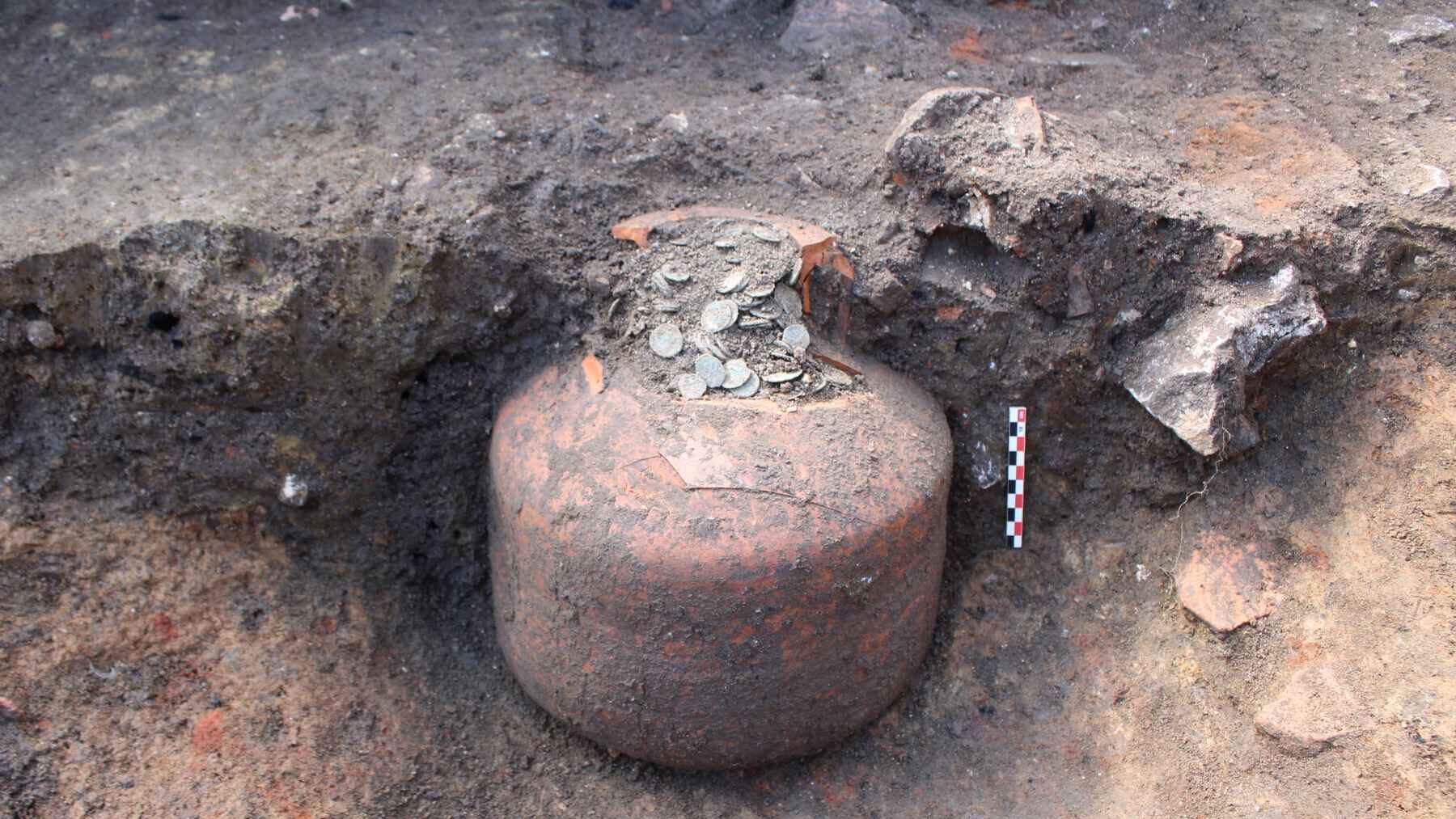
Archaeologists excavating the village of Senon in northeastern France have uncovered three large ceramic vessels linked to what may be more than 40,000 Roman coins. The find is roughly 1,700 years old, but its biggest surprise is not the raw number of coins, it is the way the jars appear to have been used like accessible household savings containers rather than treasure hidden in a sudden panic.
The vessels stood upright in carefully prepared pits inside ancient homes, with their openings close to floor level. Coins found against the outside of two jars show that at least some money was added after the containers had been placed in the ground. Apparently, this may have been the Roman-era version of a cash box tucked beneath the floorboards.
A routine project uncovers a city
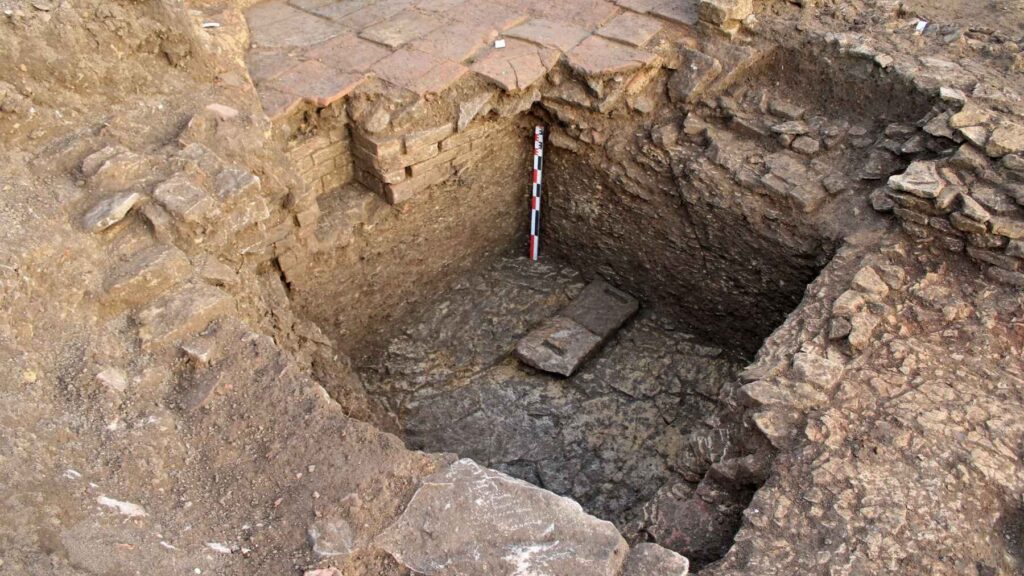
The discovery grew out of an ordinary home extension. Preventive archaeologists examined a parcel covering about 16,100 ft.² and exposed a little-known residential district with layers stretching from the pre-Roman Gallic period to the middle of the fourth century.
Senon was once one of the main settlements of the Mediomatrici, a Celtic people whose capital was Metz, then known as Divodurum. Archaeologists found pits, ditches, postholes, limestone quarries, roads, stone homes, ovens, cellars, and courtyards. The dig reads almost like a city chronicle written in soil.
Thousands of coins in three jars
The first vessel held about 83 lbs. of metal, equivalent to an estimated 23,000 to 24,000 coins. A second jar and its contents weighed about 110 lbs. and may contain 18,000 to 19,000 coins, based partly on 400 pieces recovered from its broken neck. A third container had apparently been removed in antiquity, leaving only three coins behind.
The coins range from the last quarter of the third century to the first decade of the fourth. Some carry portraits of Victorinus, Tetricus I, and Tetricus II, rulers of the short-lived Gallic Empire that governed the region separately from Rome between AD 260 and 274. Researchers currently place the jars’ burial between AD 280 and 310.
Not a treasure hidden in fear
INRAP, the French institute for preventive archaeology, cautions that it is “not certain that these were treasures hidden during insecurity.” The vessels were set vertically in well-prepared pits and stabilized with stones, without the signs archaeologists would expect from hurried concealment. Their necks sat close to the floors, ready to reach.
Why bury money where you could still get to it? The arrangement fits a system of medium-term or long-term money management within a household or administration, allowing deposits and withdrawals at different times. That is a quieter story than buried treasure, but perhaps a more revealing one.
A prosperous Roman neighborhood
The surrounding homes had lime-concrete floors, cellars, ovens, workshops, spacious rear courtyards, and in some cases, underfloor heating. The buildings and small objects recovered at the site point to relatively comfortable residents, possibly craftspeople or merchants. This was no isolated hiding place.
A public square nearby included monumental buildings such as temples, baths, and a theater. That urban setting gives the jars a richer meaning, since they may reflect everyday financial organization in a town shaped by trade, skilled work, and public life. Still, researchers do not know who owned the money.
Fire, soldiers, and an unanswered mystery
A fortification from the same period stood about 490 ft. from the excavated area. INRAP says a connection between the military presence and the three nearly contemporary coin deposits is possible, but it remains only a hypothesis. The money could have belonged to a household, business, or local administration.
A major fire damaged the district at the beginning of the fourth century, after which residents rebuilt over older walls and burned foundations. That second phase lasted no more than about 50 years before another large fire and final abandonment around the middle of the century. The earlier blaze may help explain why the jars were forgotten, though the case is far from closed.
Context is the real treasure
Around 30 coin deposits are already known in the Meuse area, so quantity alone does not make Senon exceptional. What stands out is the detailed context, including the jars’ placement, their relationship to household floors, the nearby buildings, and the layers of destruction above them. Archaeologists can examine how the money was stored, not merely what the coins depict.
This is where archaeology differs from treasure hunting. A loose coin can reveal its age, minting authority, and ruler, but a coin found in an accessible jar beneath a living space can also reveal behavior. The soil, walls, and burn layers turn thousands of separate objects into evidence about daily life.
INRAP also points to the discovery as a reminder of the damage caused by archaeological looting. Once objects are removed from their original setting, much of the evidence surrounding them disappears for good. No spectacular display case can fully replace it.
What researchers still need to learn
The study of the deposits has only begun, and the official coin count and precise chronology remain open. Post-excavation work should refine the inventory and help researchers test whether the three containers followed the same pattern of use. For now, the estimates are substantial but still provisional.
The largest question is also the simplest: why did the owners never return? Fire or nearby military activity may have played a role, but the available evidence does not yet pinpoint one explanation.
For now, the Senon jars offer something more useful than a dramatic treasure tale. They preserve a rare snapshot of how people stored and managed money in a Roman town, one small financial habit frozen beneath a floor for centuries.
The official press release was published on INRAP.