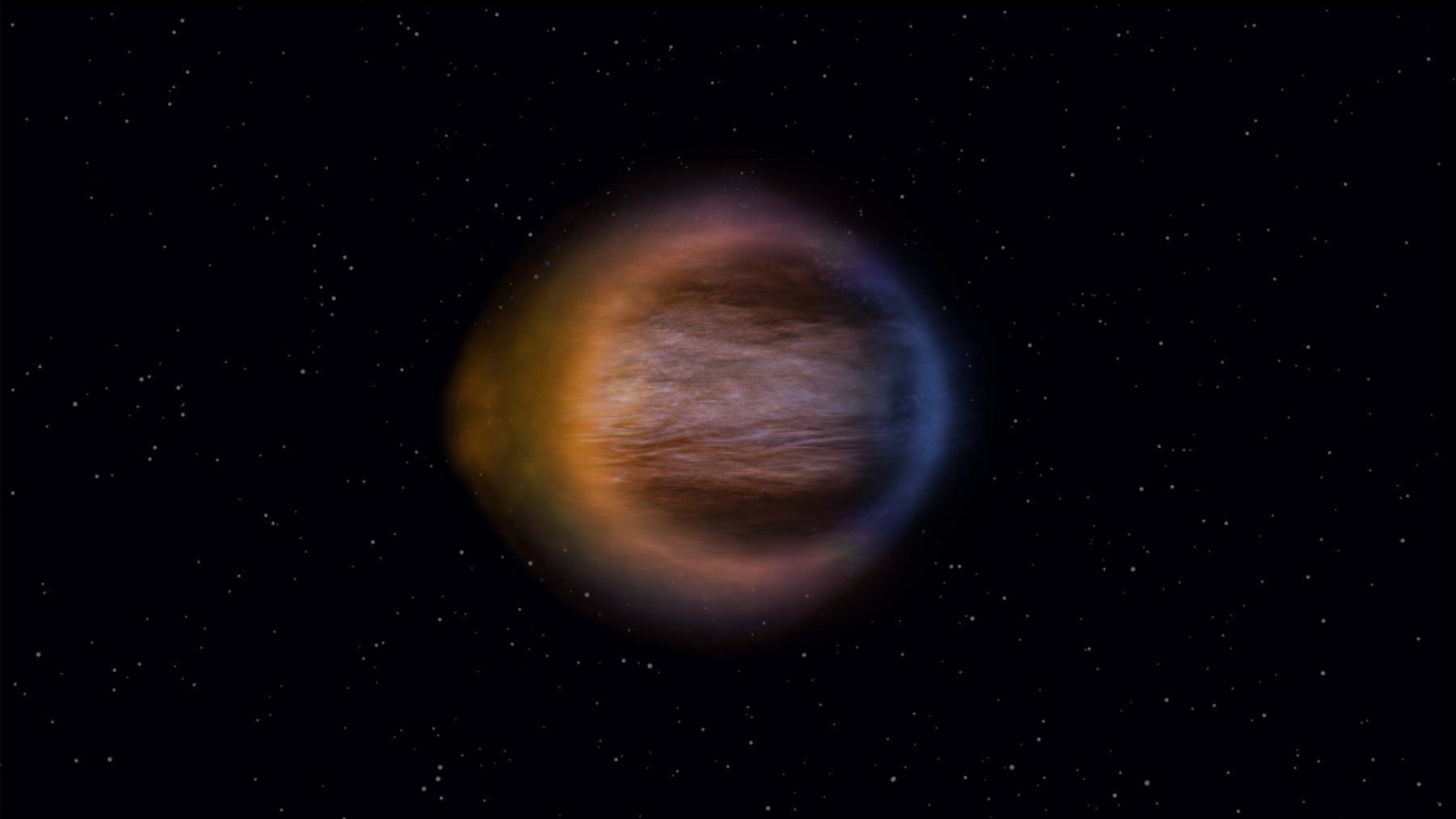
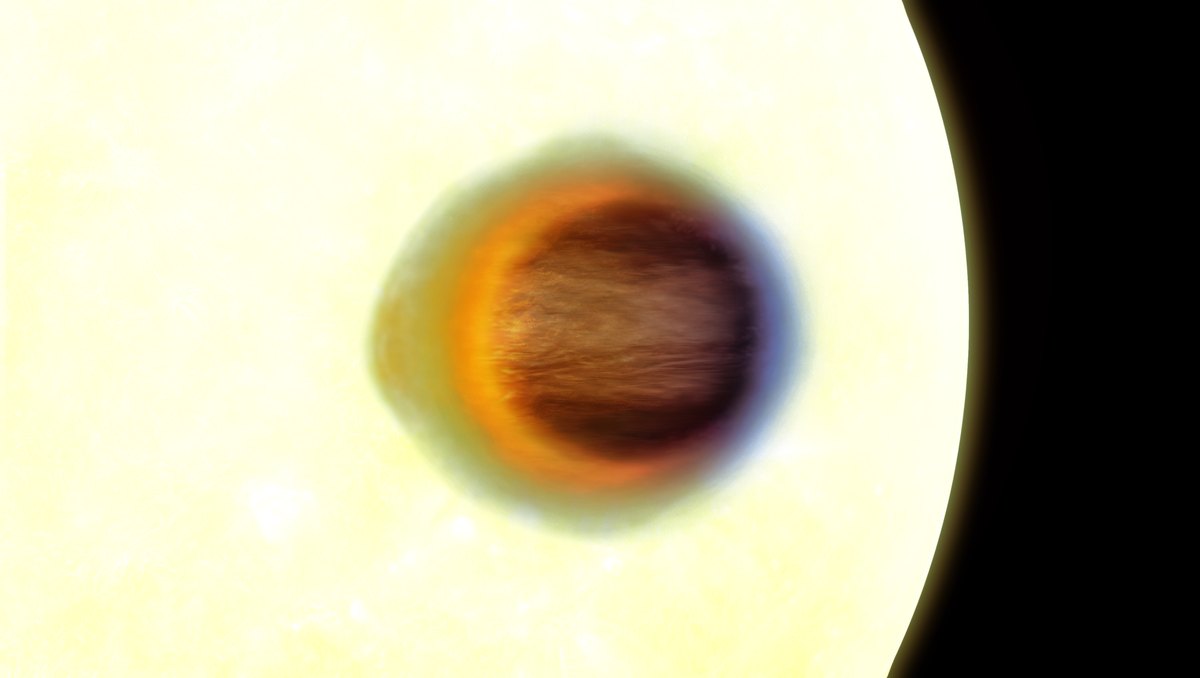
Astronomers using NASA’s James Webb Space Telescope have measured the real outline of the WASP-17b atmosphere. The gas giant lies about 1,300 light-years from Earth, and its outline is not the perfect circle that models usually assume. One side bulges outward, inflated by gas near 2,280 degrees Fahrenheit (about 1,250 degrees Celsius).
The study appeared October 14 in Nature Astronomy. It was led by Lili Alderson, a Klarman Postdoctoral Fellow at Cornell University. She began the work during her doctorate at the University of Bristol.
Evening edge near 2,280°F
According to the paper, the morning edge of WASP-17b sits at about 858 kelvins. That is roughly 1,085 degrees Fahrenheit (585 degrees Celsius). The evening edge reaches about 1,522 kelvins, so the gap is close to 650 kelvins, or about 1,170 Fahrenheit degrees.
Since hotter gas takes up more room, the two sides do not stand out equally. The team calculated the scale height, a measure of how far an atmosphere puffs outward. On the evening side it is about 1.77 times that of the morning side.
“This is proof of concept that planets are in fact 3D objects, and that consistently, as they go around their star, what we predict should be happening is happening,” Alderson said in the Cornell announcement.
Locked with one face sunward
WASP-17b is a hot Jupiter, a giant planet that orbits very close to its star. NASA calls it one of the largest and puffiest exoplanets known. It has more than seven times the volume of Jupiter, less than half its mass and an orbit of just 3.7 Earth days.
The planet is tidally locked, so the same hemisphere always faces the star. The other half stays in permanent darkness. Its morning and evening edges are the two borders between day and night, not times on a clock.
According to the Cornell and Bristol teams, jets of wind carry heat from the lit side across the evening edge. The gas cools in the dark and then crosses back over the morning edge. Webb has tracked similar heat circulation on other roasting exoplanets.
Transmission strings, built in Bristol
Astronomers study these worlds during a transit, when the planet passes in front of its star. Some starlight filters through the thin ring of air around the planet, called the limb. On the way, it picks up the fingerprints of the gases there.
Usually, astronomers squash that whole ring into one averaged spectrum. Hannah Wakeford, associate professor of astrophysics at Bristol, and senior postdoctoral associate David Grant built a method that does not. It lets the distance from the center to the edge change around the rim.
Timing does the rest, because different parts of the limb cross the star at slightly different moments. “Rather than assuming your planet is a circle with the same radius all the way around, our technique allows you to pull out different distances from the center to the edge of the planet,” Alderson said.
For WASP-17b, the researchers split the rim into angles. They fitted the light from each angle separately, as if each were its own planet. That let them follow changes from the equator toward the poles, not just between two halves.
Three Webb instruments, March 2023
The light came from transits recorded in March 2023 with Webb’s NIRISS, NIRSpec and MIRI instruments. Together they covered wavelengths from 0.6 to 12 micrometers. The data belong to the TST DREAMS program, led by Cornell astronomer Nikole Lewis.
“It was also nice to confirm that important molecules like water and carbon dioxide are pretty consistent all the way around the limb,” Alderson said. Climate modelers can now check their simulations of WASP-17b against those numbers.
“Planets are temperamental, their atmospheres complex and chaotic,” Wakeford said in the University of Bristol release. NASA, the UK Science and Technology Facilities Council and the Klarman Fellowship funded the work.
Eclipse maps tell the same story
An earlier study led by Bristol doctoral student Daniel Valentine used a different trick, eclipse mapping. It watched the light change as WASP-17b slipped behind its star. Its hottest spot was pushed east of the point right under the star, as if winds were dragging the heat along.
The new transit map agrees with that result and with separate readings of the night side. Exact temperatures differ, since each technique samples a different layer of air. Alderson called the morning-to-evening contrast “pretty much bang-on what we thought it would be.”
On WASP-39b, a cooler gas giant, Webb found the evening edge only about 320 Fahrenheit degrees warmer than the morning edge. The authors link the bigger gap on WASP-17b to its higher temperature, as circulation models predict.
Clouds around the rim remain unmeasured
Alderson and her 20 co-authors list a few shortcuts in their paper. They assumed the north and south halves of the planet match, which cut the computing time, because earlier simulations of WASP-17b showed winds racing along the equator. The temperatures also lean on atmospheric models of extreme planets.
Clouds stayed out of reach. No angle gave a clear reading of cloud height or haze, even though the measured temperatures span the point where theory expects clouds to switch from silicate minerals to salts. New MIRI observations of WASP-17b are planned to check whether different clouds sit around the rim.
And the bulge sits in gas that blocks starlight, not in any solid surface. Alderson and Wakeford expect to map many more planets this way, which goes beyond the usual question of what an atmosphere contains.
The full study was published in Nature Astronomy.
Image: Engine House and Hannah Wakeford