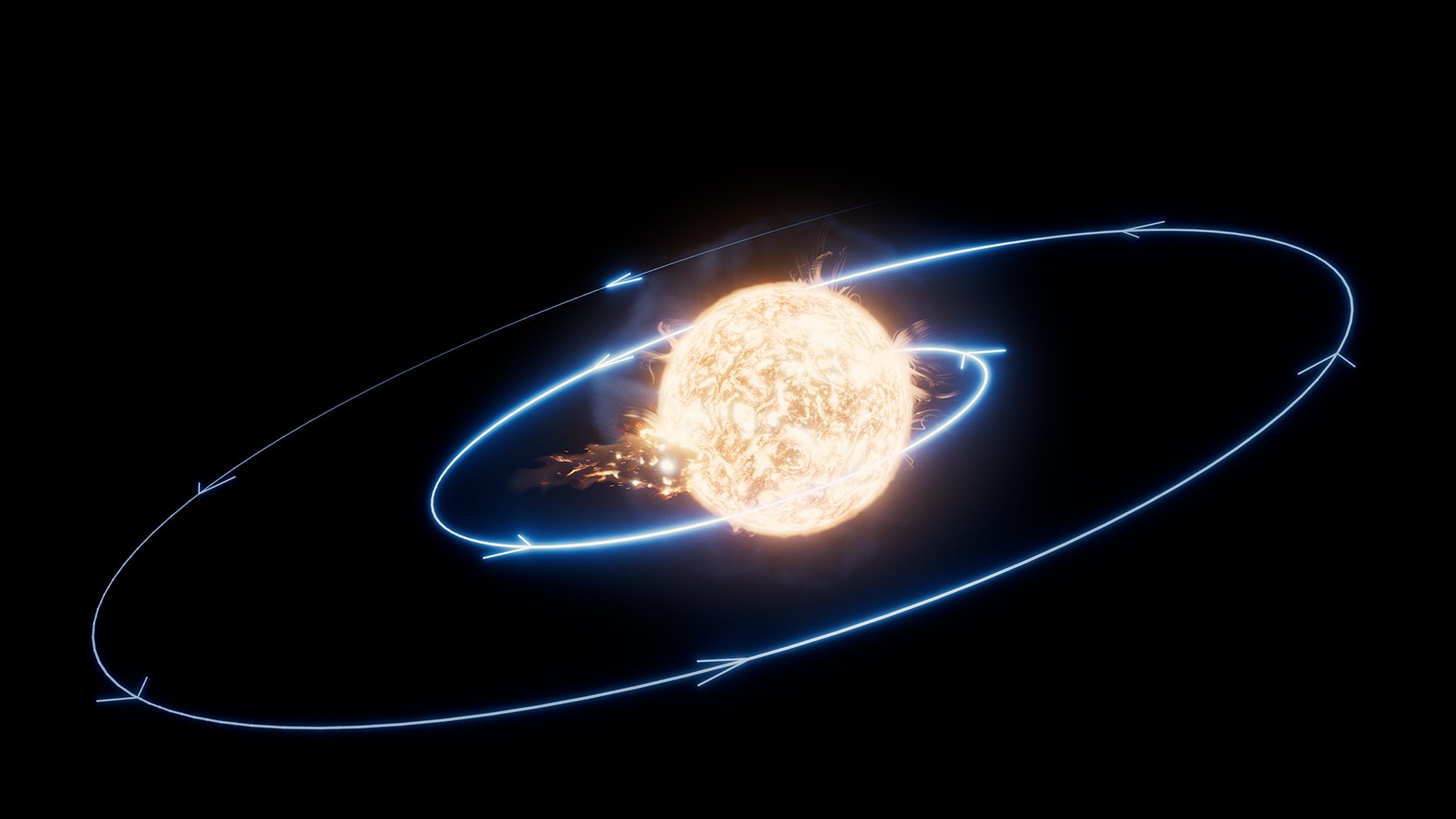
NASA’s James Webb Space Telescope has watched a giant exoplanet go through one of the most dramatic temperature swings ever seen beyond our solar system. The planet, called HD 80606 b, is roughly 4 times the mass of Jupiter and follows a stretched-out orbit that sends it sweeping close to a Sunlike star.
As it makes that close pass, Webb shows the planet’s temperature jumping by 1,100°F. That is not just a hot day in space. It is a rapid atmospheric shock that could help scientists understand how alien weather, chemistry, and clouds change almost in real time.
A planet with a wild orbit
HD 80606 b is a gas giant, which means it is more like Jupiter than Earth. According to NASA’s exoplanet catalog, it takes about 111.4 days to complete one trip around its star, and its discovery was announced in 2001.
The key detail is the shape of that path. NASA lists the planet’s orbital eccentricity at 0.93, which means its orbit is extremely stretched rather than close to circular.
Most “hot Jupiters” stay close to their stars all the time. HD 80606 b is stranger because it spends part of its orbit farther away, then rushes inward for a brutal blast of starlight.
Webb watched the heat rise
The research team used Webb’s Mid-Infrared Instrument, also known as MIRI, to observe the planet before, during, and after periastron, the point where it comes closest to its star. During that same period, the planet also passed behind the star from Webb’s point of view in what astronomers call a secondary eclipse.
Catching that moment was not simple. NASA said the observation took years of planning because the planet’s 111-day orbit and Webb’s viewing limits had to line up just right.
And then came the payoff. Webb detected a far stronger temperature rise than scientists had expected from earlier Spitzer Space Telescope data.
Why this world matters
HD 80606 b is not a place where anyone would look for life. It is a massive, punishing gas giant, and its close pass by its star is more like flying into a furnace than drifting through a calm solar system.
Still, that is exactly why scientists care. When a planet changes this fast, researchers can watch its atmosphere respond under different conditions in a short window of time.
Tiffany Kataria, the study’s principal investigator at NASA’s Jet Propulsion Laboratory, called HD 80606 b “one of the most extreme” hot Jupiters. She also said its unusual orbit creates a “different beast,” because it does not behave like the more familiar gas giants that simply sit close to their stars.
Reading light like fingerprints
To study the planet, scientists used spectroscopy. Effectively, Webb breaks incoming light into its component colors so researchers can look for clues about temperature, motion, and chemical composition.
It sounds technical, but the basic idea is surprisingly down-to-earth. Just as a detective looks for fingerprints at a scene, astronomers look for chemical fingerprints in light.
That is where Webb’s power becomes important. Ryan Challener, a co-author from the Cornell Center for Astrophysics and Planetary Science, said Webb can help distinguish chemical signatures such as “methane and carbon dioxide.”
Spitzer set the stage
Before Webb, NASA’s retired Spitzer Space Telescope had already studied HD 80606 b in infrared light. That earlier work helped make the planet famous as the “roasted exoplanet,” a nickname NASA even used in one of its popular poster series.
Spitzer showed that this planet was worth a much closer look. Webb is now building on that legacy with more detailed spectroscopic data, giving scientists a sharper view of how the atmosphere changes during the planet’s close approach.
Kataria said Webb revealed that the planet’s temperature increase was even more extreme than expected. That is the kind of result that makes researchers go back to their models and ask what they missed.
A laboratory in motion
Laura C. Mayorga, a co-investigator and exoplanet astronomer at the Johns Hopkins Applied Physics Laboratory, said observing HD 80606 b is “very efficient.” The reason is simple enough. One orbit lets scientists collect data under rapidly changing temperatures and chemistry.
That matters because exoplanets are often hard to study in detail. They are distant, faint, and usually overwhelmed by the light of their stars.
With HD 80606 b, the drama is built into the orbit. The planet gives scientists a natural experiment, repeating again and again every 111.4 days.
What comes next
The research team says it has only started digging into the Webb dataset. That is worth keeping in mind, because early findings can be powerful without being the final word.
For the most part, this discovery is not about one strange planet alone. It is about learning how giant planetary atmospheres behave when heat arrives suddenly, intensely, and unevenly.
At the end of the day, HD 80606 b is a reminder that planets are not static balls hanging quietly in space. Some are restless worlds with atmospheres that react, shift, and rewrite themselves under extreme pressure.
The press release was published on NASA’s website.