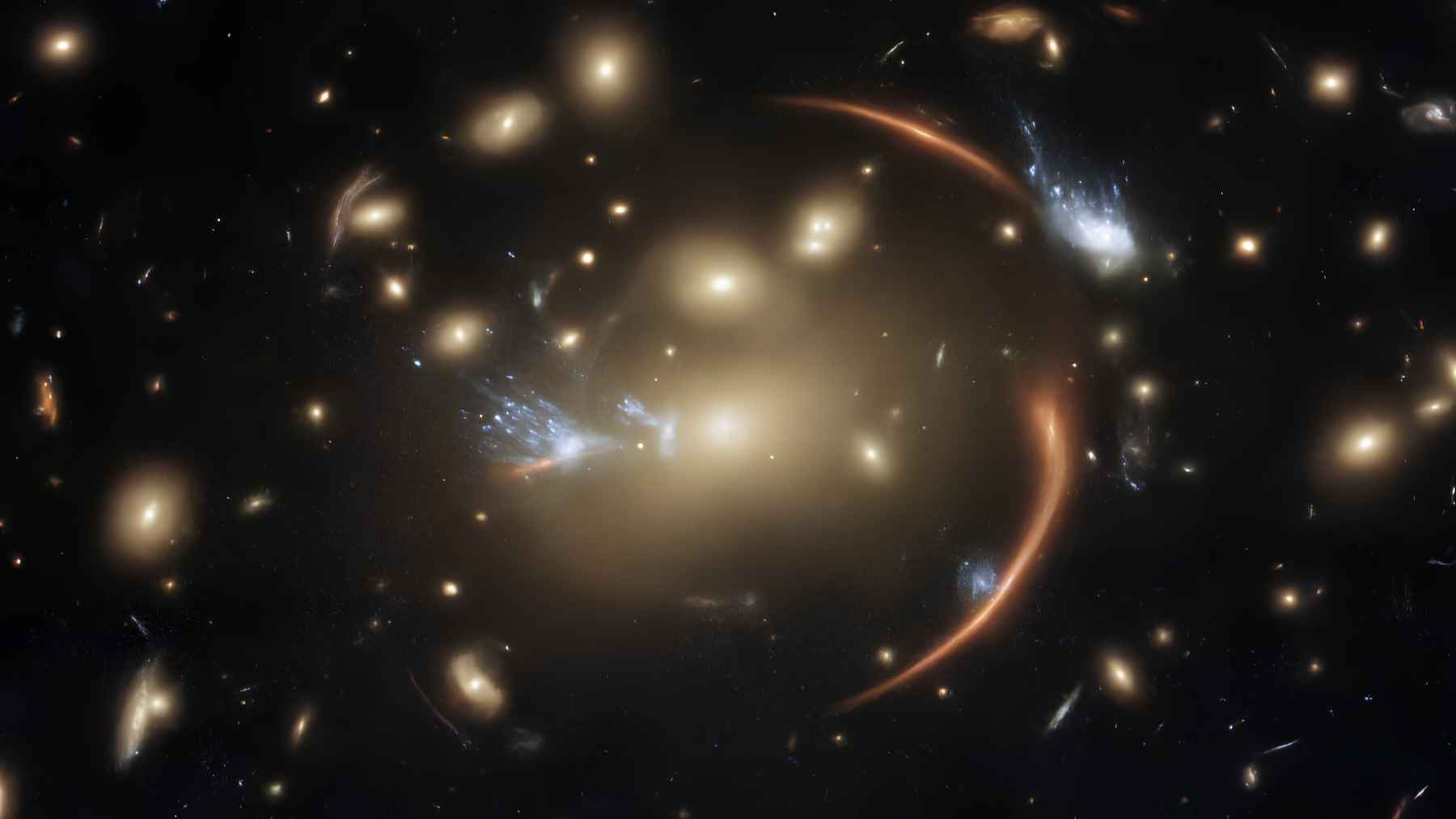
A tiny particle that crossed the universe and reached Antarctica may have started its journey inside a distant galaxy wrapped in dust. A new study points to JCMT0402−0424, nicknamed “Shadow Blaster,” as the most plausible source of a high-energy neutrino detected by IceCube in 2021.
The finding matters because scientists have struggled for years to explain where many of the universe’s most energetic neutrinos come from. This candidate source is not a blazing black hole jet, the usual suspect, but a crowded star-making galaxy about 11 billion light-years away. That changes the story.
The ghost particle
Neutrinos are often called ghost particles because they barely interact with normal matter. Trillions can pass through your body without you noticing a thing, which is strange to imagine while sitting at a desk or walking down the street.
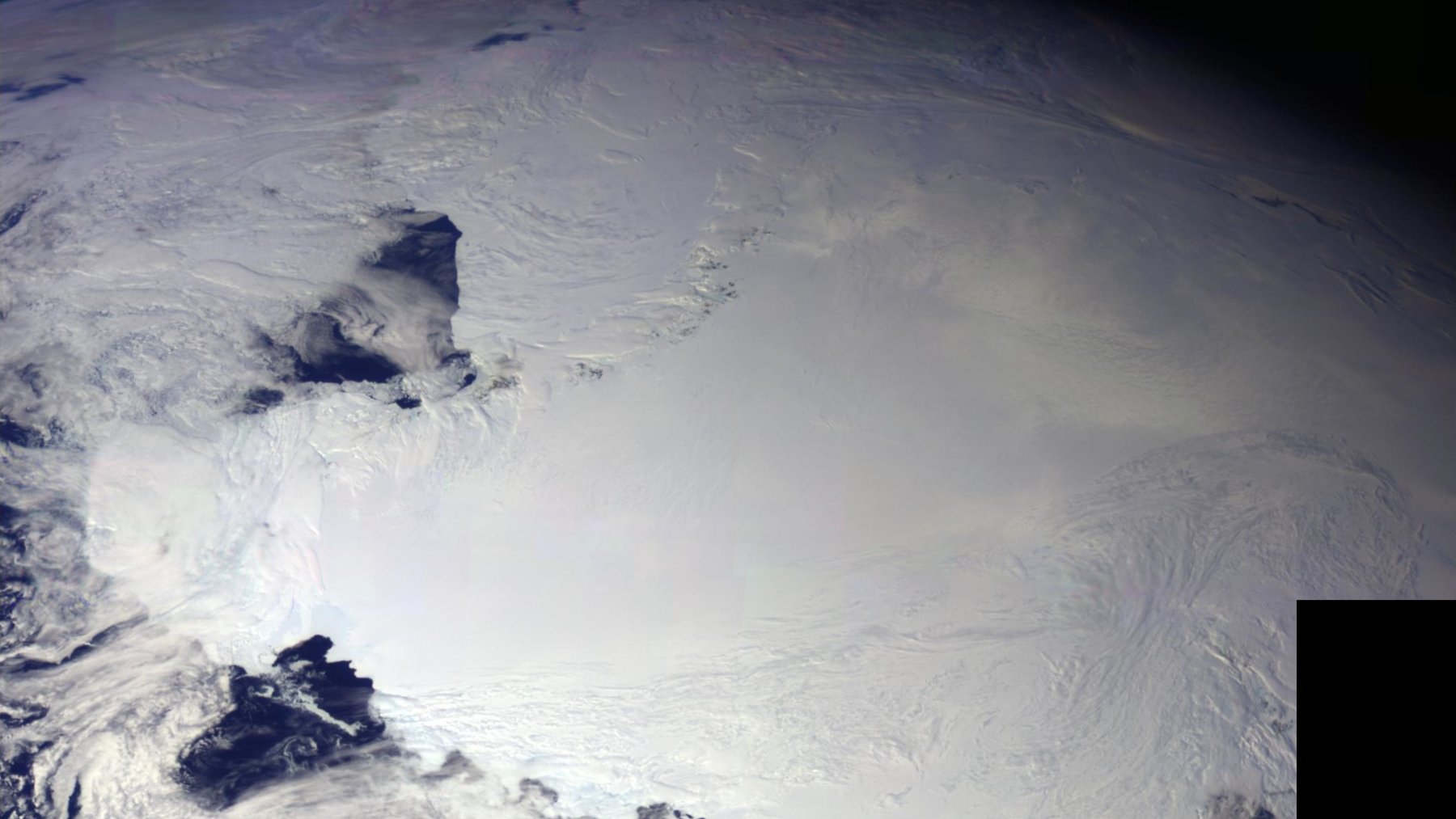
They carry no electric charge and have very little mass, so they can travel across space almost untouched. That makes them valuable cosmic messengers, but also very hard to catch. IceCube, buried in Antarctic ice, is built to detect the rare moments when these particles finally leave a signal.
A signal from Antarctica
On September 22, 2021, IceCube detected a high-energy neutrino event called IC 210922A. The alert sent astronomers searching the same patch of sky for a matching source in light, radio waves, X-rays, and gamma rays.
At first, nothing obvious turned up. No convincing gamma-ray burst, supernova, or star-shredding black hole event appeared in the region. Then Yuji Urata of MITOS Science Co. LTD. in Taiwan and his team used the James Clerk Maxwell Telescope and the Submillimeter Array on Maunakea, Hawaii, and found Shadow Blaster.
Meet Shadow Blaster
Shadow Blaster is not a normal-looking galaxy in visible light. It is heavily hidden by dust, but it shines intensely in infrared and submillimeter light, the kind astronomers use to see cold dust and gas that ordinary telescopes may miss.
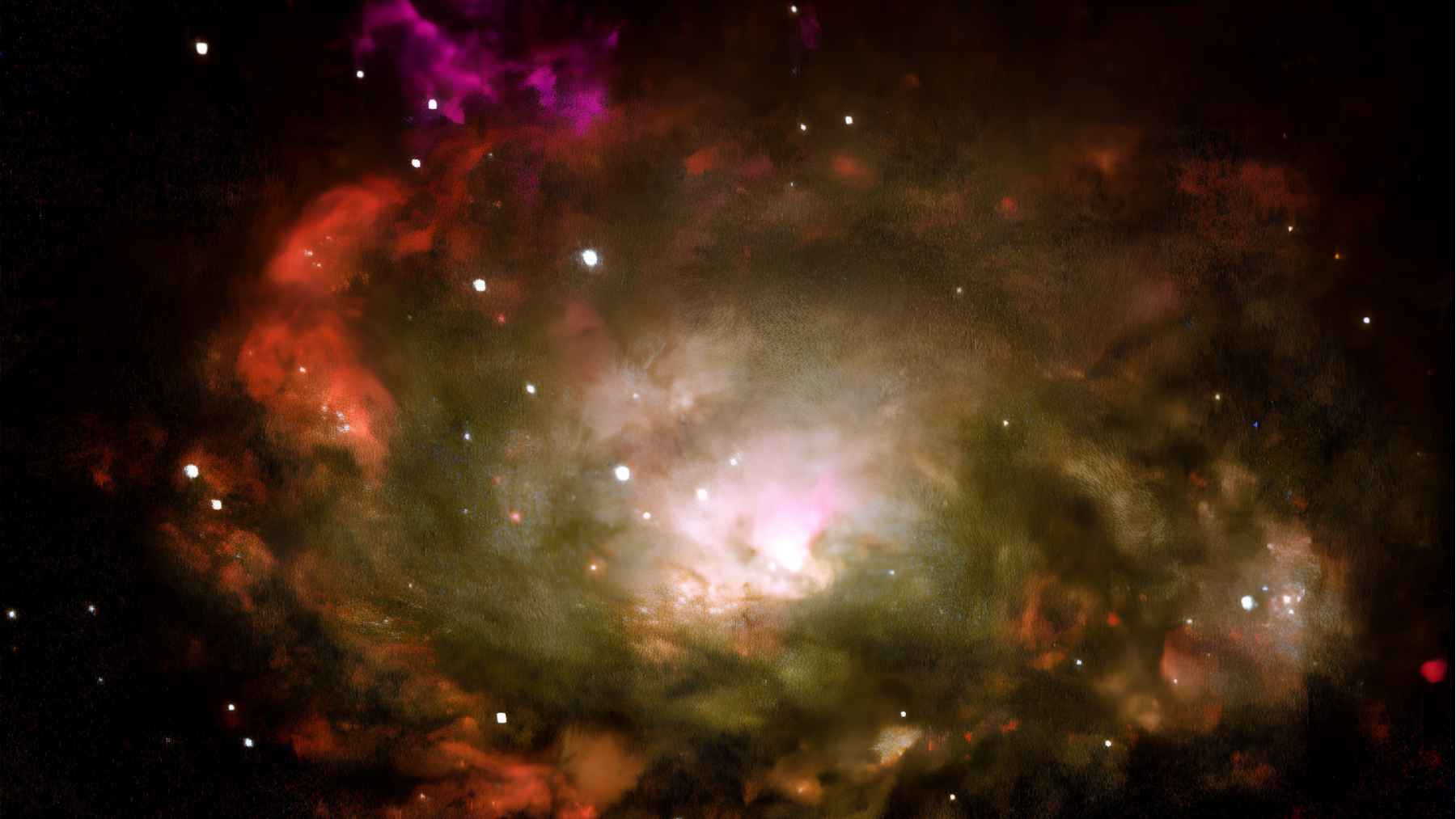
The galaxy is also being magnified by a natural trick of gravity. A massive galaxy in front of it bends and boosts its light, acting like a cosmic magnifying glass. This effect, called gravitational lensing, helped astronomers see details that would otherwise be too faint and far away.
A cosmic magnifying glass
Follow-up observations with ALMA showed that Shadow Blaster is strongly lensed and split into multiple distorted images. Gemini North data helped the team measure the foreground galaxy that created the lens, which was needed to understand how much the distant galaxy had been brightened.
In practical terms, nature handed scientists a telescope they could not build on their own. The lens revealed a compact central region packed with gas and dust, where new stars are forming at an intense rate. That crowded core is the key part of the discovery.
Not the usual black hole story
Many known or suspected high-energy neutrino sources involve active galaxies, where a supermassive black hole feeds on surrounding material and can launch powerful jets. IceCube has already linked neutrinos to active galaxies such as NGC 1068, also known as Messier 77.
Shadow Blaster looks different. The team did not find the bright X-ray or gamma-ray signs expected from a dominant active black hole. Instead, the galaxy seems to be powered largely by dense star formation, the messy and energetic process that builds new stars inside dusty gas clouds.
Why star formation matters
When stars form rapidly in a tight space, the environment can become violent. Exploding stars and other energetic processes can accelerate particles called cosmic rays, which are high-speed bits of matter racing through space.
If those cosmic rays crash again and again into dense gas, they can produce neutrinos. Urata said Shadow Blaster has the kind of gas-rich setting that models suggest could make high-energy neutrinos efficiently. That is why this galaxy is now the strongest candidate for IC 210922A.
A missing piece of the universe
The wider question is bigger than one particle. IceCube has measured a diffuse background of high-energy neutrinos arriving from across the universe, but known sources do not fully explain it.
The study suggests that compact dusty star-forming galaxies like Shadow Blaster could account for up to roughly one-fifth of that background. Not all of it. But a meaningful slice, and that is enough to make astronomers look again at hidden galaxies from the universe’s busiest era of star birth.
A new way to search
Martin Still, program director at the NSF Office of Research Infrastructure, said the work shows the power of combining particle detectors and telescopes. Scientists call this “multi-messenger” astronomy, which simply means studying the universe using more than one kind of signal.
Light tells one part of the story. Particles tell another. Put them together, and distant places that once seemed invisible can suddenly become readable, almost like turning on subtitles for the cosmos.
What comes next
The researchers are careful. Shadow Blaster is the most plausible candidate, not a final courtroom verdict. A chance alignment cannot be completely ruled out, and more events will be needed to prove that galaxies like this are common neutrino factories.
Still, the case is unusually strong because the galaxy sits in the right region, has the right dense core, and lacks a better rival after wide follow-up searches. If confirmed, Shadow Blaster would be the first individual dusty star-forming galaxy directly tied to a high-energy neutrino event.
The official study has been published in Nature Astronomy.