A flashing notification. A moving shadow. Something bright at the edge of your vision. Any of these can pull your attention away from what actually matters.
Yet the brain usually sorts through this mess in a fraction of a second. It picks the most useful signal and pushes weaker distractions aside. A new mouse study points to a surprisingly ancient group of brainstem neurons as a key part of that process.
Researchers found that temporarily silencing these cells made mice far more likely to be fooled by distracting visual information. Even weak distractions became a problem. Their eyesight and ability to move remained largely intact. So what went wrong? Their ability to decide what deserved attention.
An ancient attention circuit
The cells are known as parabigemino-lateral tegmental inhibitory neurons, or PLTi. They sit in the brainstem and belong to a system that researchers describe as evolutionarily ancient.
That is interesting for a simple reason. Scientists have traditionally linked selective attention mostly to higher cortical networks. PLTi suggests that at least part of the job may happen much deeper in the brain.
Lead author Ninad B. Kothari and senior author Shreesh P. Mysore worked on the research with Arunima Banerjee, Qingcheng Zhang, and Wen-Kai You at Johns Hopkins University.
“When we inactivate these neurons, the mice become hyper distractable,” Kothari explained. Mysore described this part of the brain as “an attentional selection engine.”
A mouse version of a human test
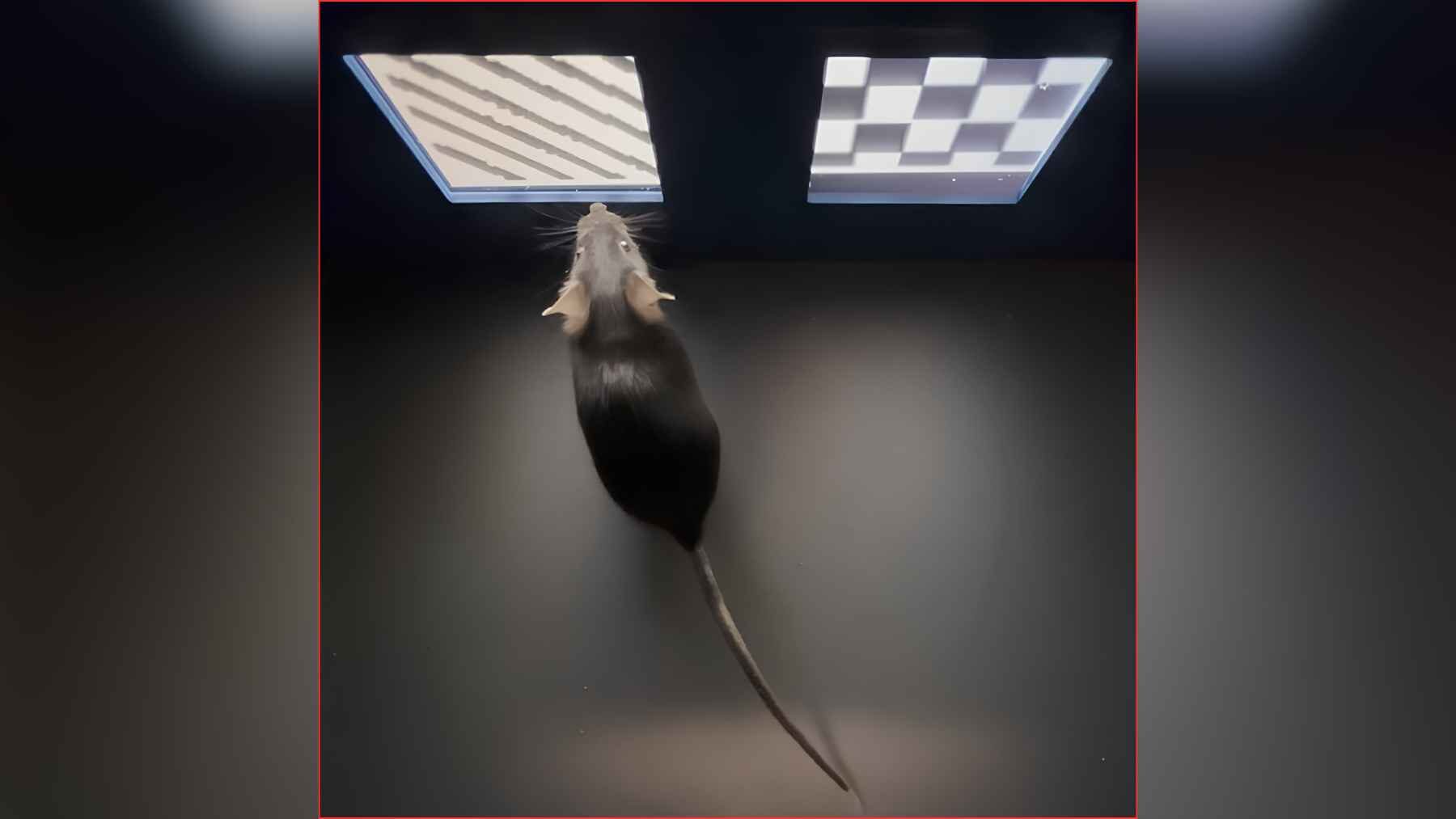
How do you test whether a mouse is paying attention? The researchers used a touchscreen flanker task modeled on a classic human attention test. Each mouse had to identify whether a small central pattern was horizontal or vertical while ignoring another pattern sitting off to the side.
Get it right, and the mouse received a small water reward.
Sometimes the side pattern matched the target. Sometimes it pointed toward the opposite answer. The researchers also changed how strongly the distracting image stood out.
That gave them a way to test two different things. How noticeable was the distraction? And did it contain information that mattered to the mouse?
What happened when PLTi went quiet
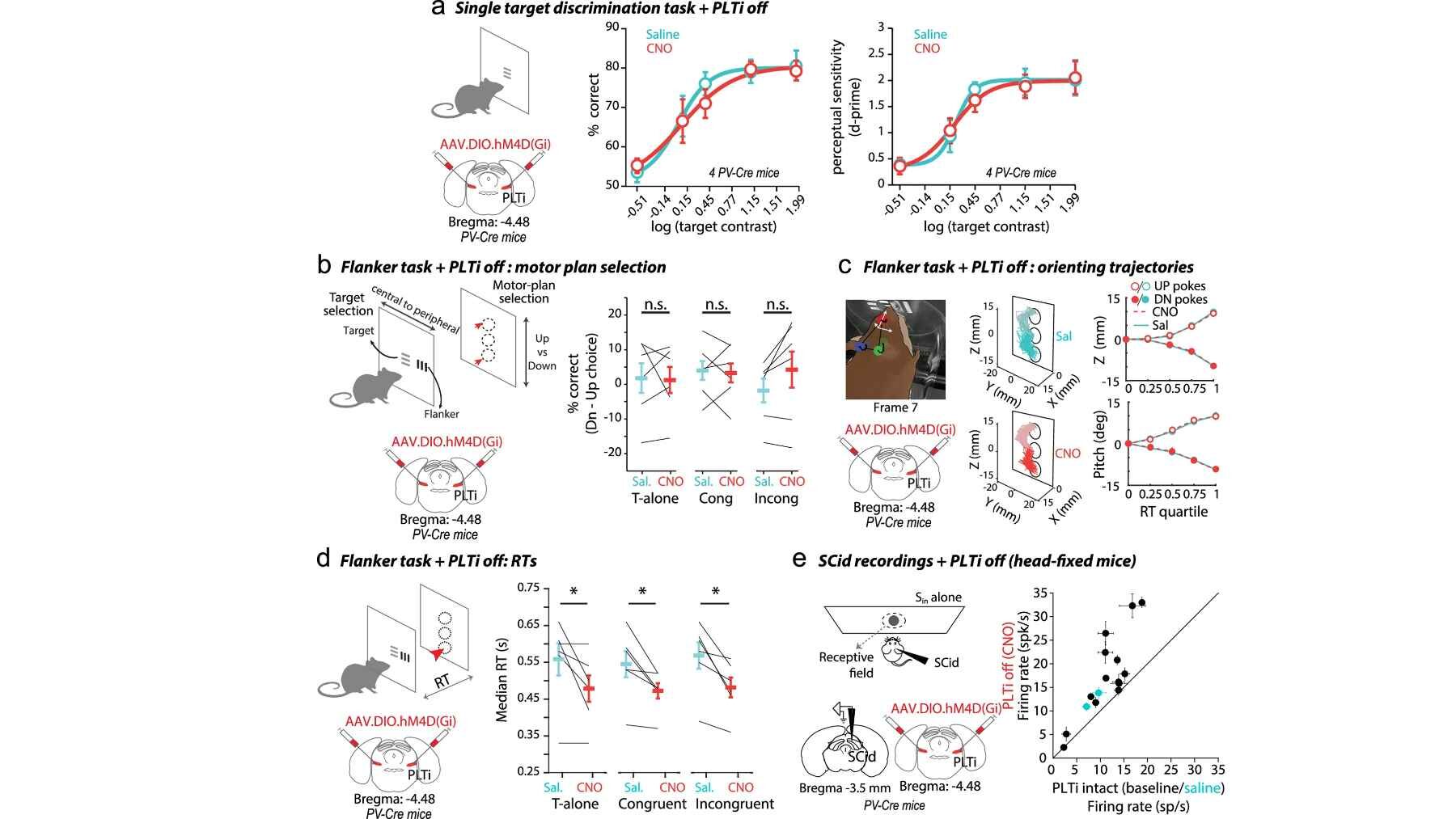
Next came the key experiment. Scientists used chemogenetics, a technique that allows specific neurons to be temporarily quieted, to silence PLTi on both sides of the brain. When the target and distractor conflicted, accuracy dropped sharply. Even weak but relevant distractions could push the mice toward the wrong answer. the effect was surprisingly specific.
The mice could still identify individual targets. They could still choose between the response locations. Their head movements also looked normal.
In other words, they could see. They could move. The problem appeared when two pieces of information started competing for attention.
Brightest does not always win
Attention is not just a contest where the brightest thing automatically wins.
Think about searching for a friend in a busy crowd. Someone wearing a neon jacket may instantly catch your eye. But if you are looking for your friend, a familiar face matters more.
The brain has to combine both types of information. What stands out physically and what matters right now.
The researchers tested exactly that. They replaced the meaningful distracting pattern with an equally visible shape that contained no useful orientation information.
What happened? Silencing PLTi no longer caused the same distraction problem.
That suggests this circuit is not simply reacting to whatever is brightest or most obvious. It also seems to care about relevance.
Drawing the line between target and distraction
With PLTi working normally, the mice behaved as though their brains drew a fairly sharp line between the important target and competing signals.
Below that line, the target usually won. Once the distractor became strong enough, errors rose quickly. Not slowly. Quickly.
Researchers describe this as a winner-take-all-like process. Think of it as a tiny tournament inside the brain. Different signals compete, and one gets to guide behavior.
When PLTi was switched off, that boundary changed. Weaker distractions could now win, and the line between “pay attention to this” and “ignore that” became fuzzier. The brain’s filter had become easier to beat.
A pathway through the superior colliculus
So how might PLTi actually do this? The researchers traced its connections to the superior colliculus, a midbrain structure involved in mapping important locations and guiding attention and movement.
PLTi sends inhibitory signals there. In simple terms, those signals act a little like brakes. They help control the competition between different visual signals.
Recordings showed that when PLTi was functioning normally, neurons in the superior colliculus represented the stronger of two competing stimuli with a sharp boundary.
Silence PLTi, and that boundary shifted. It also became less precise. Interestingly, this neural change closely matched what happened to the mice’s behavior.
Why the circuit’s age matters
Most modern explanations of attention put a lot of emphasis on the frontal and parietal cortex. But there is a catch.
Birds, fish, rodents, and other vertebrates with very different cortical anatomy can still focus on useful information while ignoring distractions. That has long suggested that older brain systems may also be doing some of the work. PLTi fits that idea nicely.
The circuit may represent an ancient solution that evolution kept around while newer cortical systems developed on top of it. That does not mean the cortex is unimportant. Far from it.
Instead, attention may depend on several layers of the brain working together, from old brainstem circuits to much newer cortical networks.
What could this mean for people?
This is where things get tempting. But also where caution matters.
Problems with selective attention occur in conditions including ADHD and schizophrenia, and silencing PLTi produced unusually high distractibility in mice. Johns Hopkins researchers say the discovery could eventually help scientists think about attention disorders in new ways. Still, this study was done in mice. Not people.
It did not test a treatment, diagnose a disorder, or prove that the same PLTi mechanism controls human attention in exactly the same way.
There are also unanswered questions. Does PLTi actually calculate which signal should win? Or does it receive that decision from somewhere else and simply pass it along? Researchers do not know yet.
What the study does provide is a clearer look at something we do constantly without thinking about it. Ignore this. Focus on that. Move on.
It sounds simple.Inside the brain, it clearly isn’t.
The official study has been published in Nature Communications.