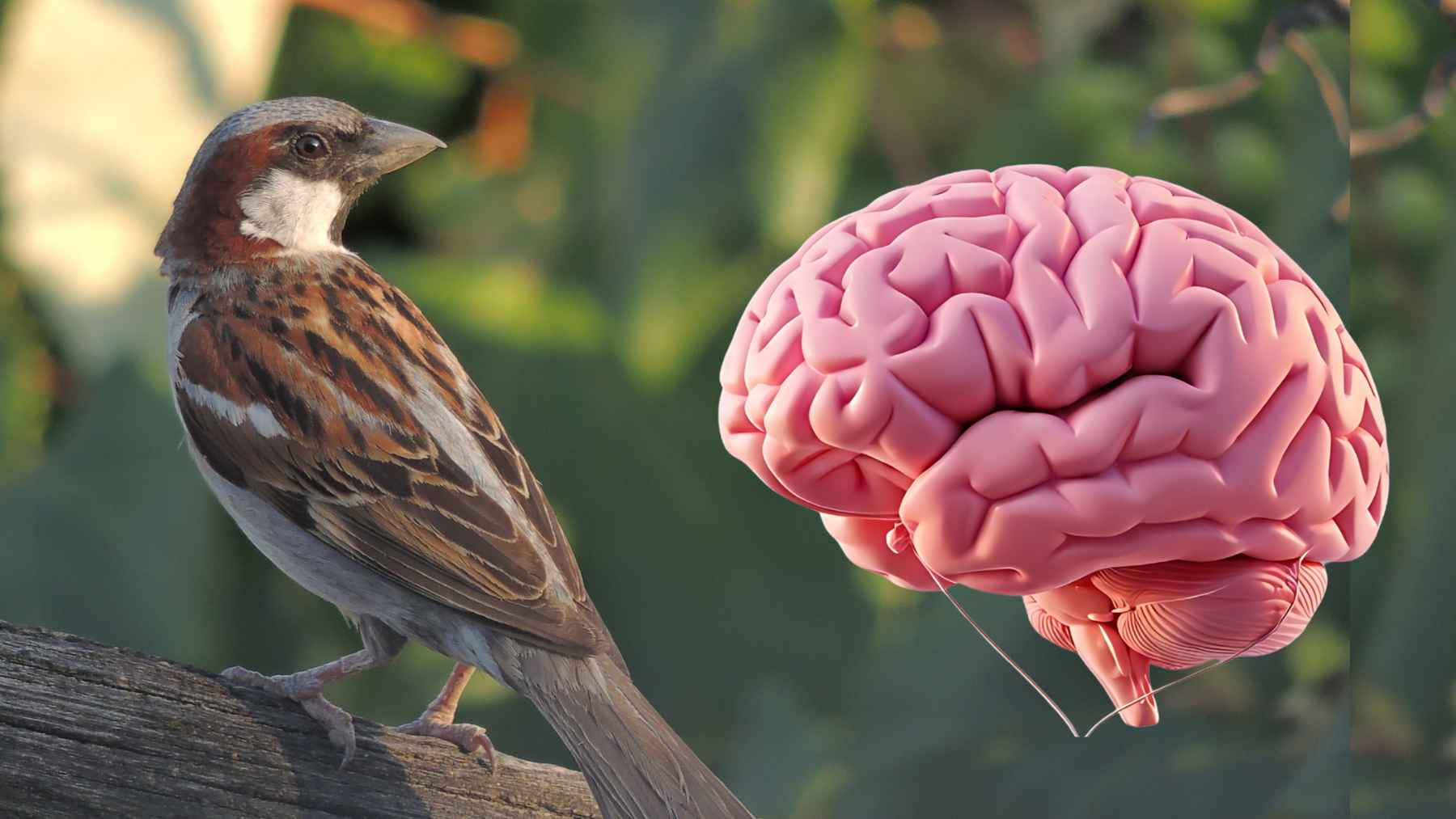
If you have ever tried to tell two almost identical sparrows apart, you already know birding is not just a slow walk with binoculars. It can feel like a fast quiz, especially when the bird is already flying away.
A new brain imaging study suggests that years of serious bird identification are linked to differences in the parts of the brain that handle attention, visual detail, and memory. The research compared expert birders with beginners across a wide age range and found a consistent pattern.
Birding pushes the brain to notice tiny details
Birders train themselves to spot small clues such as a wing stripe, a beak shape, or a split-second flash of color in a shady tree. It is the kind of focus that can make a regular park path feel like a puzzle.
Scientists call the brain’s ability to change with experience neuroplasticity, and birding is a useful way to study it. You have to notice details, hold them in mind, and make a decision. In practical terms, the mind learns what to ignore and what to lock onto, fast.
So what does that look like inside the brain, especially as people get older? That question is at the heart of this study.
Inside the study
In a peer-reviewed paper, Erik A. Wing of Baycrest Hospital, Jordan A. Chad, Geneva Mariotti, Jennifer D. Ryan, and Asaf Gilboa compared 29 skilled bird identification experts with 29 age- and sex-matched novices.
The experts were ages 24 to 75 and the beginners were ages 22 to 79, with 15 women in the expert group and 14 women in the beginner group. The findings were published March 25, 2026.
The researchers tracked both brain structure and brain activity. To look at structure, they used diffusion-weighted MRI, a type of scan that tracks how water moves through brain tissue.
They also used functional MRI, which measures changes linked to brain activity while people do a task. Participants had to match birds after a short delay, including both local species and nonlocal species that were less familiar.
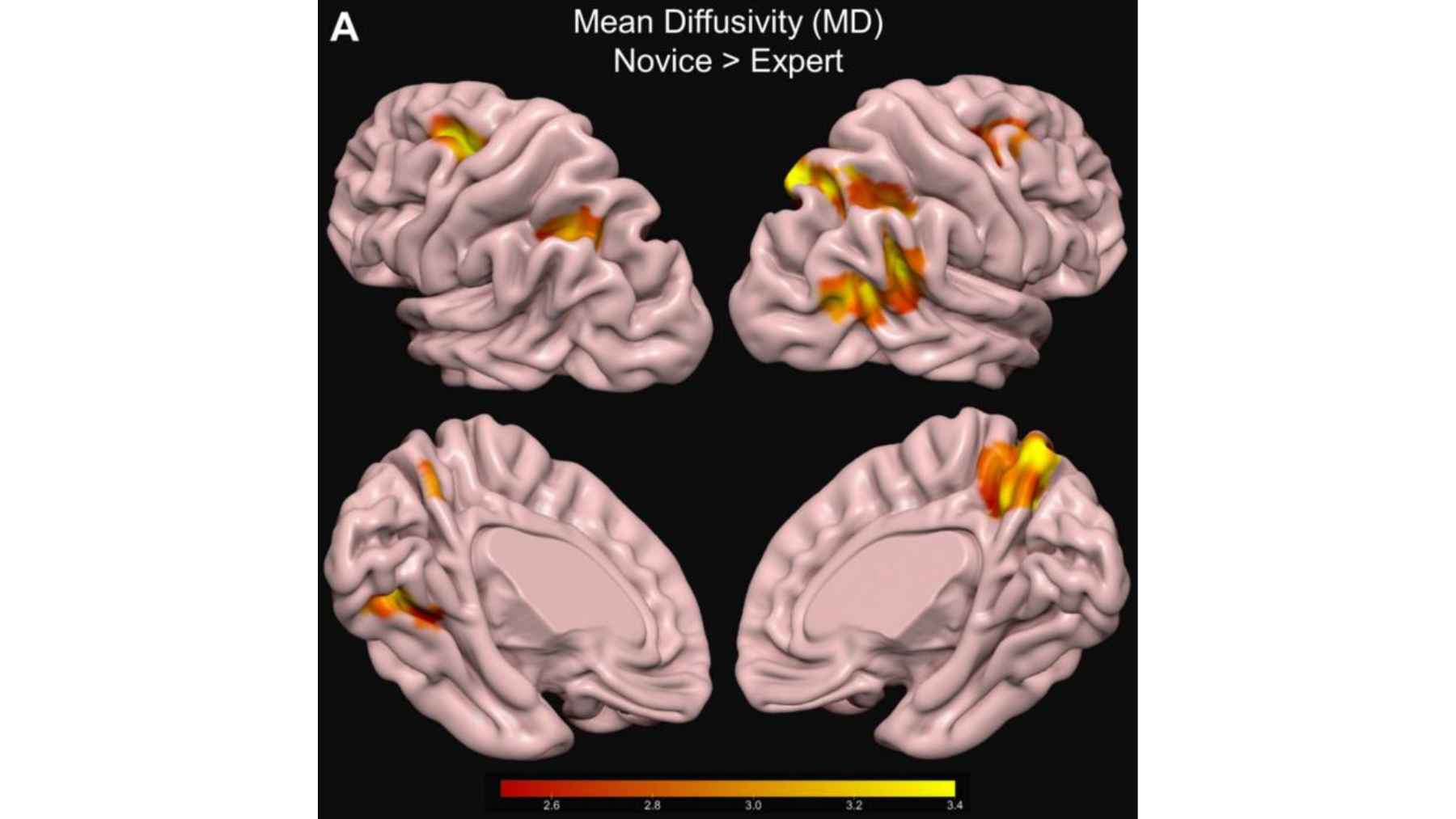
MRI scans highlight structural brain differences between expert birders and beginners, especially in attention networks.
A structural fingerprint of expertise
The clearest structural difference showed up in frontoparietal areas, which help control attention, and in regions farther back that help with detailed visual recognition.
Compared with beginners, experts showed lower mean diffusivity, which generally means water movement in those areas was more constrained. These areas sit in the cortex, the brain’s outer layer that supports many complex skills.
A Society for Neuroscience news release described the measure in plain language, and the paper itself is available as the study. After introducing the approach, the lead author said, “There’s more constraint on where water goes in the brains of experts.”
Importantly, those structural signals were not just decorative brain facts. Lower mean diffusivity across the expert-linked regions predicted higher bird identification accuracy among the experts, tying brain structure to real performance.
When the birds were unfamiliar, attention networks lit up
The team did not stop at structure. When experts had to judge the less familiar nonlocal birds, the same attention-related networks in the front and top parts of the brain were more strongly engaged than when they judged local birds.
That pattern matters because it suggests the brain is not only different in its wiring, but also tuned during the moments that actually feel hard. The bigger the response to nonlocal birds compared with local birds, the better the expert tended to do on the task.
If you have ever watched a birder go quiet, scan a tree, then suddenly say a confident name, you are seeing that tuning in action. The study suggests those snap decisions rely on brain systems that help hold details in mind and steer attention toward the right features.
Aging and the idea of cognitive reserve
The participants ranged from 22 to 79 years old, so the researchers could look at how expertise and aging show up together. In the expert group, the age-related changes in mean diffusivity appeared to increase more gradually in some regions, which the authors described as a trend rather than a proven shield against aging.
The same news release noted that these structural differences persisted in older experts, raising a bigger question about cognitive reserve, which is the idea that some experiences may help the brain cope better with age. The lead author offered a careful takeaway, saying, “Acquiring skills from birding could be beneficial for cognition as people age.”
The researchers are exploring whether birding skills can transfer to other kinds of memory tasks, and they report that older birders remembered arbitrary faces paired with birds better than beginners. Because this kind of comparison is a snapshot, it cannot prove birding caused the brain differences. More long-term studies would be needed to sort out cause and effect.
How this fits with earlier research on skill and the brain
Birding is not the first expertise that has been linked to brain differences. A well-known example is a 2000 taxi driver study, which reported that intensive navigation experience was associated with differences in the hippocampus, a region tied to memory and mental maps.
Training studies have also pointed in the same direction. A 2004 juggling training paper reported measurable brain changes after people learned a new visual-motor skill.
Long-term practice has been linked to structural differences too. A 2003 musicians study reported brain differences tied to years of musical training, suggesting that repeated attention and practice can shape the adult brain.
The main study has been published in the Journal of Neuroscience.