A small Australian spider is giving materials scientists a big problem to think about. The rufous net-casting spider, known scientifically as Asianopis subrufa, makes silk that can stretch dramatically, stiffen under pressure, and return to shape without snapping.
That combination is unusual. In human-made materials, stretchiness and strength often pull in opposite directions, like a rubber band that gives too much or a cable that refuses to bend. A 2026 study led by researchers from the University of Greifswald, the University of Bonn, Macquarie University, and the Museum of Natural Sciences in Buenos Aires suggests this spider gets around that trade-off with a hidden looped design built into its silk.
A web that stiffens as it stretches
The spider does not rely on a classic web hanging quietly between branches. It holds a small sticky net in its front legs and throws it over prey, which means the silk must move fast and take a hard pull without tearing.
What makes this so unusual? Under a microscope, the main prey-catching threads look like a soft inner core wrapped in many smaller, looped fibers. As the thread stretches, those loops straighten and reinforce the core, making the silk stronger right when the spider needs it most.
That is the clever part. The material starts out soft enough to expand, then becomes more load-bearing as tension rises, almost like a safety net that tightens when someone falls into it.
How the spider builds the trick
The study describes this as a mixed-silk structure, which simply means different kinds of silk work together in one thread. The flexible core provides stretch, while the surrounding looped fibers add strength once they unfold.
The spider also appears to tune this design while spinning. By controlling how much looped material is added to different areas of the web, it can make some parts softer and more elastic, while other parts stay firmer and more stable.
Dr. Jonas Wolff, the lead study author, said the loops straighten after the fibers are stretched, giving the material “much greater strength” and helping keep it from breaking when prey is hauled in. In practical terms, the spider is not just producing silk, it is engineering the web as it makes it.
A night hunter with a launch net
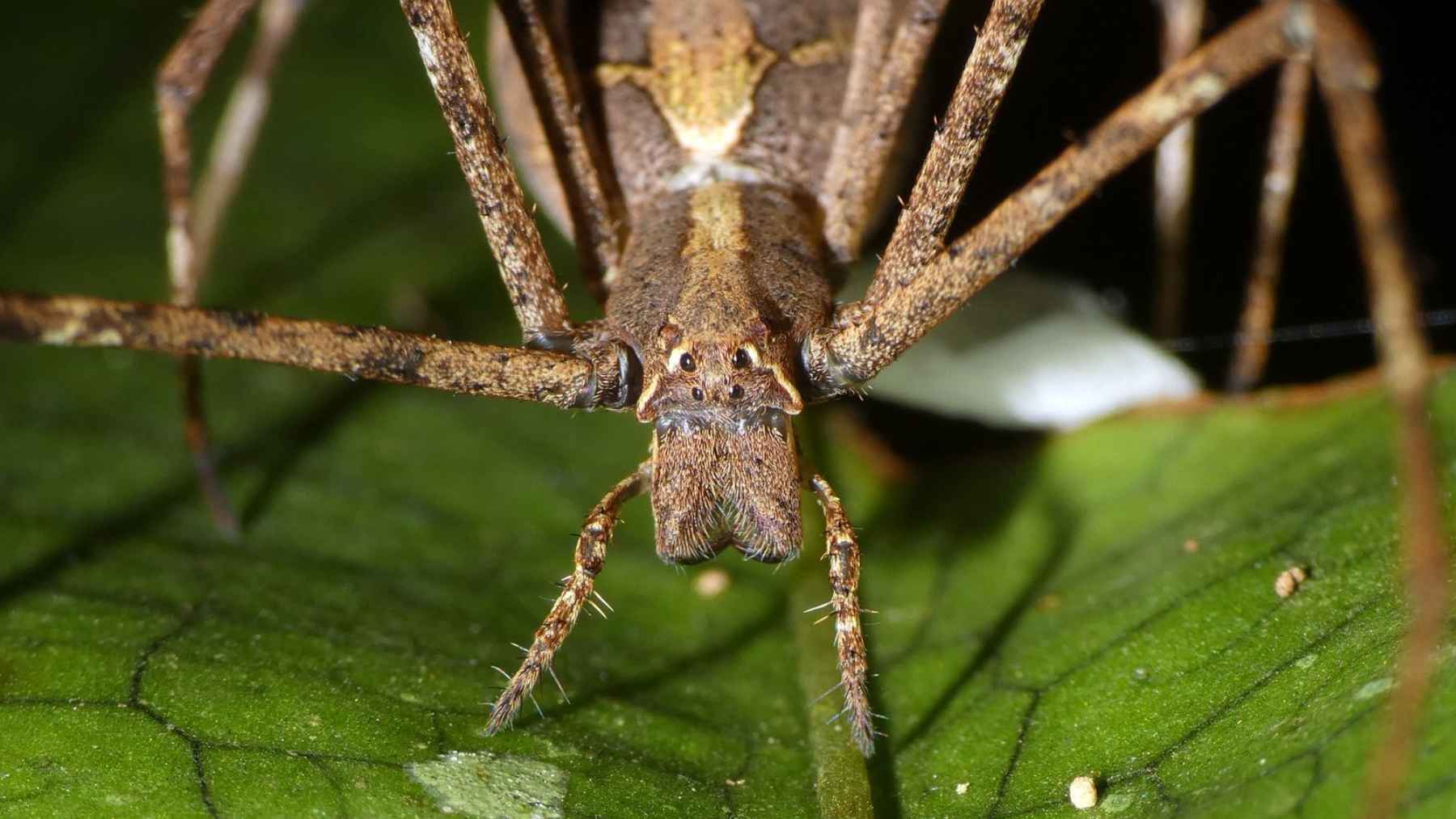
Asianopis subrufa is not a large animal. Females are about one inch long, while males are smaller, yet the spider carries a hunting system that looks almost custom-built for night work.
The Australian Museum describes the species as slender and long-legged, with eight eyes, including two oversized forward-facing eyes that help it detect prey in low light. At night, it builds a tiny net, hangs upside down, and waits for insects such as ants, cockroaches, moths, and other spiders to move within range.
Then comes the strike. The spider lunges and opens the stretchy web over the target, a maneuver that can happen so quickly that researchers used high-speed video to study it. Some parts of the net can stretch up to 24 times their original size in about a tenth of a second, according to coverage of the study.
Why engineers are watching
For the most part, engineers still have to choose between materials that are flexible and materials that are tough. A surgical stitch, an artificial ligament, a parachute cord, or a protective textile may need both qualities, but getting them in the same fiber is not easy.
That is why this spider’s silk matters beyond zoology. The research points to a possible design principle for future synthetic fibers that are soft when they need to move, then stronger when they come under strain. No one is saying tomorrow’s hospital or aircraft factory will suddenly run on spider-inspired thread, but the blueprint is tempting.
The everyday version is simple: imagine a material that stretches like athletic fabric but resists breaking more like a high-strength cable. That could be useful in medical repairs, safety gear, shock-absorbing construction materials, and technical textiles used in extreme conditions.
A microscope made the secret visible
The hidden structure became clear through high-resolution electron microscopy, a method that uses electrons instead of regular light to reveal very tiny details. One image of the silk, only about two-thousandths of an inch long, showed the winding fibers wrapped around the core.
That image, titled “Mesmerizing spider threads,” won the Royal Society Publishing Photography Competition 2025. Dr. Martín Ramírez, a CONICET researcher, said the web was “incredibly stretchy” and that normal spider silk does not extend that way and return to its original form.
The photo was striking, but it was not just pretty science. It gave researchers a visual map of how the silk works, showing that the spider’s strength comes from architecture as much as chemistry.
What scientists still need to learn
The discovery does not mean human industry can immediately copy the spider. Spider silk is difficult to reproduce at scale, and the animal’s behavior is part of the material-making process. That makes the challenge harder than simply copying a recipe.
Still, the finding adds an important clue. Instead of asking only what a fiber is made of, researchers may need to ask how its structure changes when it is pulled, bent, or loaded.
That shift could matter. At the end of the day, Asianopis subrufa shows that nature sometimes solves engineering problems not by making a material harder or softer, but by making it change at exactly the right moment.
The main study has been published in Proceedings of the National Academy of Sciences.