Most materials are predictable. Push them, bend them, heat them, and they respond the same way every time. Robots are different, but they usually need a “brain, ”lots of code, and a central controller that tells each part what to do.
A team at the University of Amsterdam is blurring that line with a new kind of “metamaterial” that can be trained to change shape, remember what it learned, and even move around without any centralized control. Their results were published in Nature Physics on April 7, 2026.
A worm-like chain with no boss
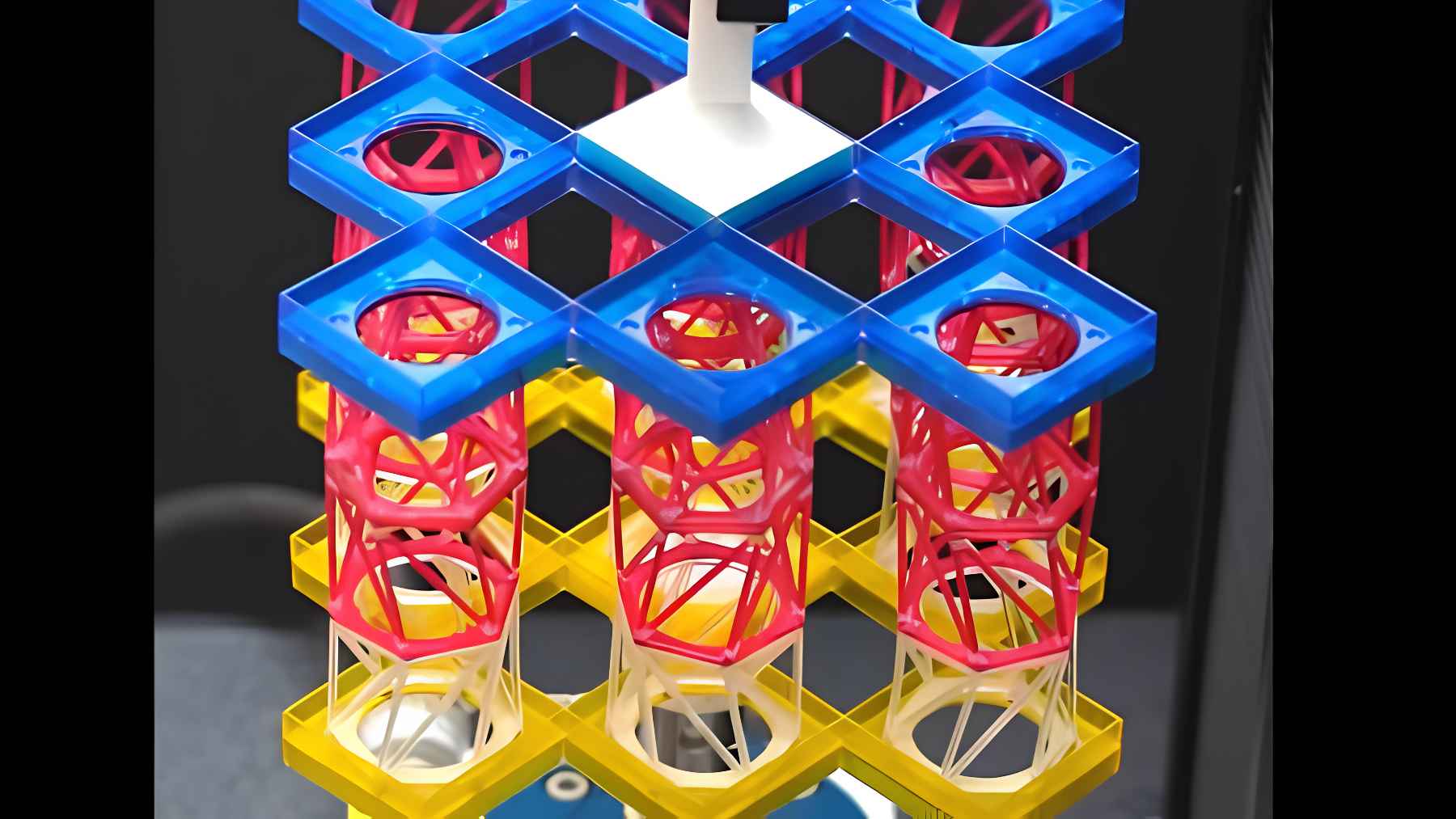
The Amsterdam prototype looks more like a mechanical toy than a traditional robot. It is a worm-like chain of identical motorized hinges connected by an elastic skeleton, and each hinge carries a microcontroller. In one published demonstration image, the chain even learns letter shapes that spell “learn” (or “leren” in Dutch).
Here is the twist. Instead of one computer running the show, each hinge measures its own rotation, remembers recent motion, and exchanges information with its neighbors. Based on that local data, the hinge adjusts how hard it “pushes back” and what position it prefers, and the whole chain settles into a coordinated shape.
“Physical learning” built into the material
In the paper, the researchers describe this as “physical learning,” meaning the material updates its own internal settings as it experiences training examples. The Nature Physics abstract says the system learns by progressively updating internal “learning degrees of freedom,” especially the local stiffness along the chain.
If that sounds abstract, think of it as a body that rewires itself a little after practice. The hinges are not just following a stored script – they are changing how they interact so the right motion becomes the easier motion next time.
Training by repeated nudges
So how do you “teach” a material? The team trains the chain by repeatedly pushing it into a target configuration, step after step, in what they call “epochs.” (iop.uva.nl)
During each epoch, the microcontrollers update the torques they apply at their hinges, which changes stiffness and the way forces travel through the chain. Over time, the chain starts to adopt the trained shape on its own when it recognizes the same input setup, almost like muscle memory kicking in.
Forgetting, switching, and doing more than one job
A key point is that the metamaterial is not limited to one learned response. In the Nature Physics abstract, the authors report that the system can “forget and learn new shape changes in sequence,” learn multiple shapes, and learn multistable responses.
That flexibility matters because real environments are messy. One day a device needs to grip an object – the next day it needs to crawl over uneven ground, and in the lab the team shows those kinds of capabilities as “reflex gripping actions and locomotion.”
From “brainless” motion to adaptable matter
This result did not come out of nowhere. The University of Amsterdam notes that the same lab previously explored “brainless” locomotion, showing oddly designed objects that could roll, crawl, and wiggle over unpredictable terrain without centralized control.
The missing ingredient back then was memory. The new study adds a learning rule borrowed from machine learning called “contrastive learning,” allowing the chain to update local stiffness from examples, then reuse that experience later on.
Why this matters outside the lab
At first glance, learning metamaterials can feel like a robotics story, not an environmental one. But the sustainability angle shows up when you zoom out and think about how often we throw hardware away because it is too rigid to adapt.
Ever opened a drawer full of old chargers and mystery cables and wondered why so much tech ends up there?
In 2022, the world generated about 68 million U.S. tons of electronic waste (62 million metric tons), and only 22.3% was documented as properly collected and recycled.
The Global E-waste Monitor 2024 warns the total is rising by about 2.9 million U.S. tons a year (2.6 million metric tons) and is on track to reach roughly 90 million U.S. tons by 2030 (82 million metric tons). The report also estimates about $62 billion worth of recoverable natural resources were left unaccounted for in 2022.
A material that can be retrained to do a different task points to a different design mindset. In practical terms, it hints at machines that can be updated in the field instead of replaced, which is the dream for everything from sensor networks in wetlands to inspection robots crawling through storm drains after heavy rain.
The fine print and the next questions
It is also important not to oversell what this is today. These are research prototypes, and they include motors, electronics, and power demands that still come with their own footprint, especially if scaled up without careful design.
The authors also note that supporting data and code are available via Zenodo, which should make it easier for other teams to test and build on the approach.
Du and colleagues are already looking ahead to more realistic challenges. In the University of Amsterdam release, Yao Du says that “once the system starts to learn, the possibilities of where it ends up feel almost limitless,” and he also points to future work on time-dependent behaviors and learning with “noise and uncertainty.”
Still, the core idea is hard to ignore. When the “smarts” are distributed through the material itself, you may end up with devices that keep working when parts fail and that adapt in place instead of being discarded, and that is a sustainability story hiding in plain sight.
The study was published in Nature Physics.