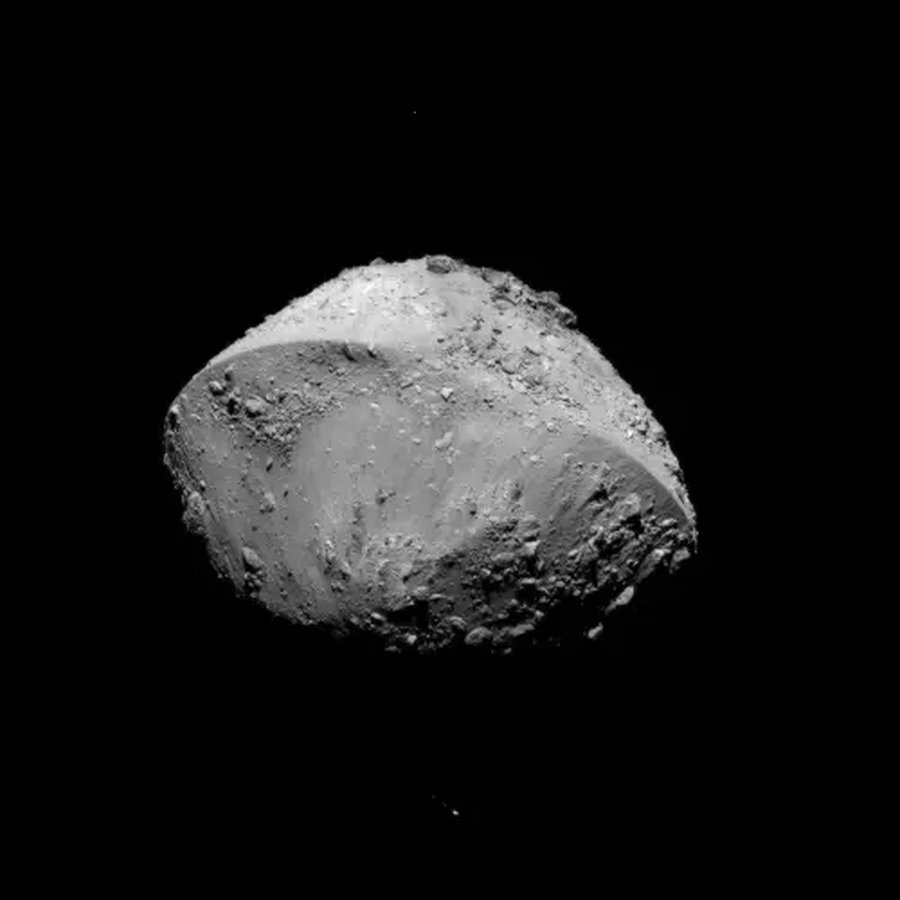
The European Space Agency’s Hera spacecraft is now studying its target asteroids with instruments that see beyond the human eye. New images released on November 17 show the larger asteroid, Didymos, from just 28.5 kilometers (about 18 miles) away.
Hera is Europe’s first planetary defense mission. In 2022, NASA deliberately crashed a spacecraft into Dimorphos, the small moonlet of Didymos. Hera’s job is to find out what that impact did.
Three ways of seeing an asteroid
The first view comes from Hera’s Asteroid Framing Camera, which is used both to navigate and to do science. Its black-and-white image resolves details about 2.7 meters (roughly 9 feet) across per pixel.
Didymos is dominated by a dramatic ridge around its equator, according to ESA. The view shows boulder-rich areas and clearer regions, according to the Hera team. It also shows traces of what might be landslides toward that central ridge.
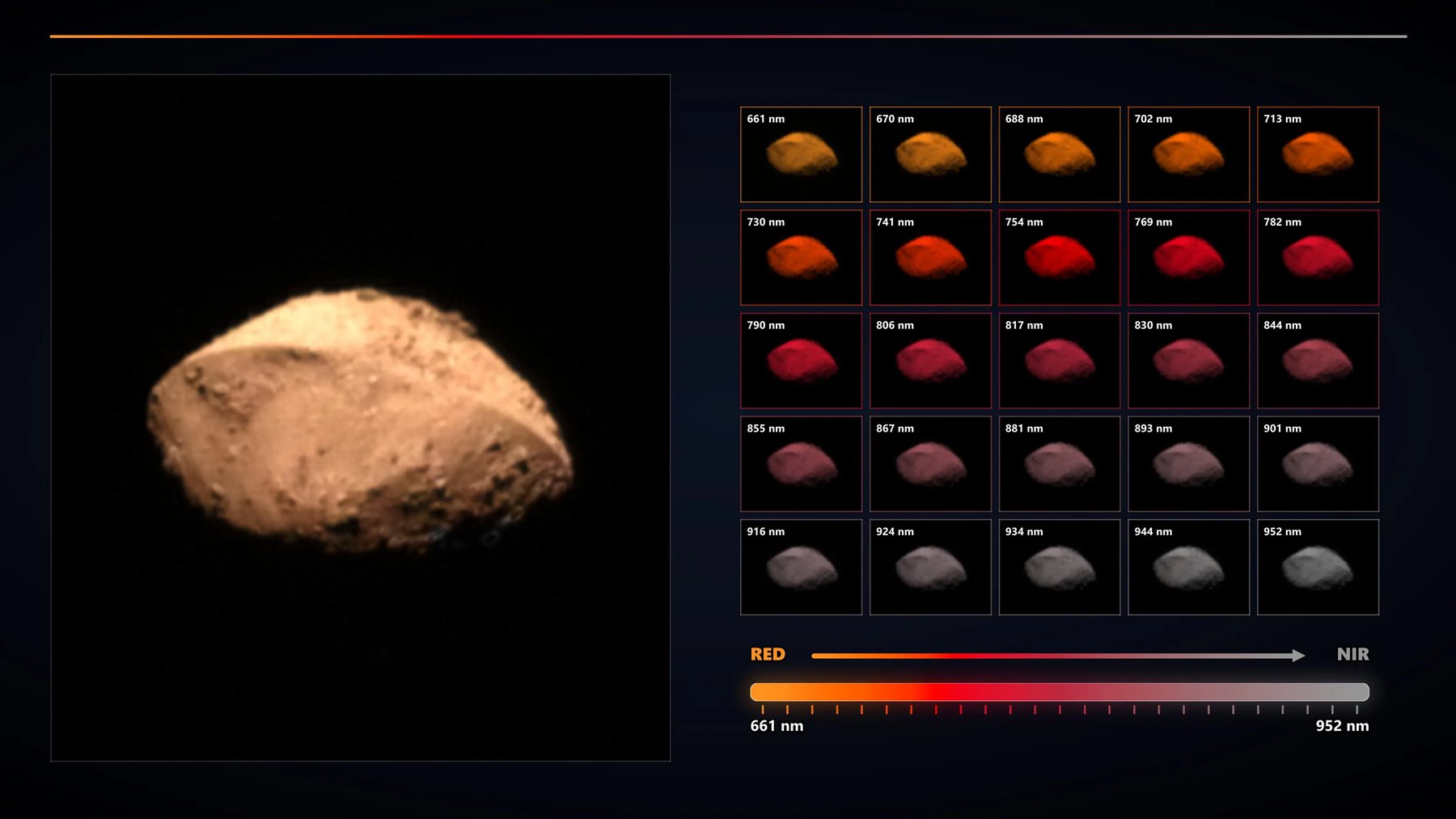
A second instrument, HyperScout H, adds color by observing the surface in 25 different hues. They run from the red that people can see into the near-infrared, which is beyond the sensitivity of human vision.
Tiny differences in how much sunlight the surface reflects are directly linked to what it is made of. Scientists can compare those readings with lab tests on meteorites and minerals. That helps them work out what the asteroid is made of.
Superman-style heat vision
The third instrument is the Thermal Infrared Imager, or TIRI, supplied and operated by the Japan Aerospace Exploration Agency. ESA says it gives Hera Superman-style heat vision. Hot areas show in red and cool ones in blue.
Mapping temperatures across different regions of Dimorphos, and how they change over time, tells scientists whether they are looking at solid, porous or broken rock. It can also reveal loose material of different sizes, down to dust.
In these images the 151-meter moonlet Dimorphos is almost entirely in shadow, with only a small speck caught in sunlight. The exception is the TIRI view, where the whole moonlet shows up in thermal infrared.
Fast spin, sharp ridge
Didymos measures about 780 meters (roughly 2,560 feet) across and spins once every 2.2 hours. In a November 12 preview, ESA said that is fast enough to bring the asteroid close to coming apart.
Patrick Michel is Hera’s principal investigator and a research director at CNRS and the Observatoire de la Côte d’Azur. He links the spin to the ridge. “Didymos is spinning very rapidly for its size, rotating every 2.2 hours, so this spin might actually be encouraging this migration of material towards the equator, helping form this ridge,” he said.
That earlier image was taken from 56 kilometers away. It showed large boulders, smoother regions and a surprisingly sharp ridge, with only part of Dimorphos peeking out near the top of Didymos.
Models of fast-spinning asteroids suggest material may flow from higher latitudes down to the equator, according to ESA. It might even be possible that some is shed from Didymos altogether, which could potentially account for Dimorphos.
Dimorphos orbits a little more than a kilometer from Didymos, according to ESA. A few boulders were visible along its top side in that preview.
Back to the crash site
On September 26, 2022, NASA’s 580-kilogram DART spacecraft hit Dimorphos at 6.1 kilometers per second. The impact threw a plume of debris across 10,000 kilometers of space and shortened the moonlet’s orbital period by about 33 minutes.
Big questions remain before this kinetic impact method becomes a well-understood defense technique, ESA says. Did DART leave a crater, or reshape Dimorphos entirely? And why was the deflection much larger than simulations predicted?
Hera fired its thrusters for 93 minutes in October to brake toward the pair. Over the coming months it will carry out a close-up crash site investigation. It will also release two shoebox-sized CubeSats for a closer look and eventually move toward a landing.
ESA called the November 12 image an early preview, and it plans to unveil detailed images of both asteroids on November 25. The work matters because real threats do turn up, such as an asteroid that once had a 3.1 percent chance of hitting Earth in 2032 before NASA ruled it out.
Asteroid strikes have reshaped life on Earth before, most famously with the asteroid that wiped out the dinosaurs. Hera’s findings will help decide whether nudging a dangerous space rock off course is something humanity can rely on.
Image: ESA