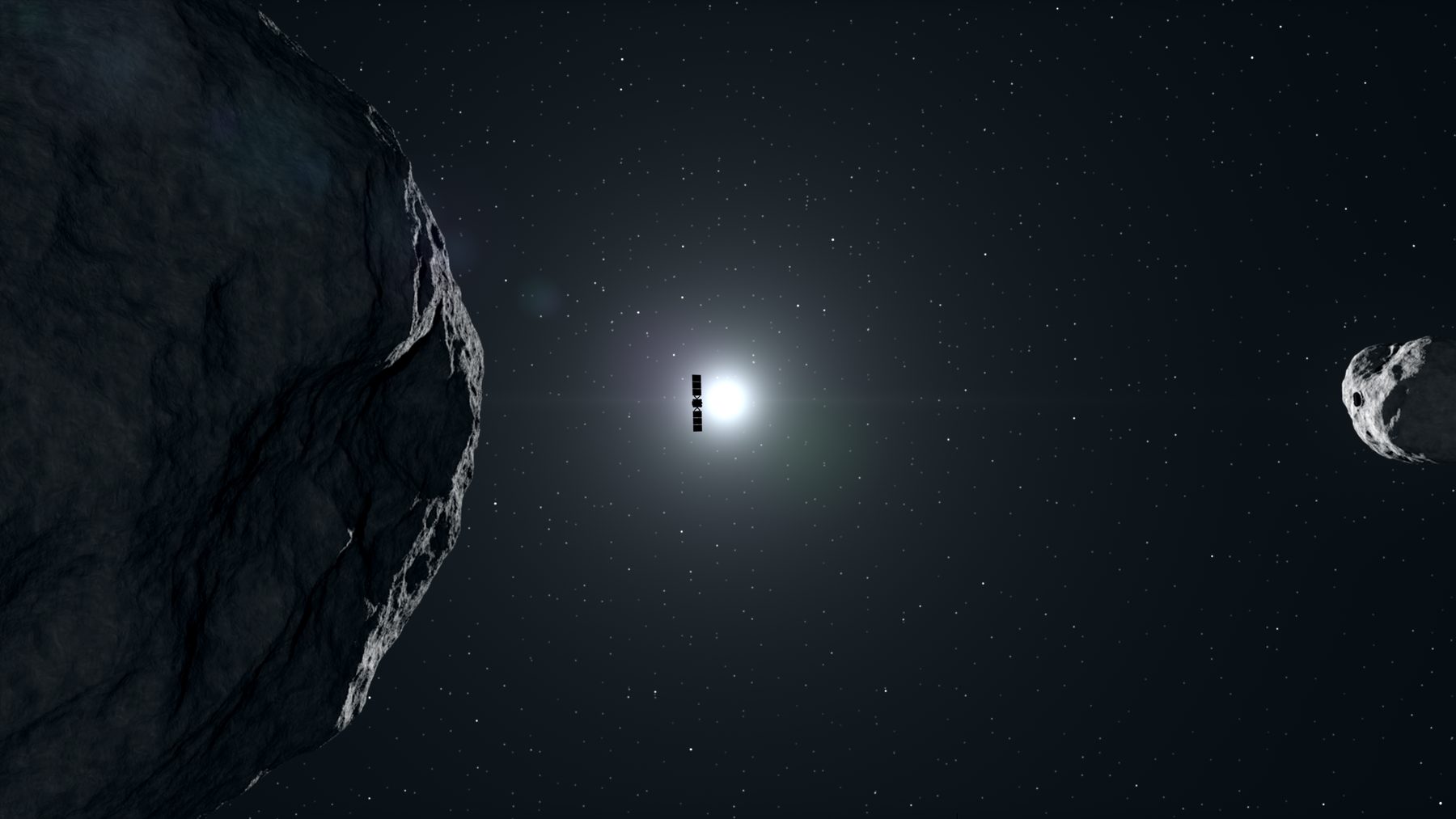
The European Space Agency’s Hera spacecraft is flying at more than 26,800 mph (12 kilometers per second) relative to Earth, and before it can stop beside the two asteroids it was sent to study, it has to slow down to match their pace. ESA wrote last week that the mission team was “preparing to light a fire in the sky,” and the fire it meant was a braking burn.
ESA scheduled the first of two big braking burns for the early hours of Thursday, October 15, and a second one for Thursday, October 22. The targets are Didymos and its small moon Dimorphos, the pair NASA’s DART spacecraft deliberately struck in September 2022.
ESA says Hera “will perform a close-up crash scene investigation to gather key data about the asteroid and its response to DART’s impact.” Patrick Michel, a planetary scientist at the French National Centre for Scientific Research (CNRS), is the mission’s principal investigator.
Two years of mostly coasting
Hera lifted off from Cape Canaveral on October 7, 2024, just ahead of Hurricane Milton, and as ESA put it, “since then Isaac Newton has been doing most of Hera’s driving.” A flyby of Mars in the spring of 2025 bent its course and gave it extra speed, and the agency says Hera “has been moving like a race car changing lanes, first crossing Mars orbit and now closing in on the orbit of the Didymos binary asteroids.”
In February and March, a deep-space maneuver split into three engine burns used 271 pounds (123 kilograms) of hydrazine and changed Hera’s velocity by about 821 mph (367 meters per second). “This is the Hera mission’s largest manoeuvre in terms of fuel consumption, and we used it to test all of the systems that we will need during the braking and rendezvous manoeuvres later this year as we arrive at Didymos,” said Francesco Castellini of the Flight Dynamics team at ESA’s operations center in Darmstadt, Germany.
The braking plan was made tougher on purpose. “The reliability of the propulsion system, in particular, has enabled the team to design a new more aggressive manoeuvre plan that involves ‘braking’ later and harder during the approach to Didymos. This will allow Hera to arrive at the asteroids a month earlier than we had initially planned,” Sylvain Lodiot, ESA’s head of outer solar system and planetary defense missions operations, said in October 2025.
Three thrusters burning for 93 minutes
For the first braking maneuver, called BRM-1, Hera swings around so the ring of Orbit Control Thrusters on its underside points at the Didymos system, and three of those hydrazine thrusters fire together for 93 minutes without a break. ESA says that should cut Hera’s speed relative to the asteroids by a few hundred meters per second, which is hundreds of miles per hour.
“To prepare for this initial Braking Manoeuvre, known as BRM-1, we performed a brief test burn on 2 October, after which we started to generate the full sequence of telecommands,” Castellini explained in ESA’s preview of the braking campaign. Once the engines stop, the plan was to pick up Hera’s signal with one of ESA’s two 115-foot (35-meter) deep space antennas at New Norcia, Australia.
“At this point the really hard work starts for us: we will use Hera’s GNC (guidance, navigation and control) sensor outputs via the telemetry we receive plus ranging and Doppler data embedded in the signal itself to assess that the direction and magnitude of the braking matches the anticipated change in ‘delta-v’,” Castellini said, using the engineers’ term for a change in velocity.
As of Thursday morning, ESA had not posted a result for BRM-1 on its website or on its official Hera and operations accounts.
A shorter burn on October 22
After a few days of checks, commands for a second burn, BRM-2, are due to go up to the spacecraft for the early morning of October 22. ESA says that roughly 31-minute burn “should complete most of the Delta-V required to match the velocity of the Didymos system, at the same time compensating for any misperformance in the BRM-1,” and three small “transition” maneuvers late in the month should bring Hera’s relative speed down to near zero.
Michael Mueller, a flight dynamics engineer at ESA, said the team will not rely on a single reading. From these braking maneuvers onward, he said, “we have a total of six different teams to actively look at the data coming in from the spacecraft, including sanity checks in the form of multiple independent assessments.”
“Compared to the mission’s closest predecessor, ESA’s Rosetta comet mission, Hera possesses much greater onboard autonomy,” Mueller added. “Rosetta returned its data and then we had to perform all orbital calculations on the ground. Hera, by contrast, operates on a more autonomous basis, with its degree of autonomy increasing as it draws nearer to the asteroids.”
Hera has already spotted its target
On October 7, its second launch anniversary, Hera’s camera caught Didymos for the first time from roughly 147,000 miles (236,500 kilometers) away, as a dot “smaller than an individual pixel but sufficiently bright to be detected by the camera,” in ESA’s words.
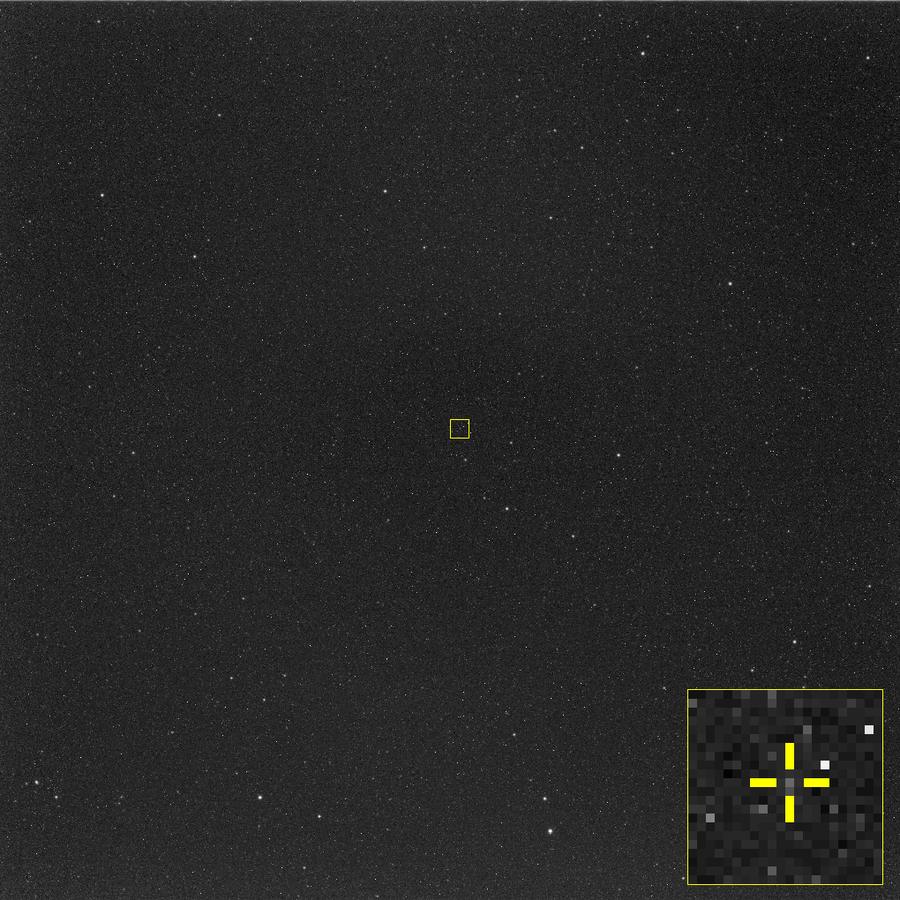
Didymos is about 2,560 feet (780 meters) wide, and Dimorphos, which circles it, is about 490 feet (150 meters) across. When DART slammed into Dimorphos it shortened the moonlet’s orbit by about 33 minutes, the first time people deliberately changed the path of a natural object in space.
Closer and closer through next year
ESA’s schedule has Hera studying both asteroids from 16 to 19 miles (25 to 30 kilometers) away in November and December, then closing to about 6 miles (10 kilometers) later in December. Early next year it is due to release two small CubeSats, Milani and Juventas, and then move as close as about 2.5 miles (4 kilometers), with a final experimental phase aimed at a single kilometer, about 0.6 mile, from Dimorphos.
“This is a big technical leap forward but had to be done to perform science,” Mueller said of that close flying. “Once the asteroids fill its field of view, Hera will be optically tracking surface features on the asteroids as a means of determining its own orbital position and motion.”
The measurements are meant to turn DART’s single hit into “a well-understood and potentially repeatable planetary defence technique,” ESA says, which is the kind of tool planners wanted on hand when asteroid 2024 YR4 briefly looked like a threat.
What could still surprise the team
The dates above are ESA’s plan, and they depend on both braking burns working as designed. The team also does not know exactly what state Dimorphos is in now.
“There’s a lot of uncertainty, especially in terms of the asteroid’s degree of tumbling due to the collision. We cannot simulate all probabilities but have to restrict ourselves to the more likely outcomes. The prospect of some impact debris remaining in Dimorphos’s vicinity has not been entirely ruled out. So potentially there might be surprises ahead, but this is an adventure we’re looking forward to!” Mueller said.
ESA laid out the braking plan in a mission update published on October 7, 2026, and described its navigators’ work in a separate article the same day.
The next famous rock on the calendar is closer to home, since Apophis will pass safely by Earth on April 13, 2029.
Image: ESA