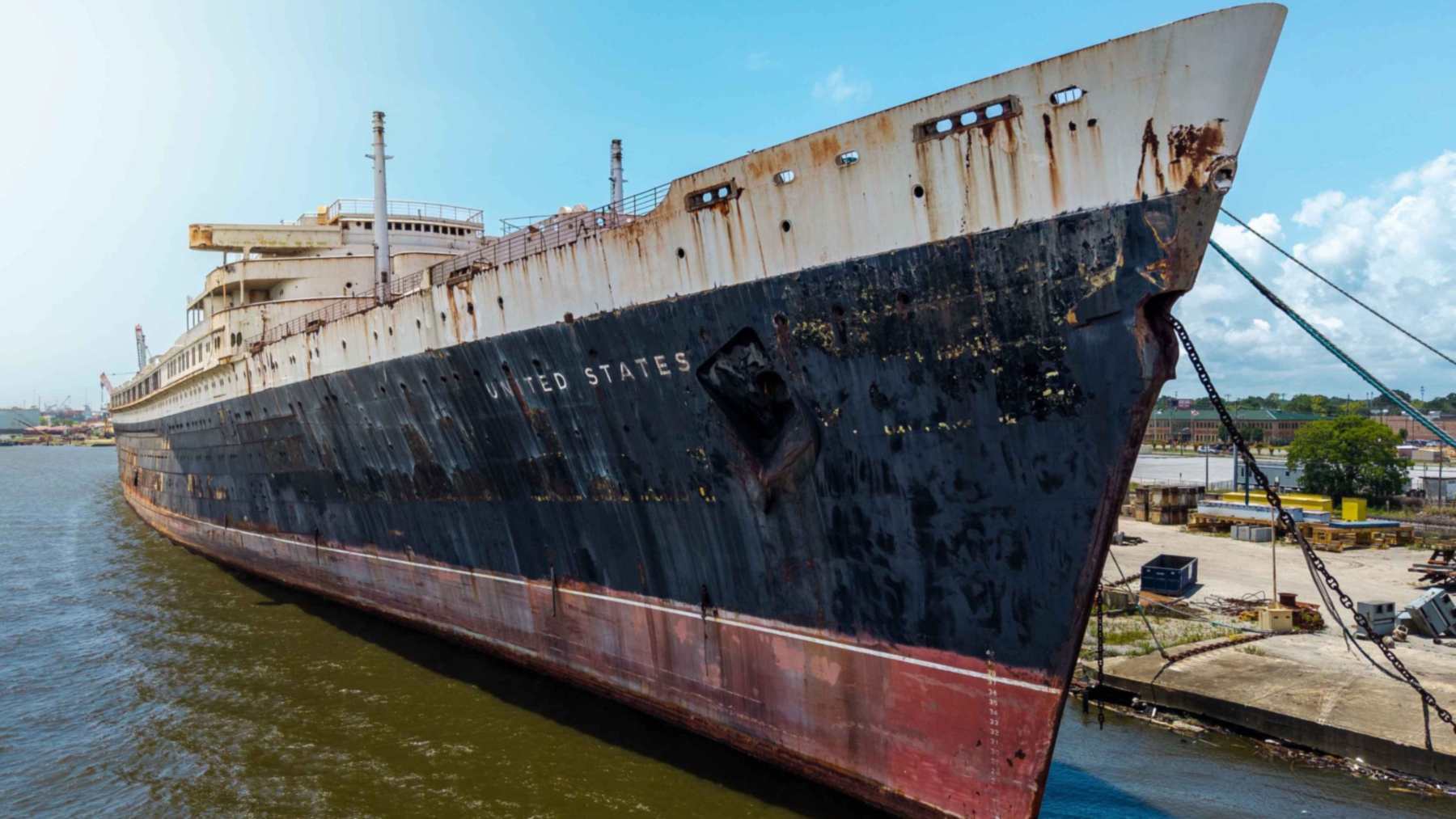
Okaloosa County, Florida, plans to sink the 990-foot (302-meter) SS United States in the Gulf about 22 nautical miles, or roughly 25 statute miles (41 kilometers), southwest of Destin-Fort Walton Beach during the second week of November 2026, turning the former ocean liner into what the county calls the World’s Largest Artificial Reef. The ship has been at a pier on South Royal Street in Mobile, Alabama, since March 2025 while contractors stripped out fuel, wiring and other hazardous material.
The county’s deployment update, posted on its Destin-Fort Walton Beach tourism site, says the date is not locked in. “This activity is weather-dependent, and dates can change,” it reads.
A week in November, with no day picked yet
The county says more details on the deployment will be released “in the coming weeks,” and the SS United States Conservancy, which sold the liner to the county in 2024, says those details will include the final schedule of events and how its supporters and the public can take part “both in person and online.”
The date has slipped before. In November 2025 the county said the ship was scheduled to be deployed in early 2026, and a presentation to commissioners that December still listed “Early 2026” for deployment.
The county’s question-and-answer page on the ship still says that “once we receive final approvals from the Army Corps of Engineers and the EPA, we will be able to set a date for deployment.” The October announcement does not say whether those approvals have arrived.
Who is paying for the reef
The project is funded with tourism bed tax revenue collected from short-term rentals in Okaloosa County, plus contributions from local partners, and “no general fund revenue is being used,” the FAQ says. Commissioners allocated $13 million for the whole project, covering towing, remediation, the purchase of the vessel and help for the Conservancy to build a land-based museum in the Destin-Fort Walton Beach area.
In November 2025 the county approved partnership agreements that bring $1.5 million from Visit Pensacola and $500,000 from the Coastal Conservation Association Florida. Brian Gorski, the group’s Florida executive director, said the gift “represents the largest single donation in CCA Florida’s 40-year history.”
Flooding a liner without explosives
Alex Fogg, the project leader, laid out the method in a December 2025 presentation. The slides say no explosives are permitted, that a naval architect is using a previously developed model to plan the flooding, that the ship will sit at anchor on site for three days, and that more than 40 law enforcement vessels will keep a security perimeter around it 24 hours a day.
Holes are being cut around the hull “to ensure she lands upright as she is submerged,” the FAQ says. By December the slides reported all 120 fuel tanks empty and 99 percent of the materials containing PCBs, toxic industrial chemicals once common in wiring and insulation, already removed, while both funnels, the radar mast and a propeller had been lifted off and stored on land.
The FAQ gives a proposed depth of 180 feet (55 meters) to the bottom and about 55 feet (17 meters) to the upper deck, “which will satisfy the diving aspirations of both beginners and technical divers.”
The new reef will join the USS Oriskany, an aircraft carrier already sunk off Pensacola. “With the addition of the SS United States and Pensacola already home to the USS Oriskany, Northwest Florida is becoming one of the world’s most extraordinary destinations for divers and marine exploration,” Visit Pensacola President and CEO Darien Schaefer said in the county’s announcement.
Ten years of monitoring
The county’s slides also list research partners for after the sinking. The Dauphin Island Sea Lab will compare the underwater soundscape before and after deployment, Louisiana State University will track tagged fish around the vessel, and the Woods Hole Oceanographic Institution is down for “Biological, Chemical and Physical monitoring for 10 years.”
The FAQ says that “in addition to the usual reef fish species like red snapper and grouper, the size of the SS United States will also attract the more pelagic species of fish such as amberjack, mackerel and tuna,” the sort of growth researchers recorded off Western Australia, where two artificial reefs grew from a dozen fish species to more than 60.
Critics still point to the paint
Not everyone wants the ship on the seafloor, in a state where between 1 million and 2 million tires were dumped into the Atlantic for a reef in the early 1970s. The county’s December slides list the outside challenges it has faced, from the ship’s place on the National Register of Historic Places to concerns about aluminum, PCBs, lead and asbestos.
On the ship’s old paint, the county’s FAQ says that “the vessel coating substance that has been making media headlines is not a federally regulated substance when it comes to artificial reefing.” It adds that the vessel is being prepared under the national best management practices that the EPA and the Maritime Administration set for ships meant to become artificial reefs.
The county also answers the ship’s fans directly. “We understand the passion surrounding the SS United States. We have it, too,” the FAQ says, adding that the county bought the ship “instead of that history being lost to a razor blade factory.”
Part of the ship stays on land
The Conservancy says it has secured the ship’s funnels, the radar mast, the stem anchor and many other components for a planned land-based museum near the departure points for future dive trips to the wreck.
The liner left Philadelphia in February 2025 for a tow of more than 1,600 miles to Mobile at an average of about 6 mph, according to the county. Its last trip, to the reef site, is now set for November.
Photo: Okaloosa County