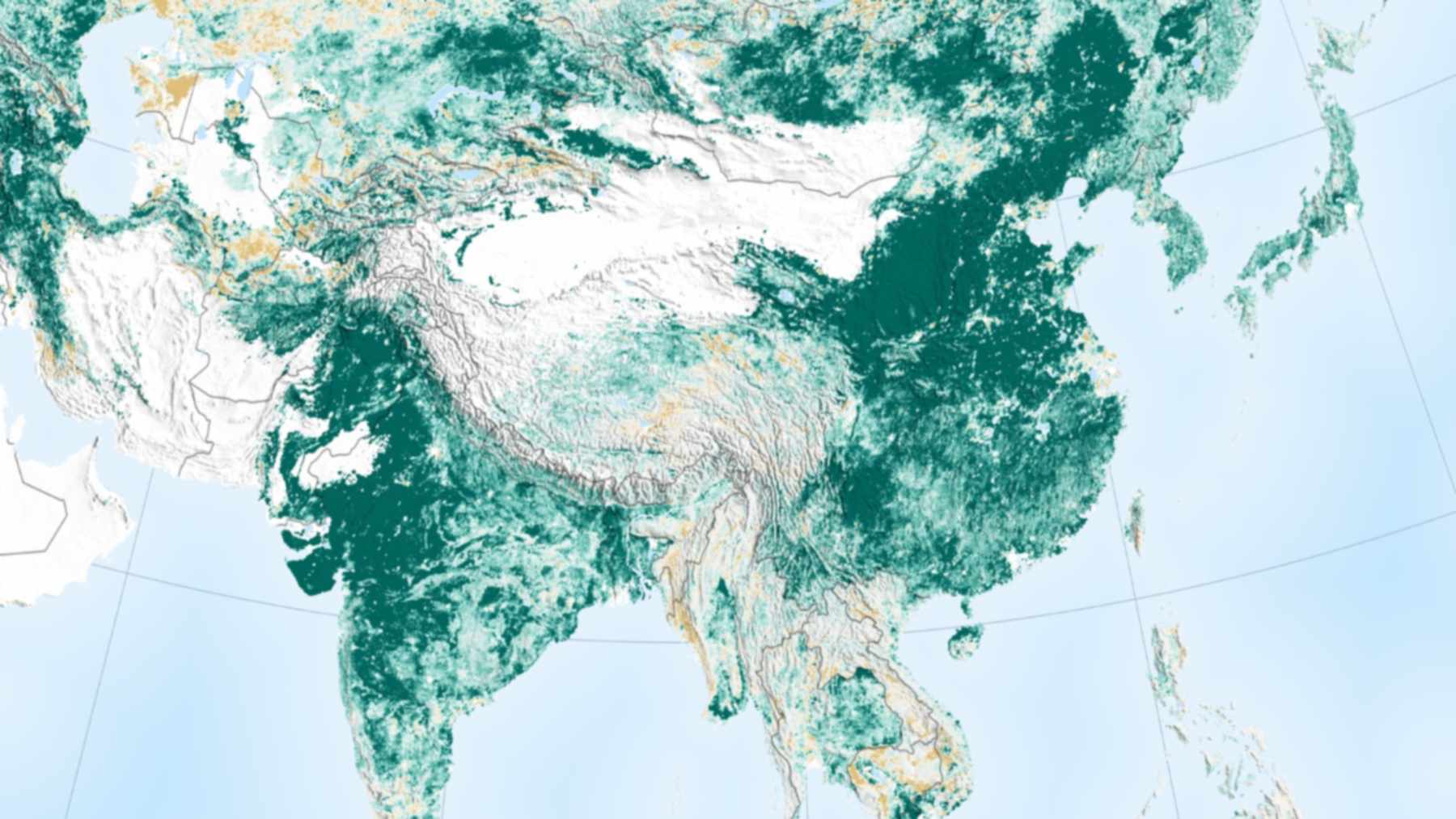
As a Ph.D. student at Boston University, Chi Chen went through satellite images of the planet pixel by pixel. “So we have millions of pixels to cover the entire globe,” he told NPR in February 2019, the week his study showed that greening in China and India accounted for about a third of the new leaf cover on Earth.
“The Earth’s surface is getting greener,” Chen said on Morning Edition. One section of Brazil had gone the other way, and he had gone and looked. “I personally checked the data. This is because of drought.”
Now a team in Nanjing has run that greening through a climate model, and the result, published in September in Advances in Atmospheric Sciences, reaches a long way from Asia. With both countries greening, the simulations show “a consistent cooling over western Eurasia, while warming dominates over northern North America.”
Min Xiao, a graduate student at Nanjing University of Information Science and Technology, led the work with Professor Miao Yu, the corresponding author, and co-authors at Fudan University, the Institute of Atmospheric Physics of the Chinese Academy of Sciences and the Zhoushan Meteorological Bureau.
Like dropping a rock in a pond
Abigail Swann, an atmospheric scientist and biologist at the University of Washington who was not involved, has spent years on the idea that trees in one place can change the weather somewhere else. She explained it on the public radio program Living on Earth in 2021, talking about her own work on forest loss in the US.
“So it turns out that plants are able to influence the atmosphere around them, so they can influence the local climate that’s experienced nearby, but that the atmosphere, because it is circulating around, is moving, those local changes, they can get communicated to other places,” she said. “And so changes in plants in one location can actually have impacts on the climate somewhere else.”
On the radio she reached for El Niño. “So we’re all pretty comfortable with the idea that this thing called El Niño influences climate in places in North America. But it’s actually a big sloshing around of temperature in the tropical Pacific Ocean,” Swann said. “And so that big sort of oscillation in temperature in the tropics influences the atmosphere, kind of like dropping a rock in the pond.”
Back in 2011, as a postdoctoral fellow at Harvard, she had turned the farm fields and grasslands of North America and Eurasia into forest in a climate model. The tropical rain belt moved north, the southern Amazon dried out and rain fell in the Sahara.
“There are lots of reasons why planting trees is a good thing,” Swann told the Harvard Gazette then. “There are many local benefits. But when you think about it as a global-scale climate mitigation strategy … we need to think about what some of the side effects would be.”
Fields in India, forests in China
China and India got greener for different reasons. Molly Brown, a geographer at the University of Maryland, had seen it up close. “These are really good examples of how policy can really make a difference,” she told NPR.
In India it was water for farming. “Instead of having just crops when it’s raining, they also have a whole, you know, six months of cropping and greenness when it’s not raining,” Brown said. About half of China’s new leaf cover came from a reforestation drive meant to head off dust storms, NPR reported. “They are really doing a good job. They have very large and comprehensive tree planting, tree maintenance.”
China alone supplied 25 percent of the world’s net gain in leaf area while holding 6.6 percent of its vegetated land, equal, Carbon Brief noted, to the greening observed in Russia, the US and Canada over the same period. Forests were 42 percent of China’s share and croplands 32 percent. India’s was 82 percent farmland.
Ranga Myneni, the Boston University remote sensing scientist who co-wrote Chen’s paper, told Carbon Brief that “land-use by humans is a major factor of greening – something not recognised before.” A year later he told the Daily Free Press, Boston University’s student paper, why anyone should care. “Obviously, this is very important because green leaves produce sugars,” Myneni said. “That’s the basis of all food and life.”
Clouds over one country, sun over the other
“Right well, the local surface temperatures care a lot about how much water gets evaporated,” Swann said on Living on Earth. “So in general, when water is able to evaporate off the surface, you’ll get less change in temperature. So your skin, when water evaporates off your skin, when you sweat, it helps keep you cool. If there isn’t as much water available, the surface is likely to get warmer.”
In Nanjing, Xiao and Yu fed the patches where satellites had seen vegetation increase significantly from 1982 to 2020 into CAM6.0-CLM5.0, a model in which land and air respond to each other, and ran China alone, India alone and both, counting only heat and water and leaving out on purpose the carbon the plants take up.
China came out cooler, with more rain in the south and northeast and less over central eastern China. India warmed, and the abstract says “greening in India leads to local warming and a widespread reduction in precipitation.”
Over southern China the water the plants sweat out builds clouds that shade the ground and rain back down. Over India much of it “is transported away instead of forming clouds and rain locally,” according to a release from the Institute of Atmospheric Physics on EurekAlert.
“Greening does not necessarily produce the same climate response everywhere,” Yu said in the release.
Swann, talking about her US forest simulations, had landed somewhere close. “We found that the location of the forests really matter,” she said. “It’s really the location of where those plants are, and how they’re able to influence the atmosphere and what changes in climate that leads to, that plants care about.”
Europe cools, Canada warms
Green both countries and, over more than half the world’s land, you get about what adding the two separate runs would give; over the rest the release calls it nonlinear. Southern China gets cooler and wetter. Western Eurasia cools and northern North America warms.
The authors trace the long reach to atmospheric heating, to Rossby waves (huge, slow bends in the high winds that steer storms) and to the upper-level jet, and the release says the shifted East Asian and Central Asian jet streams made it easier for cold polar air to push toward Eurasia.
“The atmosphere connects regions that may appear far apart,” Xiao said. “Vegetation change in one region can reinforce, weaken, or even reverse the climate effects caused by vegetation change elsewhere.”
Swann put the same thing her own way on the radio. “The reason the atmosphere can sort of propagate that signal elsewhere is because it’s essentially, you know, the atmosphere is a big fluid. And so waves and other things propagate in the atmosphere.”
“If you do enough of this tree planting, you can actually change circulation patterns,” Gordon Bonan, a geoscientist at the National Center for Atmospheric Research in Boulder, Colorado, told Quanta Magazine in 2018, talking about Swann’s simulations.
A 2019 paper in National Science Review, led by Yue Li of Peking University with Shilong Piao and Philippe Ciais among the co-authors, ran China’s forest expansion and greening from 1982 to 2011 through a model and found that spring cooling over China warmed the Russian Arctic by about 0.3°F (0.17°C) per decade and cooled the Canadian Arctic by about 0.2°F (0.13°C), roughly 58 and 61 percent of the simulated spring change in each. Its authors concluded that “spring vegetation dynamics in China may affect climate in northern high latitudes.”
Closer to the plantings, the side effects are easier to see, from water disappearing from soils and aquifers near the Gobi desert to the unexpected problem created by China’s Taklamakan tree megaproject. Plants are on the move elsewhere too, and research shows Earth’s green wave is changing course toward the northeast.
What’s still missing
It is one model, mostly, and the authors say more models will be needed to test the far-off responses. The abstract and release don’t say by how many degrees.
Swann has called herself “a little bit on the more skeptical side” that signals like these will show up in real-world records. “These signals almost certainly do exist, just based on what we understand about atmospheric science,” she told Inside Science in 2018. “The question is if they’re large enough that you would ever detect them.”
Quanta noted that nobody knew what the huge government tree plantings in China and the Sahel had done to global climate. “What we would like to be able to say is, if you plant this amount of trees, you would see this reduction in planetary warming,” Bonan said. “We don’t really quite have that answer yet.”
The full study was published in Advances in Atmospheric Sciences.
Image: NASA Earth Observatory / Joshua Stevens, using data courtesy of Chen et al. (2019)