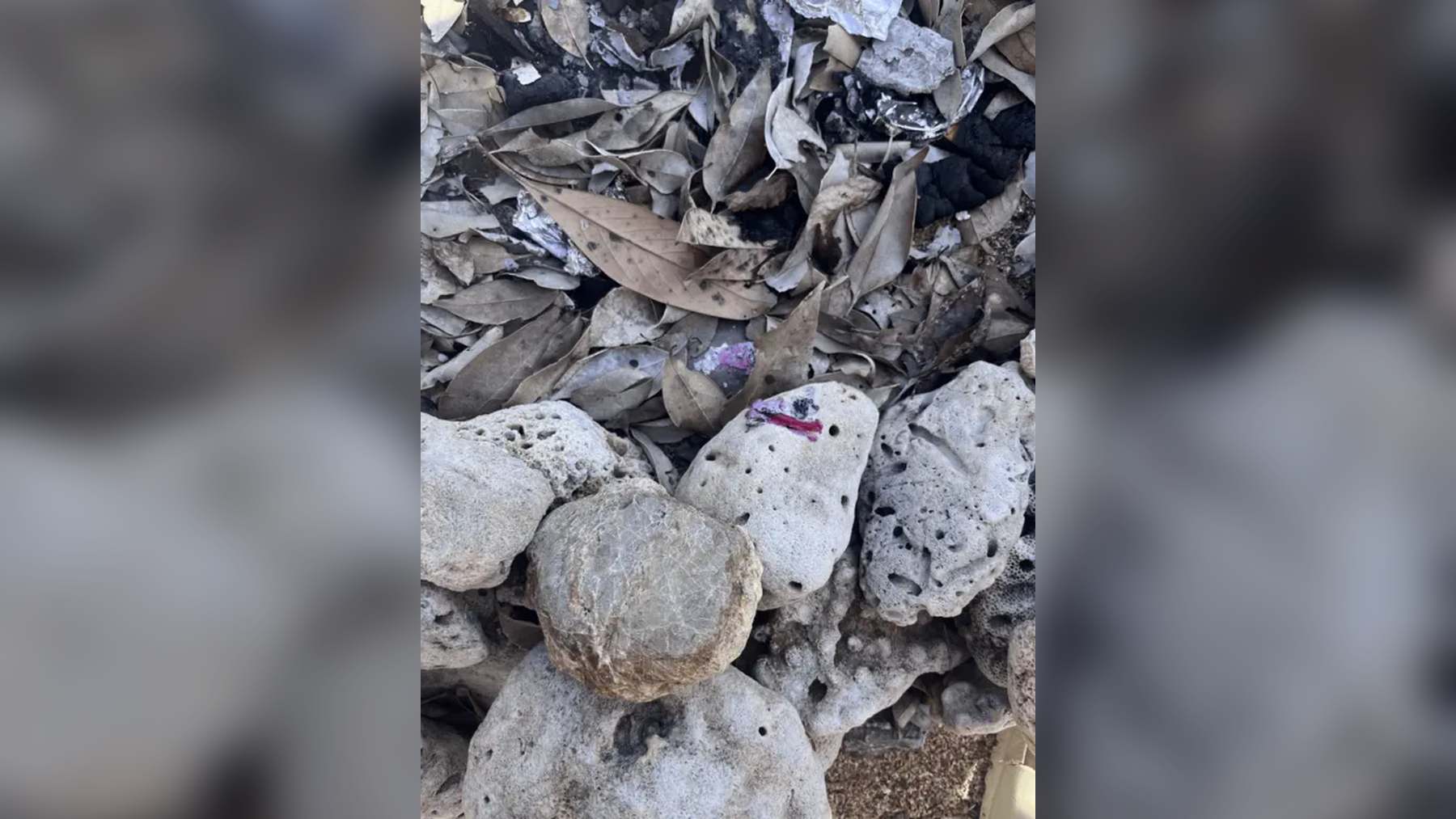
In August 2024, a team counting trash on Okinawa’s beaches came across small, brightly colored specks in the pale coral rubble. They took some back to the lab and found plastic fused to coral, melted so far into the dead skeletons that it could not be separated.
“We did not set out to discover plasticoral,” first author Ifenna Ilechukwu told Mongabay in an email.
The paper lists Ilechukwu with the Molecular Invertebrate Systematics and Ecology Laboratory at the University of the Ryukyus. The senior author is Professor James D. Reimer of the same university, and the paper also lists researchers from the Marine Climate Change Unit at the Okinawa Institute of Science and Technology (OIST).
Five pieces on three Okinawa beaches
The five pieces came from three beaches on Okinawa Island. OIST’s photos show samples from two of them, Sosu Beach and Ibu Beach, both inside Yanbaru National Park, a protected area in the north of the island.
OIST’s caption for one of the photos says the Sosu sample was “found at the bottom of a beach firepit.” It goes on: “Plastic waste combined with beach fires is a likely source of plasticorals, as the heat thermally adheres the polymers to the coral rubble.”
Ilechukwu told Mongabay that the team suspects a beach fire, but more research is needed before anyone can call that confirmed.
How plasticoral differs from plastic rocks
Melted plastic stuck to natural stuff has a name already, plastiglomerate, and there have been reports of rocks made of plastic that could stay on Earth as future fossils.
The Okinawa find is a little different. “While earlier documented variants such as plastiglomerates and plasticrusts are chiefly formed between plastic and abiogenic substrates, this study introduces plasticorals, a new form of plastic litter variant formed from plastic materials thermally adhered to or agglutinated to coral rubble,” the authors write. Abiogenic just means not made by a living thing, like a beach stone.
Plasticoral is a type of plastiglomerate, but Ilechukwu said “plasticorals represent something different.” Then he described what sets them apart. “The melted polymers literally liquidized and conformed to the intricate, porous skeleton of the coral rubble,” he said.
Bottle plastic and cap plastic in the pores
The team checked the plastic with Raman spectroscopy, which shines a laser on a sample and reads the light that bounces back to tell what it is made of. Four of them came back as polyethylene, which is the plastic in a lot of single-use bottles. The odd one out was polypropylene, the stuff of food containers and bottle caps, Mongabay reported.
Both of those plastics can go soft and lose their shape when heated, the study notes, according to Mongabay. They’re also among the most common types of plastic found in the ocean.
Then they looked inside. Using micro-CT scanning, a high-resolution cousin of the CT scans used in hospitals, plus microscopy, they could see the plastic running into the skeletal pores and where it met the coral, the abstract says.
Coral rubble is habitat for reef life
These were all beach finds, none from the reef itself. Rubble that washes up can get washed right back into the sea, though, and the institute’s release explains why that matters. “New corals use rubble as a stable substrate, and the rubble’s irregular shapes create nooks that shelter juvenile fish and other small marine life from strong currents and predators,” the release says.
With plastic melted into it, the rubble “may not function effectively as natural substrates,” Ilechukwu told Mongabay.
In the release, OIST also cited earlier research. “We already know from previous studies that chemicals leaching from common polymers disrupt coral propagation, and plastic pieces have been found to harbor coral pathogens and propagate up through the marine food chain,” the release says.
And burning plastic can give off dioxins and fine particles, Mongabay noted, and break it into microplastics faster, the kind already found in places as far from the ocean as the howler monkeys of Los Tuxtlas in Mexico.
A possible marker of the Plasticene
Plastic is the third most made material on the planet, after cement and steel, OIST says. Geologists in the future will “likely be able to pinpoint the period from the 1950s onwards, popularly called the Plasticene, as a distinct plastic layer in the Earth’s crust,” according to the release.
Ilechukwu thinks plasticoral could be part of that layer. It could “potentially represent an early stage in the transition from transient plastic litter to a more persistent, lithified sedimentary record of the Plasticene in tropical reef environments,” he told Mongabay. Lithified is a geology word for turned into rock.
Human junk ending up in the sediment is not new, either. Geologists have found it in the sand of the D-Day beaches in Normandy, decades after the war.
What five samples cannot show yet
So far there are five pieces from one island, and they were found by accident. That’s enough to give it a name. Nobody knows yet how much of it is out there, whether you need a fire pit to make it, or what it does to the animals living on the reef.
“We recommend further studies to better understand formation processes, distribution, and potential ecotoxicological impacts of plasticorals on coral reef environments,” the authors write.
Ilechukwu also runs Reeflitter.com, where divers can upload photos of trash they see on reefs. “Over the past three years, my research into marine litter pollution has shown that the presence and impact of marine debris on coral reefs are significantly under-reported,” he writes on the site. Deep-sea surveys keep turning up the same kind of thing, from fishing nets and bags to a VHS tape nearly 13,000 feet down in the Argentine Sea.
Ilechukwu and his colleagues are hoping other scientists, and regular people too, will help them keep track of litter of all kinds, including plasticoral. “Let us keep protecting our environment, it is all we have,” Ilechukwu said.
The full study was published in Marine Pollution Bulletin.
Image: Ilechukwu et al., 2026 / OIST (CC BY-SA)