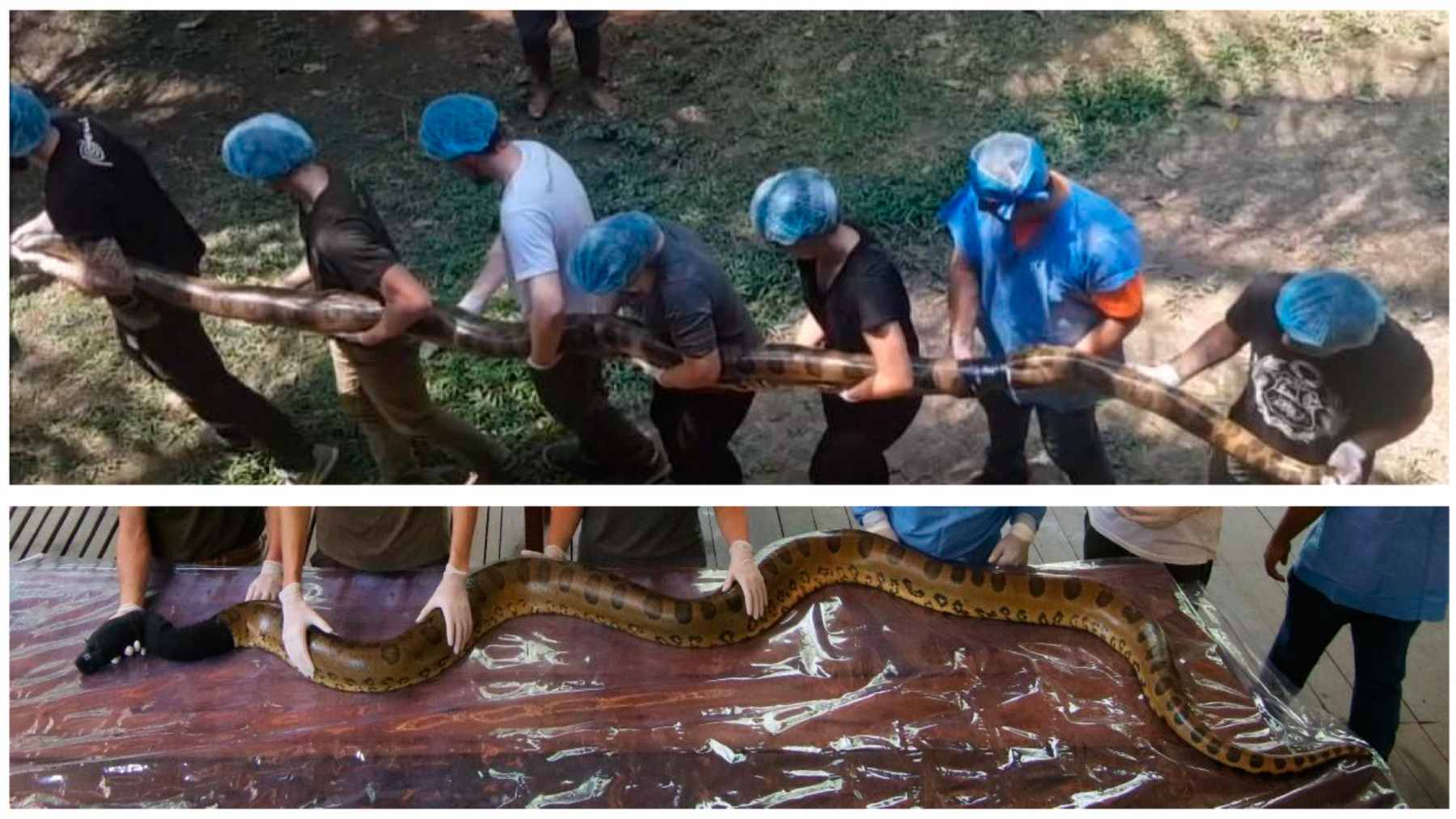
On a riverbank in Ecuador’s Amazon, Waorani guides climbed off a boat and held down a northern green anaconda that Bryan Fry guessed was up to 17 feet long, and Will Smith, who said afterward that “that was scary, even from the boat,” had to be talked into wiping the mud off the snake’s belly so Fry could snip off a scale.
“Yeah, nah. I’m a little nervous,” the actor told Fry in the clip from “Pole to Pole with Will Smith,” and Fry answered, “You can do it,” then made the cut and said, “There you go. There’s our sample. We can do all the research on this animal with just that one tiny little piece.”
That snake belongs to Eunectes akayima, which Fry, Jesús Rivas and their colleagues split from the familiar green anaconda in February 2024 after finding that the two lineages differ genetically by 5.5 percent and parted ways almost 10 million years ago, a result Rivas summed up by saying that “their genetic divergence is much larger than that between humans and chimps.”
A rare invitation from the Waorani
Fry, a biologist at the University of Queensland and a National Geographic Explorer, was the scientific leader of the expedition into the Bameno region of the Baihuaeri Waorani Territory, and he has said that “our team received a rare invitation from the Waorani people to explore the region and collect samples from a population of anacondas, rumoured to be the largest in existence.”
According to his university, the hunters took the team on a 10-day expedition, partly by canoe, and one female they found measured 6.3 meters (20.7 feet), while the Waorani spoke of others longer than 7.5 meters (24.6 feet) and around 500 kilograms (1,102 pounds), figures Fry called “anecdotal reports.” The longest wild snake ever measured, for the record, was a python.
Two Waorani, Chief Penti Baihua and Marcelo Tepeña Baihua, are co-authors of the paper, and its acknowledgments thank Will Smith “for his help in collecting the E. akayima samples.”
A study run from New Mexico
The study was led from Las Vegas, New Mexico, where Rivas and his wife, Sarah Corey-Rivas, both teach biology at New Mexico Highlands University (NMHU), and where the project had been in the works since the two met at an international snake ecology conference in 2004, with Rivas leading the study and Corey-Rivas guiding its genetic design.
“Right under my nose, there were two different species,” Rivas told the Albuquerque Journal. “It’s another icon, a species that was so iconic … and still, two species were snuck under the radar.”
The team used samples of all anaconda species “across their distribution, including nine countries,” and found that green anacondas from Ecuador, Venezuela, Trinidad, Guyana, Suriname and French Guiana formed one lineage while those from Peru, Bolivia, French Guiana and Brazil formed another, which kept the old name Eunectes murinus, even though, as the authors write, “specimens from the northern and southern clades are indistinguishable morphologically.”
When the analyses finished, “I didn’t expect that level of divergence,” Fry told National Geographic, adding that “it’s just mind-blowing” and that “we were all of us very much doing happy dances.”
Genetic work has been redrawing lines like this for years, splitting a Himalayan viper into five species and an Iberian rabbit from the European rabbit, but the same anaconda paper went the other way with yellow anacondas, proposing to fold three species into one, and Fry told National Geographic, “I’m very conservative, and I’m a lumper at heart. So for me, it fits with lumping the yellows together.”
An early supporter later signed the critique
“This is a very thorough study, and I full trust the genetic results,” Wolfgang Böhme, a senior herpetologist at the Museum Koenig in Germany, told National Geographic by email in February 2024. “The discovery of the deep genetic split within the green anacondas is an important discovery.”
On March 15, 2024, less than a month after the paper came out, three researchers from the National Autonomous University of Mexico and the University of Cambridge argued in the journal Bionomina that “the article in question violates fundamental aspects of the International Code of Zoological Nomenclature,” the rulebook for naming animals, and a 51-page critique led by the journal’s founder and chief editor, Alain Dubois, appeared in the same journal.
In August, Wolfgang Wüster, a zoology professor at Bangor University in Wales, published “How not to describe a species” in the Zoological Journal of the Linnean Society with 15 co-authors, Böhme among them, writing that the anaconda study “generated extensive publicity, but also provoked considerable controversy due to inadequacies of the evidence used and errors in nomenclature” and warning against “an over-reliance on mitochondrial DNA data.”
The team admitted mistakes and kept the species
Rivas and colleagues answered in July 2024 with a second paper in Diversity, writing that “we acknowledge some mistakes were made in this description, especially regarding the application of ICZN,” and adding, “Nonetheless, we stand by the scientific merit and conclusions of our paper.”
The holotype, the specimen that anchors the name, is one Rivas himself collected back in 1993 at Hato El Cedral, a ranch in Venezuela’s Apure State, and it is the “skin of a female, 485 cm in total length,” about 15.9 feet. The authors, who say they have “measured in excess of 1400 anacondas of all sizes,” also reported body differences they had missed the first time, with northern males that “never exceed 3.5 m” (about 11.5 feet) and averaged 253.5 centimeters (8.3 feet) across 353 snakes, against 279 centimeters (9.2 feet) for 66 southern males.
They also complained that the Dubois critique was submitted on March 4 and accepted on March 8, writing that “it would certainly seem impossible to obtain 2-3 independent reviews in that short period.”
“We did not accept the notion that a name given by a person that only knew the snake from a jar and never saw it alive would take precedence over the name given by those who lived with the snake and interacted with it on a regular basis,” they wrote of akayima, a Carib word that translates as “The Great Snake.”
Rivas told the Albuquerque Journal he had thought about naming the snake after his 2-year-old daughter, then went with the Carib word because “I felt that it would be more fair if I named it after the people who could share the land with the anacondas before.”
Why a smaller range matters
“It’s important, because the newly described northern green anaconda has a much smaller range than the southern, and so that means it’s much more vulnerable,” Fry told National Geographic, and the paper makes the same point about the green anaconda’s least concern listing, noting that “evidence pointing toward two species in its original range may change that conclusion.”
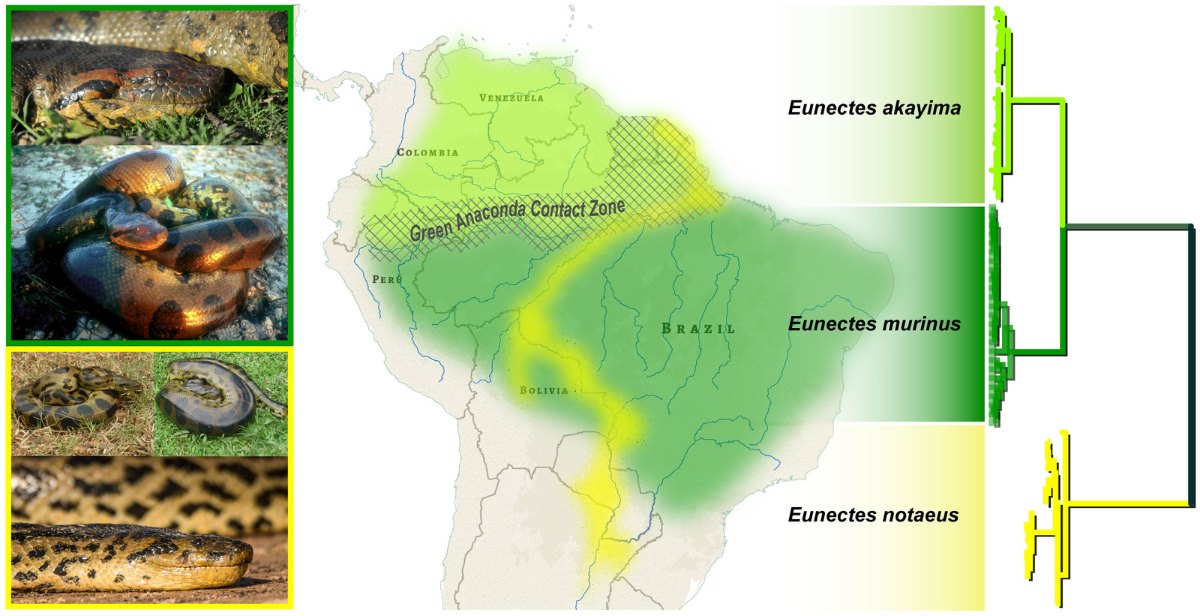
“Ultimately, it’s really good news for anacondas,” Corey-Rivas told the Albuquerque Journal. “That’s what matters. It really will help us figure out how to do conservation planning and have specific protection policies in place.”
The scale clipped in front of Will Smith was meant to “measure the accumulation of pollutants in the water,” and Fry has said that “of particular urgency is research into how petrochemicals from oil spills are affecting the fertility and reproductive biology of these rare snakes and other keystone species in the Amazon.”
The questions still open
Wüster’s group says “denser sampling and an analysis of informative nuclear markers are required for meaningful species delimitation in Eunectes,” and the NMHU team concedes that the nuclear genes it tried “did not provide sufficient numbers of variable sites within the Eunectes genus to distinguish lineages,” though it argues that “the divergence of these clades is substantial.”
Fry has pointed to French Guiana, where the two species seem to live as close as opposite riverbanks without signs of interbreeding in their genes, as one of the puzzles still waiting. “For every question you answer, seven more interesting ones pop up,” he told National Geographic. “To me, that’s a sign of a good study, is that it raises as many new questions as it answers the old.”
The full study was published in Diversity.
“This pattern of diversity of anacondas, it’s humbling to me,” Corey-Rivas told the Albuquerque Journal, and she added, “They are just so secretive.”
Photo: Jaroen Ten Haaf / Rivas et al., Diversity (2024) (CC BY 4.0)