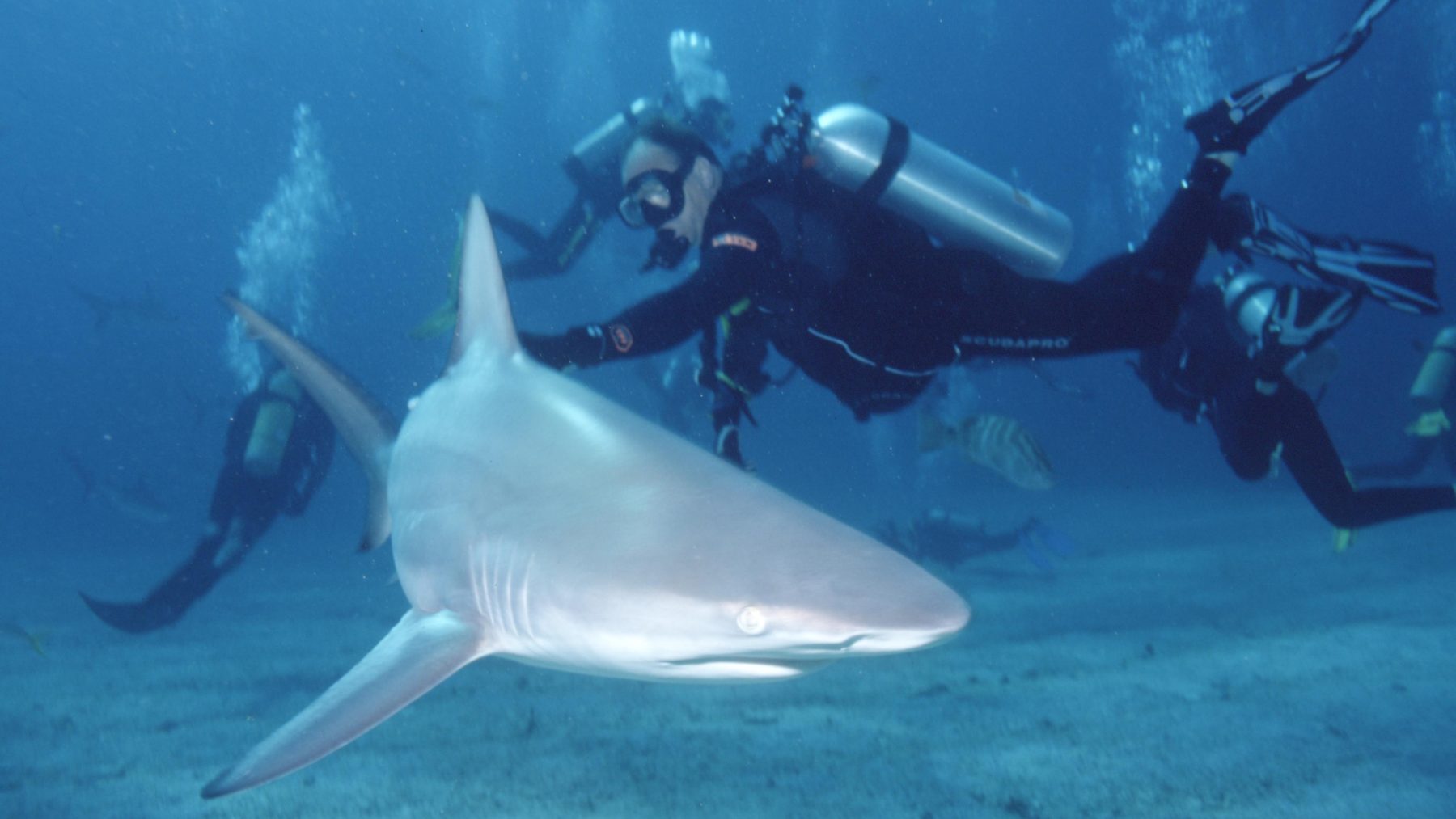
The sound came from a speaker dangling about 3 feet (1 meter) below the surface near a small anchored boat off Southeast Florida, and blacktip sharks cruising as far as 243 feet (74 meters) away heard it, swung their heads around and bolted.
That is a long way for a shark to notice a sound in the water. It is also the first time anyone has put a number on it in free-swimming sharks this far from the source, according to researchers at Florida Atlantic University (FAU) who filmed the whole thing with a drone.
A master’s project off Southeast Florida
Caroline Sullivan did the fieldwork as part of her master’s degree in biological sciences at FAU. Her co-authors were research director Edmund Gerstein and senior author Stephen Kajiura, a professor of biological sciences in FAU’s Charles E. Schmidt College of Science.
Every winter, from about January to March, blacktip sharks (Carcharhinus limbatus) pile up along the Palm Beach coast. Some stay all year.
“Their abundance and accessibility made it possible for us to observe them from above without disturbing their natural behavior, while also presenting controlled underwater sounds,” Kajiura said in an FAU news release.
Why not just test them in a tank? Sullivan has a simple answer. “Trying to do hearing experiments in a tank results in the sound bouncing off the walls which causes complex and confusing signals,” she said. “It is like being in a house of mirrors. This is why it is so important to do these types of experiments in the ocean with wild sharks to get a natural response.”
A laptop, an amplifier and a light box
The gear was pretty ordinary. Sounds played from a MacBook Pro, went through a Sony stereo amplifier running off a 12-volt marine battery, and came out of an underwater loudspeaker that drifted on the current to roughly 43 to 62 feet (13 to 19 meters) behind the boat, far enough to keep the boat from swaying how the sharks reacted.
A remote-controlled light box floated on top of the speaker. It switched on with each sound so the drone, parked about 130 to 165 feet (40 to 50 meters) up, could see exactly when a sound started.
They worked in water 7 to 16 feet (2 to 5 meters) deep near the Jupiter, Palm Beach and Pompano Beach inlets, between 7:30 in the morning and 12:30 in the afternoon, on days with little wind.
Could the drone have bothered the sharks? The authors say no. At that height it “was undetectable by the sharks and thus could not influence their behavior,” they write, because drone rotor noise only shows up at measurable levels underwater when the aircraft is flying lower than about 16 to 33 feet (5 to 10 meters).
Sharks ignored the control and fled the low sounds
When a shark swam into view, it got five seconds of a high 10,000 hertz control sound, five seconds of nothing, and then one of three low, pulsing noises picked at random: 100 to 200 hertz, 200 to 400 hertz, or 400 to 800 hertz. Hertz is just vibrations per second, and the lower the number, the deeper the sound.
The control did nothing. Not one shark reacted to it.
The low sounds were another story. Sharks reacted 59 out of 72 times to the deepest band, 47 out of 54 times to the middle one and 59 out of 83 times to the highest.
“Upon detection, C. limbatus elicited a sudden 20–160° turn away from the speaker and rapidly swam away,” the paper says. The average turn was about 73 degrees.
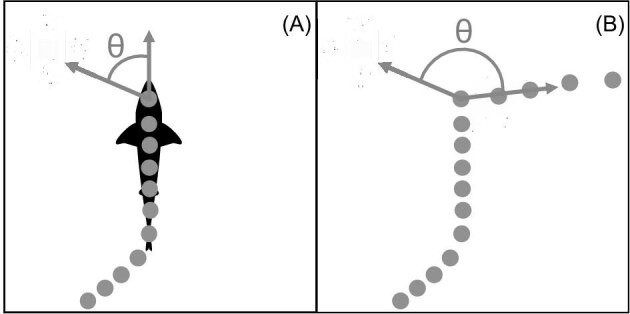
To get distances, the team put a dot on each shark’s head in every frame of video and used the boat, which they knew was 22 feet (6.73 meters) long, as a ruler. On average the sharks turned at about 134 feet (40.7 meters) from the speaker for the deepest sounds and 98 feet (30 meters) for the 400 to 800 hertz band. The record was 243 feet.
The far field is the surprising part
Near a speaker, the water itself gets shoved back and forth. Physicists call that the near field. A few wavelengths out, you’re in the far field, where the sound is mostly a pressure wave and the water barely moves.
Sharks “are presumed to lack the capacity to detect these sounds beyond the acoustic near field, where particle motion dominates,” the study says. Yet more than 70 percent of the reactions in Florida happened in the far field, and that’s using the most conservative cutoff the team could pick.
“What makes this finding particularly interesting is that the sharks were responding to sounds beyond the acoustic near field, where the sound behaves differently than it does close to the source,” Kajiura said. “This suggests that they are detecting the particle motion associated with sound even at considerable distances from the source,” he said, which is “something we have not previously been able to demonstrate in free-swimming sharks.”
Somebody may have seen this before, sort of. A 1964 abstract described sharks, spotted from a circling airplane, orienting to an underwater transducer from more than 200 yards away. The full study never came out.
Deeper sounds needed less volume
The team had mapped how loud each sound was at different distances, out to about 200 feet (60 meters), using hydrophones, which are underwater microphones. So they could work out how loud it was right where each shark turned.
For the deepest band, about 16 decibels above background noise was enough. The 400 to 800 hertz band needed about 45. That lines up with older work showing sharks are best at hearing low sounds.
And yes, the sounds were meant to be unpleasant. “In this study, we deliberately presented sharks with a repulsive acoustic stimulus designed to evoke an immediate and robust response regardless of motivational state,” the authors write. Other wildlife studies have used playback, too. In Alaska, recordings of human voices sent bears and eagles running from salmon streams.
Sharks hear without a swim bladder
A lot of bony fish hear far-off sounds with help from a gas-filled swim bladder. Sharks don’t have one. The authors say they “must rely solely on the particle motion component to detect sound in the far field.”
Shark inner ears have patches of hair cells topped with heavy little crystals, a bit like the ear stones bony fish carry, the ones scientists slice to read a bluefin tuna’s age. Sharks also have an extra sensory organ with no crystals, the macula neglecta. The team thinks it could be “the specialized mechanism that allows sharks to detect the low levels of particle motion in the far field.”
A 2023 study of nine shark species fits that idea. Its authors counted more hair cells in this patch in sharks that feed in open water than in seafloor feeders, and wrote that “sharks within Carcharhinidae seemingly possess a specialized macula neglecta compared to other shark species.” Blacktips belong to Carcharhinidae.
Other fish wandered through the shots, too. “During sound playback, blacknose sharks exhibited behavioral responses that mirrored those of C. limbatus,” the authors write, while free-swimming nurse sharks “did not exhibit an overt behavioral response during sound production.” Big tarpon and crevalle jacks showed “no apparent response” at all.
Sharks’ relatives have their own early warnings, by the way: a frightened bat ray can warn its neighbors with a chemical signal.
What the study can’t tell us
“Ideally, particle motion would have been measured as well, but this was not practical under the field conditions,” the authors write. Their hydrophones recorded sound pressure, so the particle motion idea is an inference from how the sharks behaved.
Some of the deepest sound leaked below 100 hertz, so some “far field” reactions might really be near field ones. The authors note that plenty of reactions to the 400 to 800 hertz sound can’t be explained that way.
These were loud, scary noises meant to chase sharks off. The results say nothing about how far a blacktip can hear a hurt fish, or you splashing at the beach.
“Therefore, it should not be surprising to discover that sharks are capable of orienting to sounds in the acoustic far field. However, the mechanism remains unclear,” the paper concludes.
Offshore construction adds its own racket to the water. Off Virginia Beach, bubble rings around wind turbine foundations cut pile-driving noise in the water, though vibrations still moved through the seabed.
Sharks are listening
“The ocean is an acoustic environment, and sharks are clearly tuned into it in ways we are only beginning to understand,” Kajiura said. “Being able to detect and respond to sounds from hundreds of feet away gives these predators an important source of information about their surroundings. The next question is how their sensory system allows them to pick up and interpret these distant sounds.”
The full study was published in June 2026 in Integrative Organismal Biology.
Photo: Albert Kok / Wikimedia Commons (public domain)