An Atlantic bluefin tuna begins life no bigger than an eyelash, yet the species has produced a verified fishing record of 1,496 pounds. That is a long way from the small portions most people picture at the seafood counter.
There is another surprise hidden inside this ocean giant. Scientists can estimate its age from growth bands in tiny ear structures, information that helps assess fish populations and guide decisions about how much fishing they can support. Fishing restrictions have helped Atlantic bluefin recover, but their future still depends on maintaining that balance.
From a tiny hatchling to a record-breaking fish
Bluefin is not a single species, but a name covering Atlantic, Pacific, and southern bluefin tuna. The Atlantic species (Thunnus thynnus) includes the record fish, caught by Ken Fraser off Aulds Cove, Nova Scotia, on October 26, 1979. It remains the International Game Fish Association’s all-tackle world record for the species.
According to the Marine Stewardship Council, a bluefin can reach about 6.6 feet and 375 pounds at age 10, and roughly 8.9 feet and 882 pounds at age 20. These figures illustrate the scale of its growth, rather than a fixed timetable for every individual.
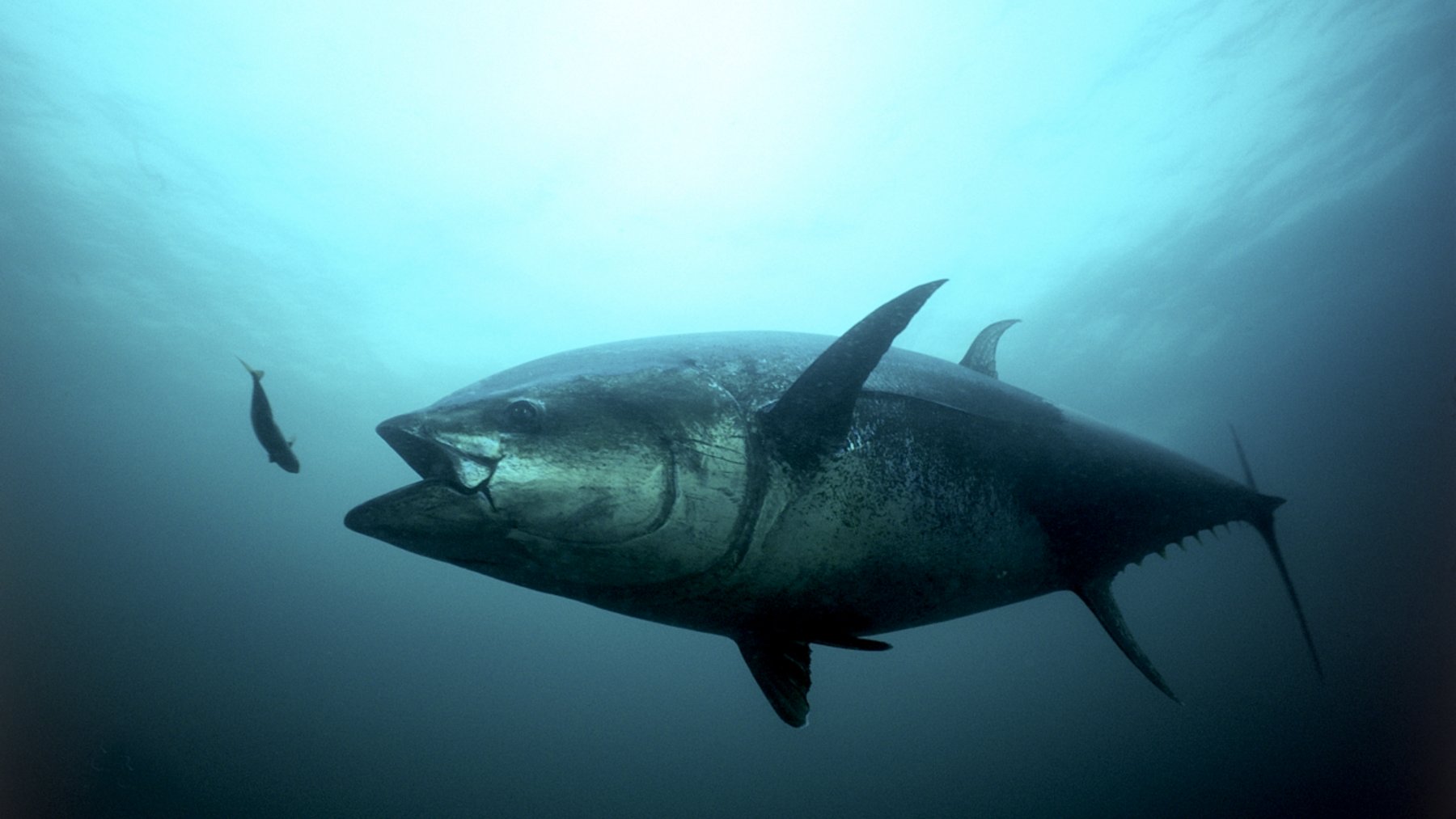
At a glance, Atlantic bluefin also have recognizable features, including a dark blue-black back, a pale belly, and short side fins. Those pectoral fins help distinguish them from several other tuna species, although identification involves more than color alone.
Reading the rings inside a tuna’s head
How do you age a fish with no birth certificate? One answer lies in its otoliths, small mineral structures involved in hearing and balance that accumulate layers as the fish grows.
Using samples from caught fish, researchers examine sections of these structures and interpret annual growth bands to estimate age. For Atlantic bluefin, the task takes care because extra bands can be mistaken for yearly ones, and older fish can also be difficult to age accurately.
That makes an otolith more than a biological curiosity. Age estimates help reveal how quickly fish grow and the mix of young and old animals in a population, information used to assess stocks and guide fishing management.
Built for speed and a very big appetite
The Marine Stewardship Council’s wildlife guide puts bluefin’s top speed at 44 mph, although it does not identify how that figure was measured. Their streamlined, torpedo-shaped bodies are well suited to fast swimming.
NOAA also describes specialized blood vessels that help bluefin retain heat, keeping their bodies warmer than the surrounding water. That extra warmth supports muscle performance and allows them to operate across a broad range of ocean conditions.
All that activity requires food. Young Atlantic bluefin eat fish, squid, and crustaceans, while adults mainly target smaller fish such as herring and mackerel. But they are not untouchable, with sharks and marine mammals among their natural predators.
Ocean travelers do not follow borders
Atlantic bluefin are managed as eastern and western stocks, but those divisions are not walls in the water. NOAA reports that many Mediterranean-origin tuna cross into the western Atlantic to feed and grow before returning to spawning areas.
Newer tracking research adds detail to that picture. A study highlighted by NOAA in April 2026 used electronic tags deployed on 1,720 bluefin between 1996 and 2025 and found that lower fishing pressure in western and northern Atlantic waters provided a refuge for eastern-origin fish. The researchers also analyzed catch records extending back to 1950 to compare fishing pressure across regions.
Following a tuna is not just a matter of drawing a line on a map. Its journey can cross national waters and the high seas, which is why the International Commission for the Conservation of Atlantic Tunas coordinates conservation measures among fishing nations.
A recovery that still needs protection
In 2021, the International Union for Conservation of Nature reclassified Atlantic bluefin from “Endangered” to “Least Concern,” citing improved fishing management and action against illegal catches. But it also warned that an improved global rating can hide depleted regional populations.
“We need to continue enforcing sustainable fishing quotas and cracking down on illegal fishing,” fisheries scientist Bruce B. Collette said in that announcement. For consumers, the practical takeaway is to ask which species is being sold and where it was caught, rather than assuming all tuna shares the same conservation story.
Management continues to evolve, with NOAA announcing on August 18, 2026, that the U.S. baseline annual Atlantic bluefin quota would rise from 1,316.14 to 1,509.58 metric tons.
The official update was published on NOAA Fisheries.