
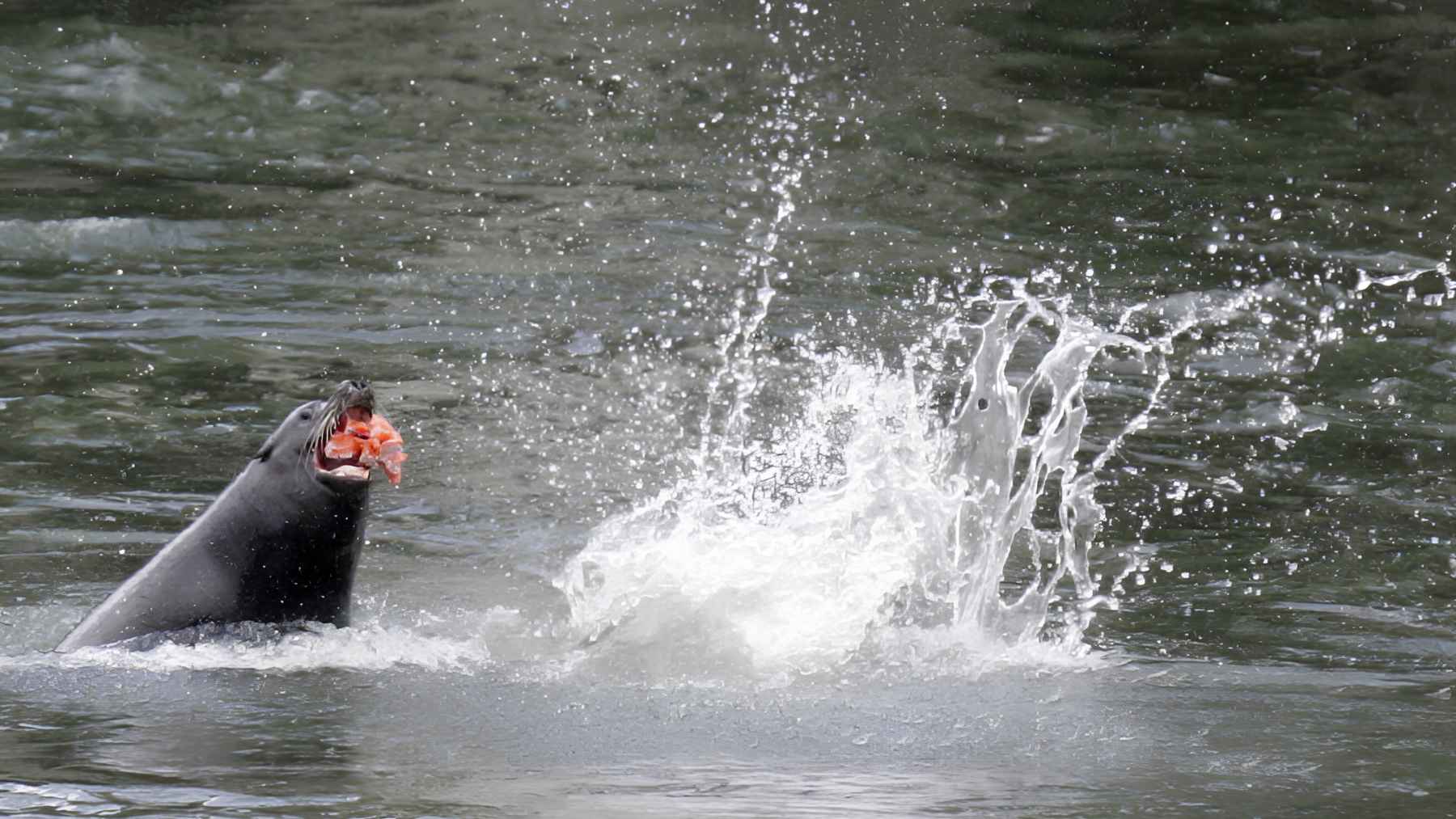
At Bonneville Dam on the Oregon-Washington border, the sea lions from California learned that they can “wait for dinner” below the hydroelectric structure, since spring salmon go around that area searching for fish-ladder entrances.
The latest federal monitoring shows that this is not the best scenario. Between April 6 and May 17, 2025 it was estimated that sea lions ate around 2.943 spring Chinook salmon. The main story is not simply that the predators eat their prey, but that the human infrastructure can teach intelligent animals where and whn vulnerable wildlife will be.
A human-made bottleneck became a dinner bell
What is happening at Bonneville can be compared to traffic jams, but in this case underwater. Here the concentration turns an enormous river into a dining area for sea lions. Specifically, fish ladders help the salmon pass the barrier, but they end up crowded together in the tailraces where the sea lions can hunt them with much less effort than in an open river.
California sea lions learned the pattern
Researchers discovered that the animals learned that in the exact same place at approximately the same time of the year, they would find a lot of prey. of the year. Social connections influenced which animals found Bonneville Dam and if they came back, while earlier modeling indicated that information about the feeding opportunity could spread through the population much like an infection.
NOAA researcher Zachary Schakner said that starting earlier makes it easier and more effective to stop the spread. And this shows how big the problem is. In the same line, as he says, changing a food habit is difficult after it is sustained for a long time.
The 2025 figures show the pressure is still real
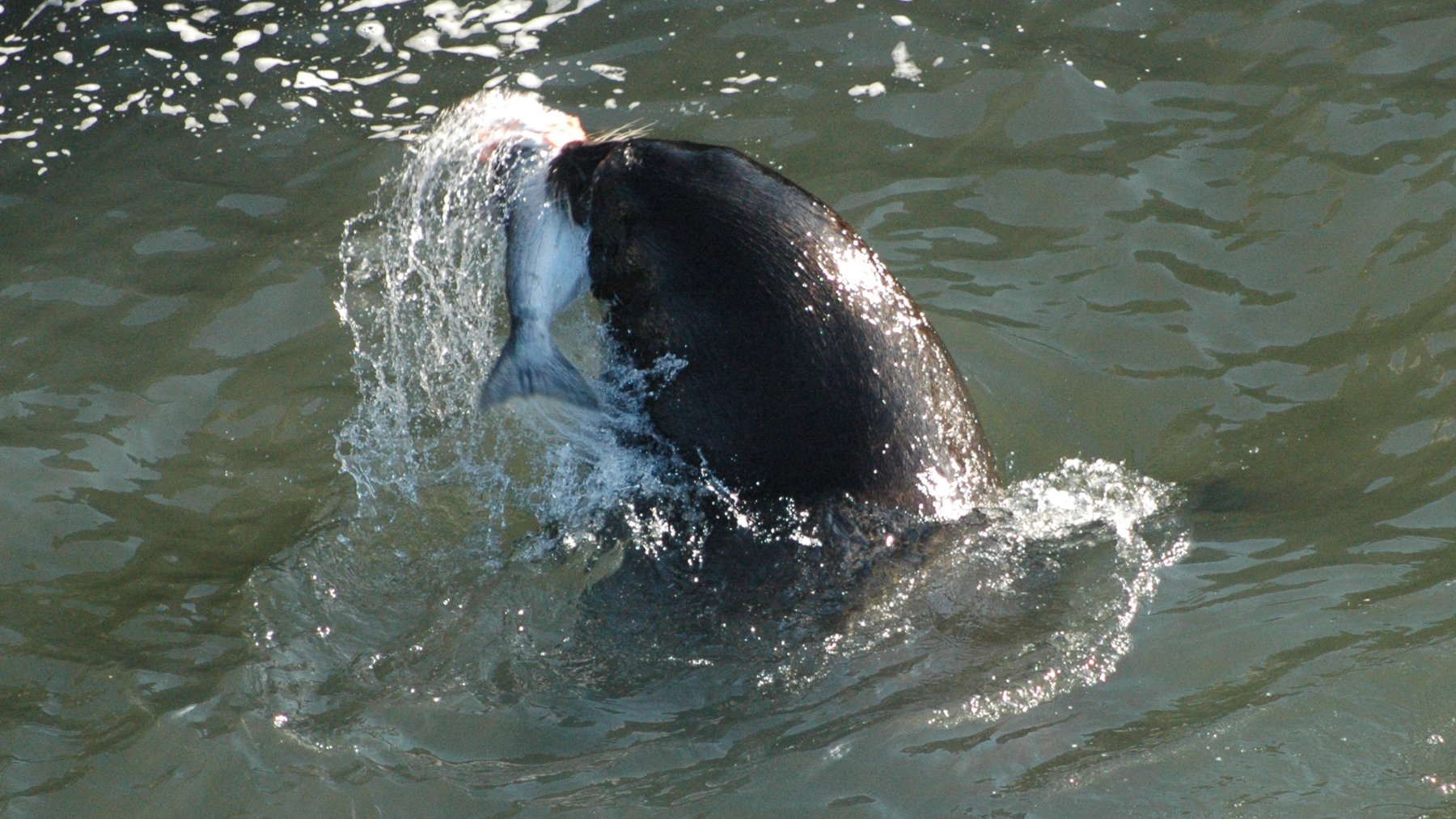
During the spring 2025 monitoring season, the U.S. Army Corps of Engineers documented minimum counts of sea lions and how many fish they ate. Their data showed that California sea lions ate a disproportionate number of salmon.
Observers estimated that sea lions ate around 2.098 salmon chinook, 102 white sturgeon and 28 steelhead during those monitorations. Researchers said that although some of the numbers for other fish can be quite small, they can still carry a heavy ecological weight.
Scaring sea lions away has clear limits
Wildlife managers have tried many ways to see if they can push them away from the dam. They tried things like disruptive noise or pyrotechnics, but the results were not what they expected. A specific study of Steller sea lions showed how after a repetitive exposition, they became less responsible and sensitive to them.
Two wildlife protections now collide at the dam
This is not a simple story about a “bad” predator. Actually, the California sea lions could appear with more strength after the Marine Mammal Protection Act. At the same time, several Columbia Basin salmon and steelhead stocks are still being protected under the Endangered Species Act. And at Bonneville, both conservation laws meet in the exact same stretch of water.
Things reached such a point that NOAA authorized local agencies to remove some sea lions. Some of them could even face lethal removal when no zoos or aquariums accept the animals. With these measures, officials confirm that recent removals appear to be reducing the number of repeat predators, but the ethical and ecological tradeoff is still uncomfortable.
Bonneville offers a warning for other dammed rivers
Projects like the one at Bonneville can actually improve access around a barrier, but in doing so, tight zones are created and that makes things predictable for the predators. That is why new projects need constant control that goes beyond the analysis if fish technically pass, and instead looks at how much time they wait, where they bunch up, and what learns to hunt them.


