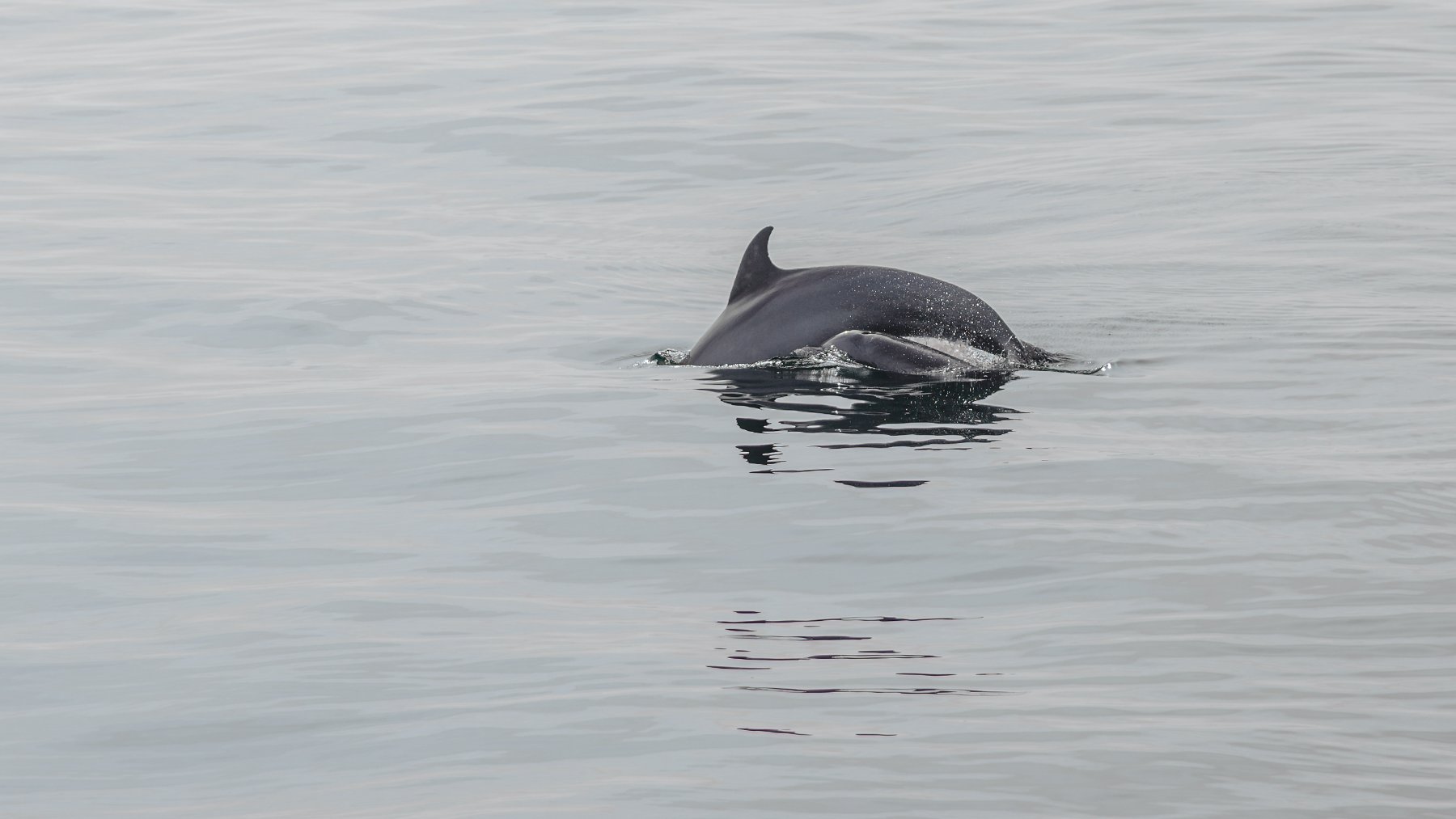
Scientists off Australia’s Queensland coast have filmed bottlenose dolphins using empty seashells as fishing tools. But the most intriguing moment came when a calf picked up a shell shortly after its mother, raising the possibility that this clever hunting skill can pass between generations.
Researchers from the University of the Sunshine Coast recorded two encounters in the Great Sandy Marine Park off Hervey Bay between July and October 2025. Their findings provide the first published records of this behavior on Australia’s east coast, although the evidence for mother-to-calf learning remains preliminary.
The shell that made a researcher shout
For marine mammal researcher Alexis Levengood, the study’s lead author, a dolphin lifting something large above the water was an immediately recognizable sight. “I started screaming because I know what shelling looks like,” she said.
Known as “shelling,” the technique involves dolphins chasing fish into large, empty shells, bringing them to the surface, and manipulating them to drain the prey into their mouths. Think of tipping the last snack from a container, except this container came from the seafloor.
The shell is not the meal. It is an object from the animal’s surroundings being used to obtain food, which is why researchers describe the behavior as tool use rather than ordinary prey capture. What matters is how the object is used, not whether the dolphin made it or whether every attempt works.
Three minutes later, the calf tried it
During the mother-and-calf encounter, the adult surfaced holding a shell, but a fish escaped. She dropped the shell and pursued it, leaving the researchers with a close-up view of a hunting attempt that did not follow a tidy script.
Three minutes after the mother dropped the shell, the calf surfaced with it. It held the opening around its snout as its mother had done and slapped the shell against the water’s surface.
The paper makes an important distinction about what happened next. Researchers could not confirm that either animal successfully caught a fish during the encounter, so the footage documents shell handling and attempted feeding, not a verified meal.
A clue about learning, not proof of teaching
Could the youngster have been copying its mom? Levengood describes the sequence as potential evidence of “maternal social transmission,” meaning an offspring learns a behavior by observing its mother.
That possibility is not the same as demonstrating a deliberate lesson. With so few observations, the study cannot establish when the calf acquired the skill or conclusively show that learning occurred during the filmed encounter.
Earlier research published in 2020 found that shelling could spread among dolphins outside the mother-calf relationship through social learning. That work documented 42 shelling events involving 19 dolphins during surveys between 2007 and 2018, illustrating the longer observation effort behind that conclusion. The new paper does not erase that finding, and its authors explicitly leave room for multiple learning pathways, including both family relationships and wider social connections.
A first record does not mean a new invention
The important “first” is geographic. The paper reports the first published records of shelling outside Shark Bay in Western Australia, rather than claiming dolphins have only just developed the technique.
Additional evidence described by the university reaches further back than the new footage. Photographs taken during local Blue Dolphin Marine Tours trips in 2013 and 2019 show that Queensland dolphins had been shelling years before the researchers’ encounters. As Levengood explains, limited research in the area had helped keep the behavior out of the scientific record, even though it was being photographed.
In her account of the findings, Levengood notes that the eastern and western populations are more than 6,000 kilometers (about 3,700 miles) apart. She suggests they likely developed the technique independently, making the observations a window into how separate dolphin communities can arrive at similar solutions.
More than a clever dinner trick
The discovery also raises questions about how dolphins use the opportunities their habitat provides. Could handling a shell help some individuals reach food that other dolphins miss, or reduce competition for a meal?
Levengood presents those possibilities as questions still needing answers, not established benefits of the technique. More observations could help researchers understand where shelling occurs, how individuals acquire it, and whether its importance differs between populations.
For now, an empty shell has revealed both an inventive hunting method and a possible connection between a mother’s actions and her calf’s behavior. It is also a reminder of how much can remain hidden in a brief surfacing.
The study was published in Marine Mammal Science.