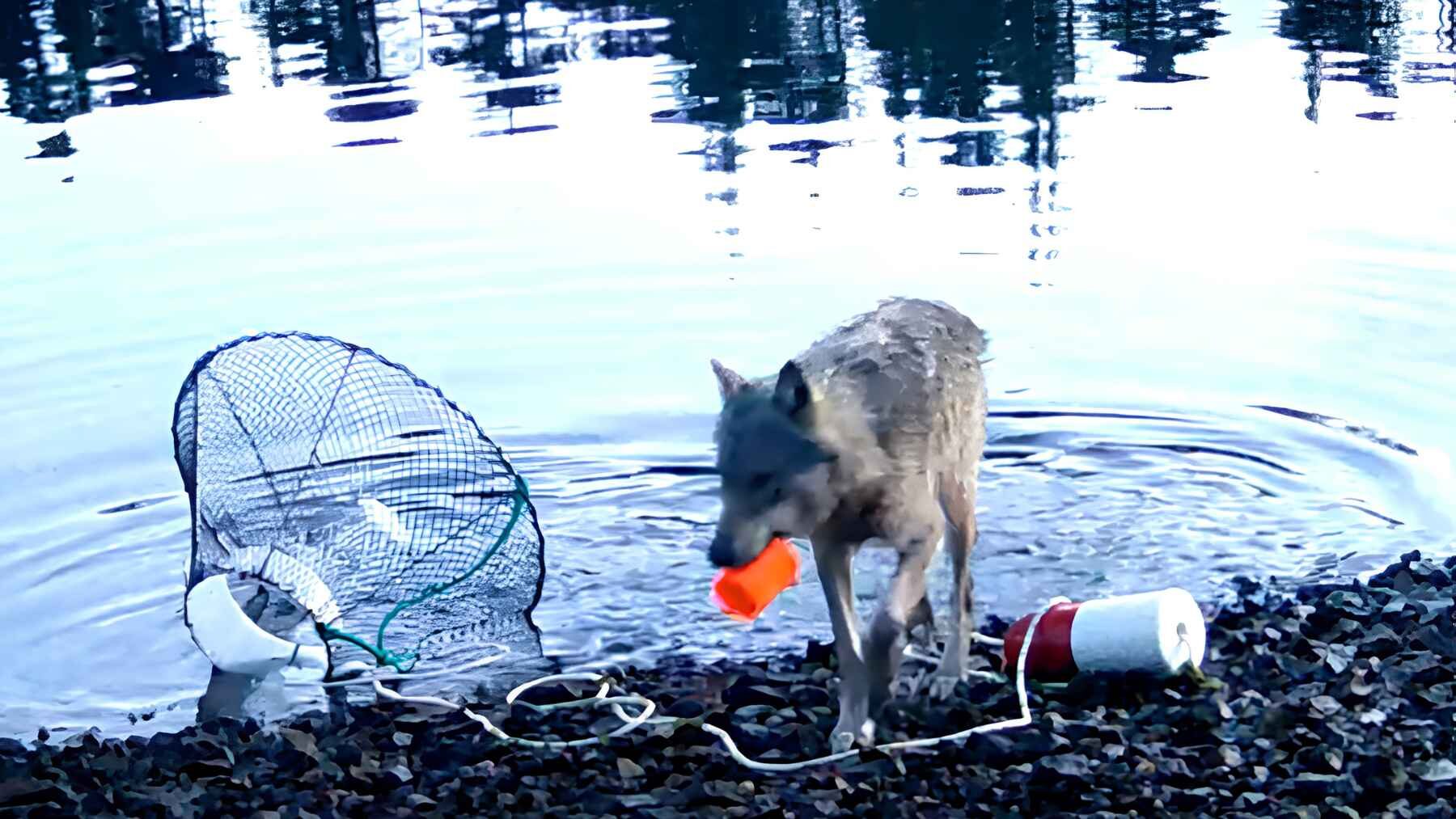
Can you imagine a female sea wolf swimming to a buoy on British Columbia’s central coast? An unexpected action like this one was captured on camera, but that was just a small part of it. Then she dragged a crap trap toward the shore and broke the equipment until she reached the bait container. This could actually be the first case of a wild wolf acting with such complexity in about three minutes.
Since the recording does not clearly show the full story behind how she did it, some scientists suggest that the wolf used a human-made object, while others say that she just pulled a rope that people had already tied earlier. Because of that, some do not think it was strictly the use of tools, and yes her intelligence to solve problems. No matter the theory you choose to believe, the video shows how a wild animal handles an unfamiliar situation with incredible results.
What the camera caught
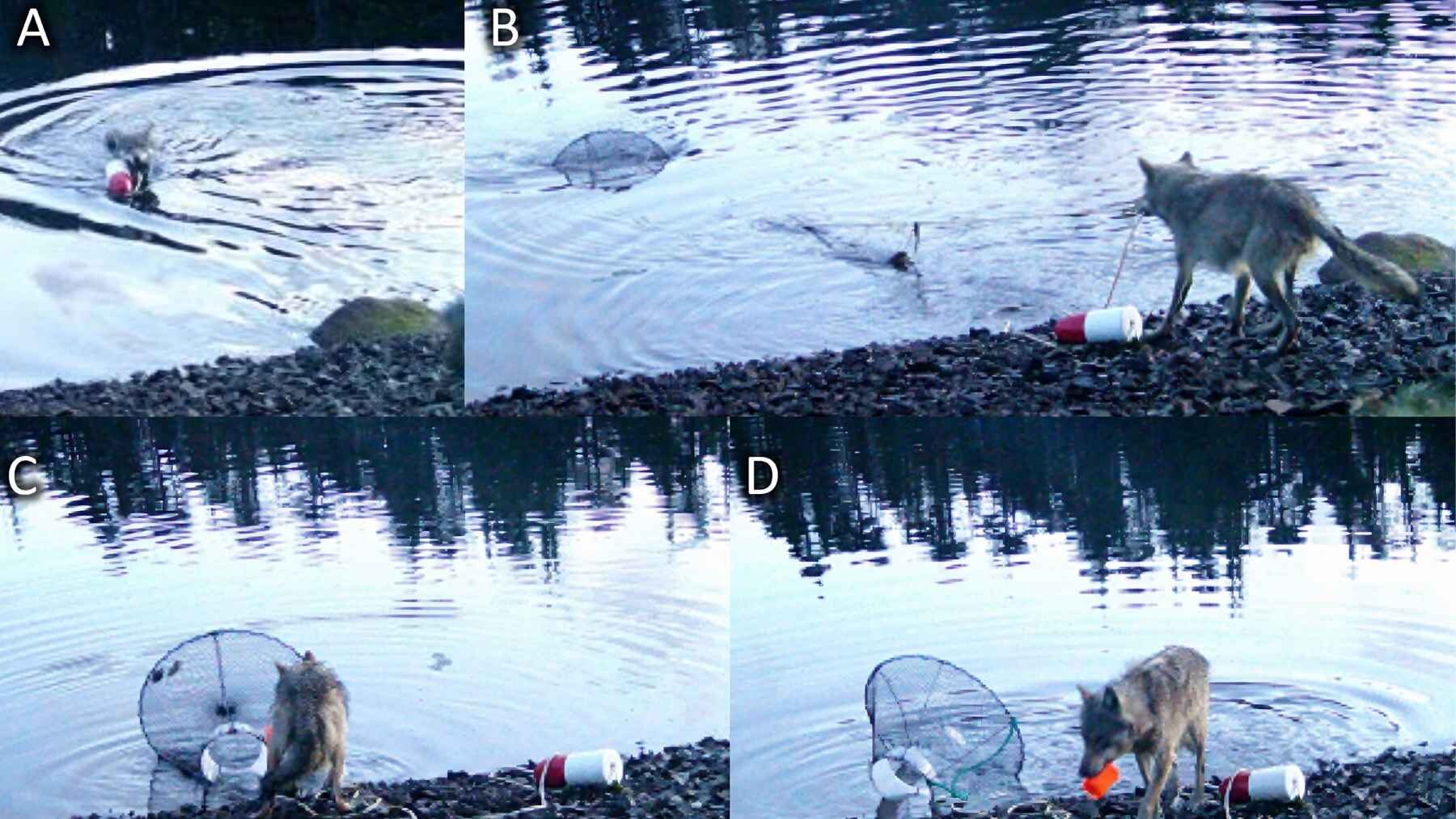
So now yes, when was this? On May 29, 2024, remote cameras near Bella Bella captured the female at high tide. At that same moment, the trap was underwater. So as you can imagine, this means it was not possible for her to see it clearly. But that did not prevent her from swimming to where the floating buoy was. That is when she carried it back in her jaws, drawing in the line.
But that is not the most impressive part. She did everything with so much care that it can be seen as very sophisticated behaviour for an animal. After placing the buoy on the rocky beach, she returned to the water, grabbed the rope farther down, and pulled until the trap was on the surface. Then, she finally chewed the net, ate the remaining bait, and left the scene.
To William Housty, a Haíɫzaqv hereditary chief, the scene looked strangely familiar. “You normally picture a human being with two hands pulling a crab trap,but there are other intelligent beings out there that are able to do this, which is very remarkable,” he said.
Why the cameras were there
The most interesting part of this story is that actually the cameras were not here to analyse and test animal intelligence. However, local guardians had been finding damaged equipment since 2023 during an invasive European green crab control program, and some traps were so deep that they could hardly be seen even at low tide. Because of this, that’s why, researchers, at the beginning thought that seals, sea lions, or otters were the ones taking the bait. And here now you know the true reason why the cameras were installed. With them the mystery was solved.
The peer-reviewed paper was co-authored by Kyle Artelle of the State University of New York College of Environmental Science and Forestry and the Heiltsuk Integrated Resource Management Department, and Paul Paquet of the University of Victoria and Raincoast Conservation Foundation.
The biggest effort included Haíɫzaqv Guardians and University of Alberta investigators, where understanding what was happening with the damaged equipment turned out to be an unexpected look at wolf cognition.
Tool use or smart shortcut?
In practice, in order to reach an “investigation goal”, biologists try to find the way that animals use an outside object. Following this definition, it could be interpreted that the buoy and rope worked perfectly, since it led them to food.
There are stricter definitions like that of Bradley Smith, a canid researcher at Central Queensland University, who rejected the idea because he insisted that humans had already connected the rope and trap. But also, Marc Bekoff of the University of Colorado Boulder argued that a similar performance by a chimpanzee would face less opposition.
This specific study says the wolf may have understood the link between the buoy, rope, and trap containing the bait, but it also cautiously acknowledges that repeated trial and error could lead to a successful result.
Coastal wolves live by the ocean
But what about the earlier research that had found that wolf island populations in British Columbia obtain much of their nutrition from marine foods? And also let’s think about a separate study that showed that they actively changed their locations searching for fish during the autumn salmon runs, while they kept on looking for food along the beaches and tidal areas. Having said this, swimming to get bait left in traps could be a more common feeding strategy than is currently known or that can be demonstrated.
One wolf does not make a tradition
It was not until February 14, 2025 that a second event was recorded. Here a different wolf was seen pulling also on a rope connected to a partially submerged trap. But the bad news is that the camera could not film the complete sequence, and after an 8-minute gap, two traps could be seen at the beach but without the bait. Unfortunately, the images did not completely show that the animal could catch a hidden trap completely underwater.
Up to now, the permanently installed cameras have not surprised us with new evidence and we have only these two precedents, which can not really prove this behaviour is typical for their species. Uncertainty about how wolves did this is still a thing to be resolved. Was it by watching people? Or is it something transmitted inside their family group?
Researchers say they might have developed the ability over time, beginning with traps exposed at low tide and progressing to deeper ones as time went on. For them, it could also be possible that the first female had experience from before, but it is still a mystery how is it that she obtained such experience. For now, both explanations remain open.
Rare and revealing footage matters
Although cameras allowed us to witness this amazing scene, we still need to be patient to learn more about wild wolves acting like this. Also we need to keep in mind that maybe the cameras are still where they should not be: in the wrong spot. So that is still a mystery to us. This rare and unexpected discovery does not prove that wolves actually use tools like we do or that they have the abilities to solve problems.
And thanks to the big role of native communities, all these discoveries can be known. They helped obtain the evidence through their constant monitoring of the area
This is also what happens with science. You may be studying something, and in this case, working with animals and nature obliges us to shift our focus and open up to new discoveries and unexpected paths. A program that was initially designed to protect coastal ecosystems from an invasive crab has accidentally become an unexpected window into animal intelligence.
The full study was published in the journal Ecology and Evolution on November 17, 2025.