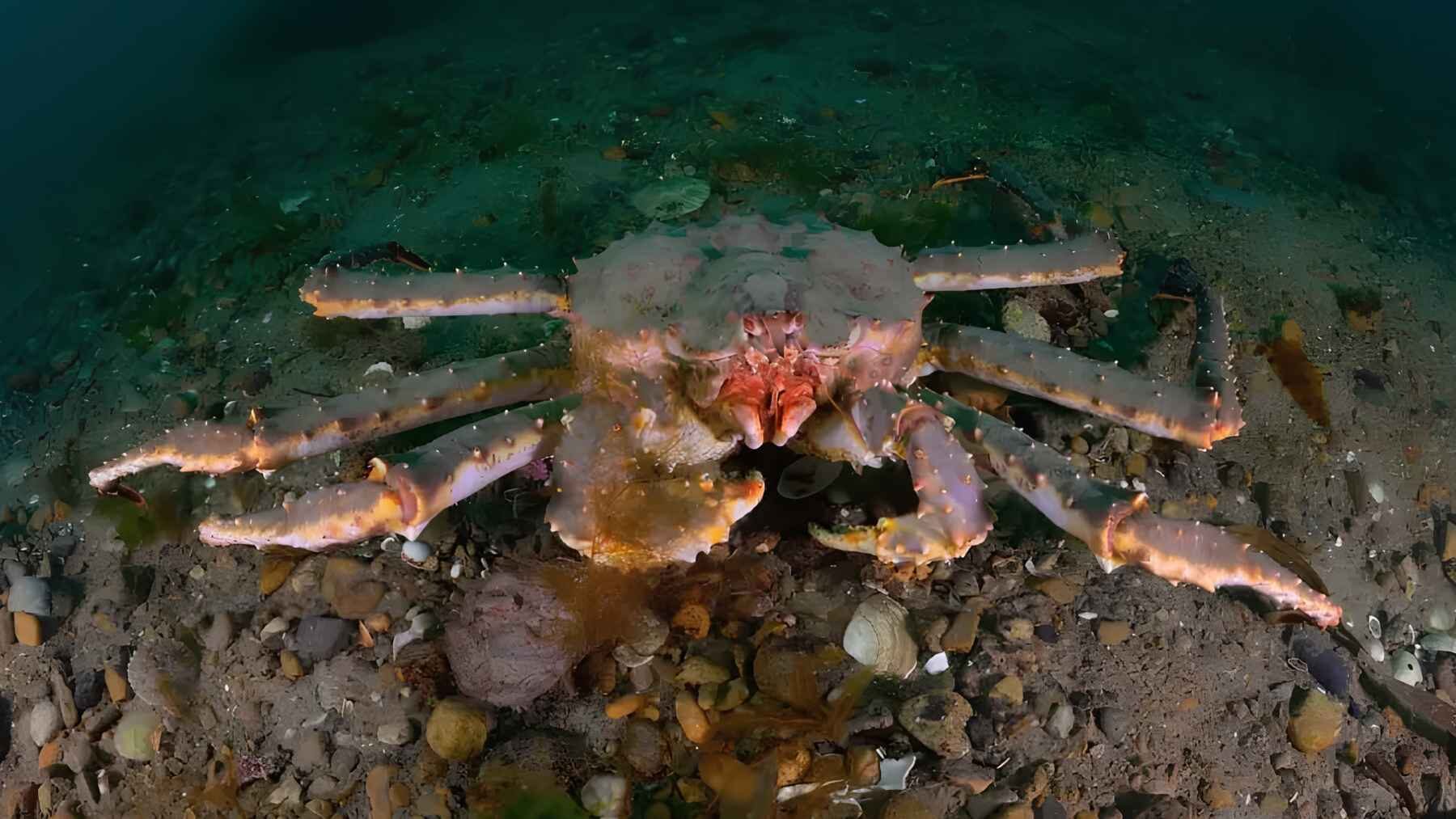
What began as a Soviet plan to create seafood wealth has become a long-running marine experiment with two very different results. Red king crabs released near Murmansk in the 1960s now support a valuable fishery across Russian and Norwegian waters, yet they are also altering native seafloor communities as they feed.
A 2011 scientific review concluded that the crabs likely succeeded because they travel far, use many habitats, eat a wide range of prey, and faced little fishing or parasite pressure while becoming established. In heavily invaded areas, researchers recorded less variety and less total weight of bottom-dwelling life. That is the trade-off behind this unusual story.
A fishery built by design
The red king crab is native to the North Pacific. Soviet scientists wanted a dependable new seafood resource in the Barents Sea, so they moved crabs thousands of miles west and released them near Murmansk.
Official records show the scale of the effort. About 1.5 million larvae were released in 1961, followed by roughly 10,000 juveniles and 2,609 adults through 1969, with another 1,200 adults added in the late 1970s. A reproductive population was evident about a decade later, and the crabs were recorded in Norway by 1976.
The review was written by Jannike Falk-Petersen and Paul Renaud of Akvaplan-niva, alongside Natalia Anisimova of the Polar Research Institute of Marine Fisheries and Oceanography. Falk-Petersen was also affiliated with the University of Tromsø. Their work combined decades of evidence to ask why the introduction worked and what it changed.
Why the crab took hold
An invasive species is a nonnative organism that becomes established and spreads into new territory. So, why did the red king crab thrive when many introductions fail? Size helped, and a NOAA species profile says it can span 5 feet and weigh up to 24 pounds, although most are smaller, while its spiked shell and long legs add protection and mobility.
The crab also uses different habitats as it grows. Larvae drift in open water, young crabs settle in shallow and complex coastal areas, and adults move between feeding and breeding grounds. Individual crabs have been recorded traveling more than 6 miles in a day.
Then there is the menu. The researchers described the species as a “large, bottom-feeding mobile omnivore,” meaning it eats animals and other available material near the seabed. Suitable nursery habitat, a broad diet, low fishing pressure during the early years, and an apparent lack of parasites all helped the population expand.
Seafloor communities are changing
Benthic life simply means organisms that live on or inside the seafloor. For red king crabs, that menu includes mussels, clams, worms, sea stars, sea urchins, and other crustaceans. These animals are often slow or fixed in place, making them easier targets for a large, mobile predator.
When dense groups of crabs feed in one place, they can remove many of the larger animals first. Studies in invaded areas have reported lower species diversity and lower biomass, which means less total living material. Some of the missing animals also build beds, tubes, or burrows that provide shelter and feeding space for other species.
A related field study in Varangerfjorden found degraded sediment and low oxygen below the surface at several invaded sites. Researchers linked the change to the loss of burrowing animals that normally mix the mud and circulate oxygen-rich water through it, a process called “bio-irrigation.” In practical terms, the mud is mixed less and the community can become dominated by smaller organisms.
Profit meets ecological cost
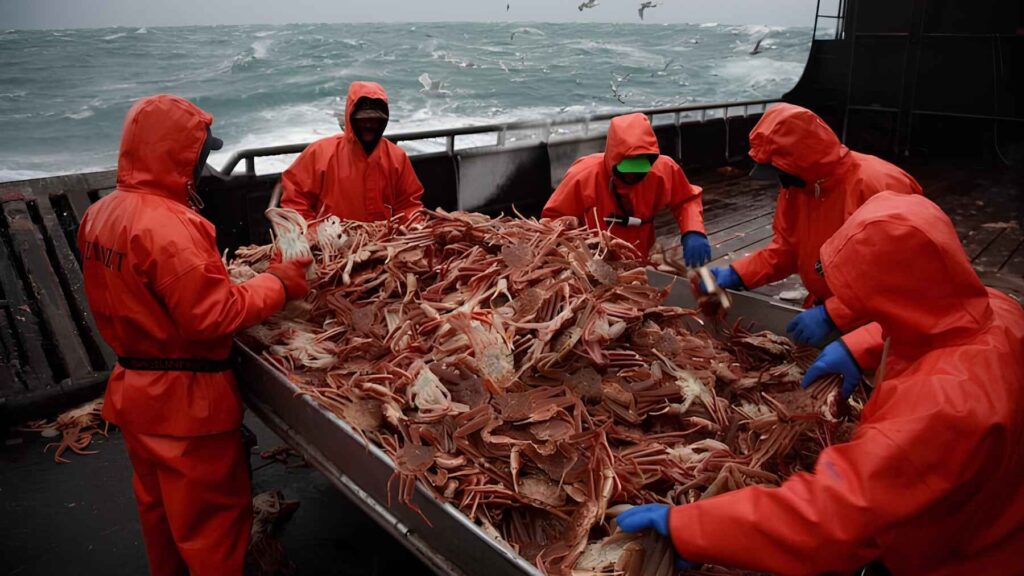
The crab has clear commercial value. Norway opened an experimental fishery in 1994, and commercial harvesting followed in the early 2000s. More than 1,000 vessels participated in the country’s quota-regulated fishery in 2024, showing how deeply the species is woven into the coastal economy.
However, the same crab can be a headache for fishers targeting other species. Red king crabs become bycatch in gill nets and longlines, creating lost fishing time and equipment costs. Anyone who has watched a torn net come aboard can understand how quickly those losses add up.
The wider effect on commercial fish populations is harder to pin down. Crabs have eaten fish eggs and may alter food webs, yet the review warned that population-level consequences remain difficult to detect and predict. That uncertainty matters because the Barents Sea supports highly productive northern fisheries.
Norway uses two different rules
Both Russia and Norway harvest the crab commercially, but Norway manages the species in two zones. East of a line near North Cape, the crab is treated as a valuable commercial stock and catches are controlled through quotas and size rules. The aim is to keep a profitable fishery operating over the long term.
West of that line, the current fishing rules change sharply. Commercial fishing is unrestricted, there is no minimum size, and live crabs cannot be returned to the water, all to slow further spread. It is less a complete eradication plan than a biological firebreak, since removing an established marine species from the open ocean is largely unrealistic.
Monitoring continues because the boundary is not a wall. Recent surveys suggest local populations may already be established farther west and south, although abundance varies greatly by place. The clock is still moving.
A warning that will last
The red king crab experiment delivered what its planners wanted in one sense. It created a sought-after seafood product and a durable source of income. However, it also created a predator that now reshapes habitats far beyond the original release site.
Not every ecological effect is simple or uniformly negative. Some impacts remain uncertain, and indirect changes may vary by location. Together, the evidence points to a broad lesson, since moving a species for immediate economic gain can leave future generations managing an animal that cannot simply be hauled back out of the sea.
The main review has been published in the ICES Journal of Marine Science.