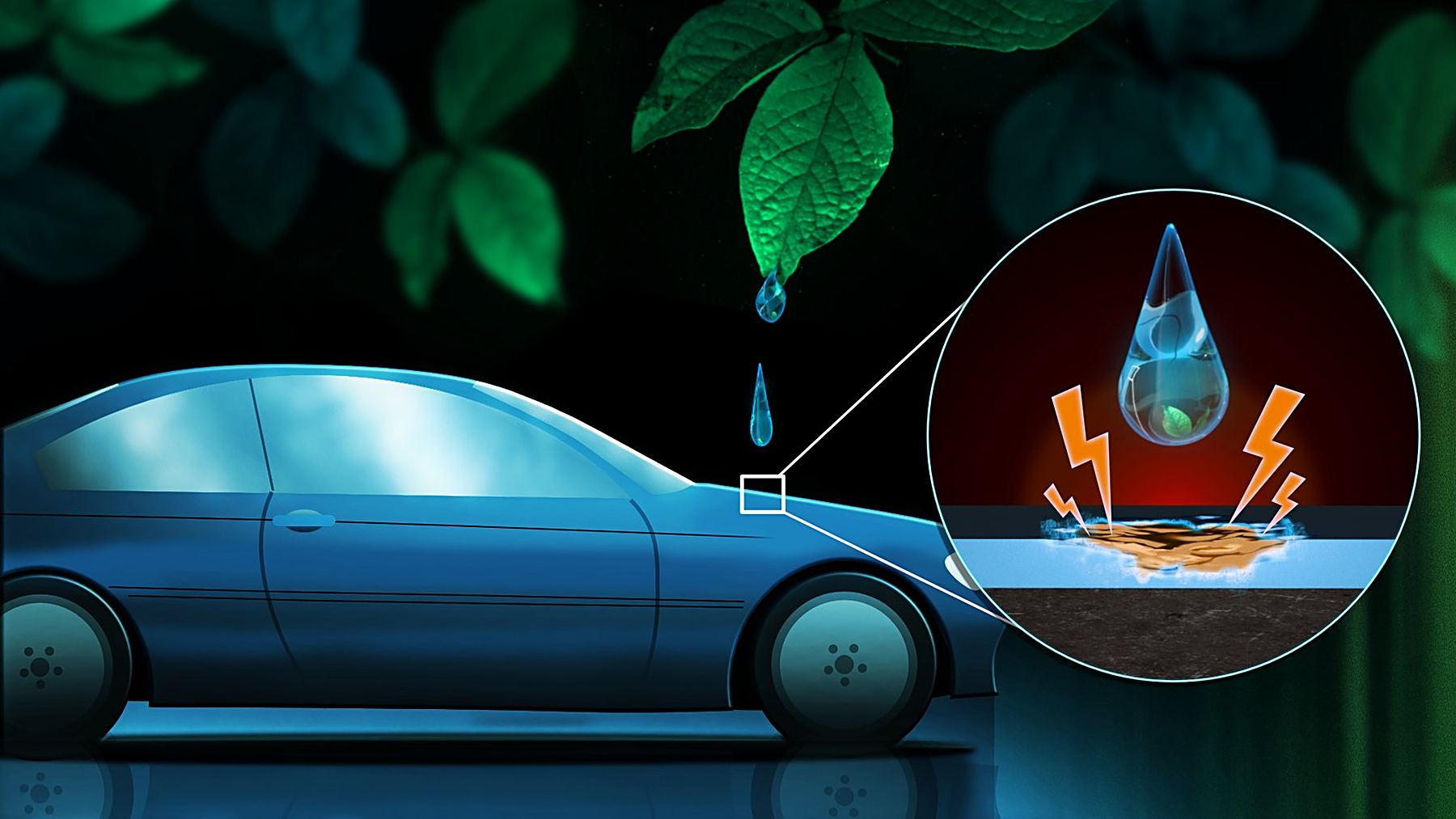
Charged water drops can puncture a protective coating and corrode the metal beneath it, a study in Nature reported on August 26, 2026. Hans-Jürgen Butt, a director at the Max Planck Institute for Polymer Research in Mainz, Germany, led the team. In the central test, 3,000 drops damaged a 60-nanometer Teflon film on copper after sliding down surfaces such as a houseplant leaf.
Uncharged drops left the same film unchanged. According to the institute’s announcement, scientists had mostly blamed friction and chemical attack when water wore down coatings. Electrical charge now joins that list, thanks to work with partners at the University of Bonn, South China University of Technology, MIT and Johannes Gutenberg University Mainz.
“This is a kind of ‘friction electricity’ in droplets and is physically much more complex than previously assumed,” said Rüdiger Berger, a group leader in the institute’s Physics at Interfaces department.
A houseplant leaf on the bench
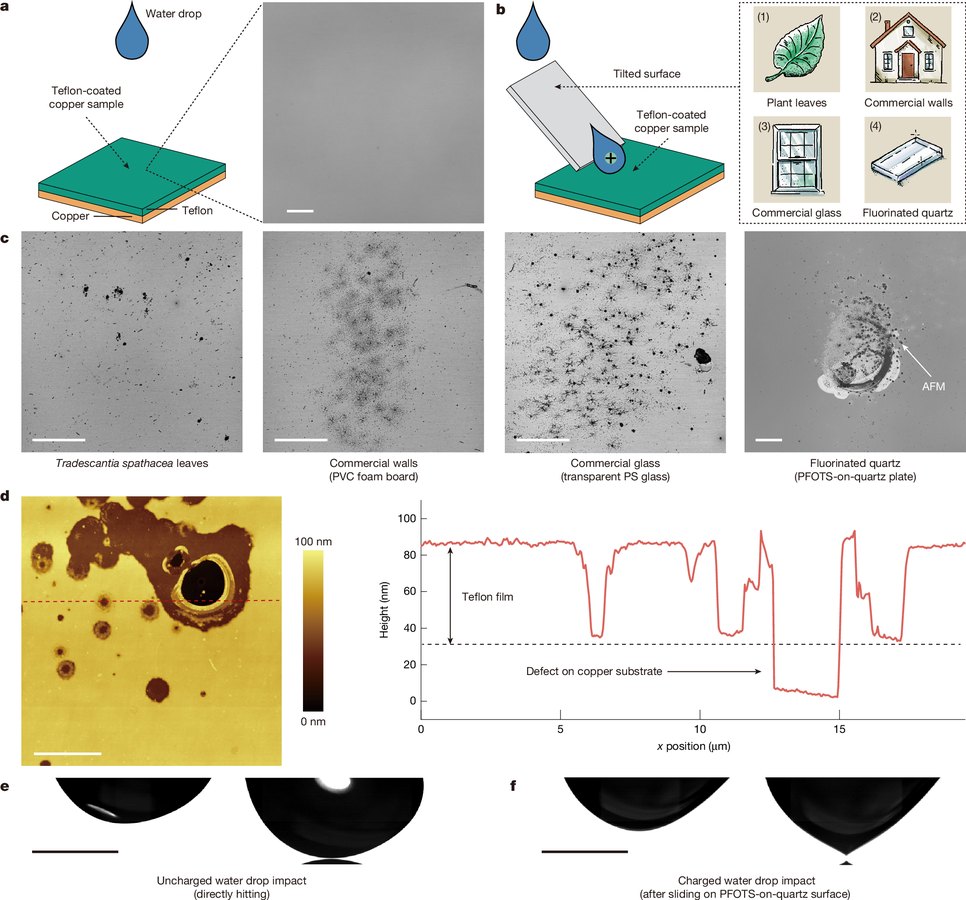
Each test drop held 35 microliters of water with a little table salt, since rain usually contains some. A pump released one every 12 seconds. The samples had 35 nanometers of copper on quartz, topped with Teflon because that material resists chemical attack.
Drops that fell 1.6 inches (4 centimeters) straight onto the sample changed nothing, even after 3,000 impacts. Next, the team let water run about 1.6 inches down a ramp tilted at 50 degrees. From the ramp’s edge it fell roughly 0.2 inch (5 millimeters) onto the sample.
Four ramps went into the experiment. One was a Tradescantia spathacea leaf from potted plants in the team’s office. Two came from a local hardware store, a PVC foam board and a polystyrene pane, and the lab made the fourth from fluorinated quartz.
Depending on the ramp, a drop picked up between 0.2 and 2 nanocoulombs, a tiny electric charge. All four ramps produced corrosion after 3,000 drops. An atomic force microscope, which maps surfaces at the nanometer scale, revealed holes through the Teflon and into the copper.
Charge varied widely from one ramp to the next. “Regardless of this, we were able to detect changes in the coating in all experiments,” said Zhongyuan Ni, the study’s first author.
Cones that form before contact
High-speed video showed how the two kinds of drops differed. Uncharged drops kept a smooth, rounded underside as they approached. Charged ones stretched into a point just before touching the sample.
The authors compare that point to the cone seen in electrospraying. In their model, the drop and the metal act as two electrodes with the coating between them. As the gap closes, the electric field grows until the insulator fails, a process called dielectric breakdown.
Current measurements supported that reading. One drop carrying 2.0 nanocoulombs sent 1.8 into the copper on impact and kept only 0.016 afterward.
“When such charged droplets strike a coating, they discharge locally and can puncture the layer in specific spots like a small flash of lightning,” Berger said. The paper puts the potential of drops charged this way above 1,000 volts, and earlier measurements it cites reached several thousand volts.
By the team’s calculation, a 2-nanocoulomb drop could break down Teflon up to about 10 micrometers thick. For polystyrene, the figure rises to about 50 micrometers.
Fifty thousand hits on copper foil
A single drop does very little. The team estimates its damage to the Teflon at less than a micrometer, and the defects then grow as more drops arrive.
Commercial copper foil with the same Teflon film lost its barrier properties after 10,000 charged drops. At equal salt levels, those impacts did far more harm than continuous immersion. After about 50,000 drops, corrosion spots exceeded 0.04 inch (1 millimeter).
Shuai Chen of the University of Bonn ran X-ray measurements that identified cuprous oxide and basic copper chloride on the foil. Similar damage appeared on polystyrene films up to 5 micrometers thick and on a silica film over gold.
A trench along hidden copper
In a separate trial, the team deposited copper on one-third of a quartz plate and covered the whole piece with Teflon. The top surface stayed flat and chemically uniform.
Drops gathered charge over the bare quartz, then discharged when their leading edge reached the buried metal. After 3,000 drops, a trench-like defect ran along the boundary. Sliding alone had done the damage, and neutral drops left no defects.
Bridges, fences and museum pieces
The institute points to the Eiffel Tower and the Golden Gate Bridge as structures that need time-consuming repainting. An earlier ECOticias report counted more than 220,000 US bridges in need of repair.
The authors write that the mechanism “may contribute to the degradation of cultural heritage sites, buildings, ships, cars and other metal components.” Clouds, thunderstorms, ocean waves, fountains and waterfalls all produce charged drops, they add.
Better materials are the team’s stated goal, alongside lab efforts such as a coating that releases rust-fighting molecules where it is damaged. Other engineers want to exploit moving water by turning raindrops into electrical impulses or building panels that convert the impact of rain into electricity.
Car paint awaits outdoor trials
These results come from controlled lab runs with salted pure water, regular timing and mostly very thin films. The paper reports no test on automotive paint. It also does not measure how much charge real raindrops carry when they land on a car or a monument.
Nobody can yet say how many years of weather would equal 3,000 or 50,000 drops. The share of outdoor wear caused by electricity, as opposed to abrasion and chemistry, remains unmeasured.
The full study, titled Spontaneously charged water drops induce corrosion, appeared in Nature.
Image: Katharina Maisenbacher / MPI for Polymer Research